Retatrutide (LY3437943) is a once-weekly triple GLP-1/GIP/glucagon receptor agonist that produced 24.2% mean weight loss in Phase II — surpassing every approved obesity drug in history. Complete 2026 guide: mechanism, Phase III TRIUMPH trial data, dosing protocols, and how it stacks up against semaglutide and tirzepatide.
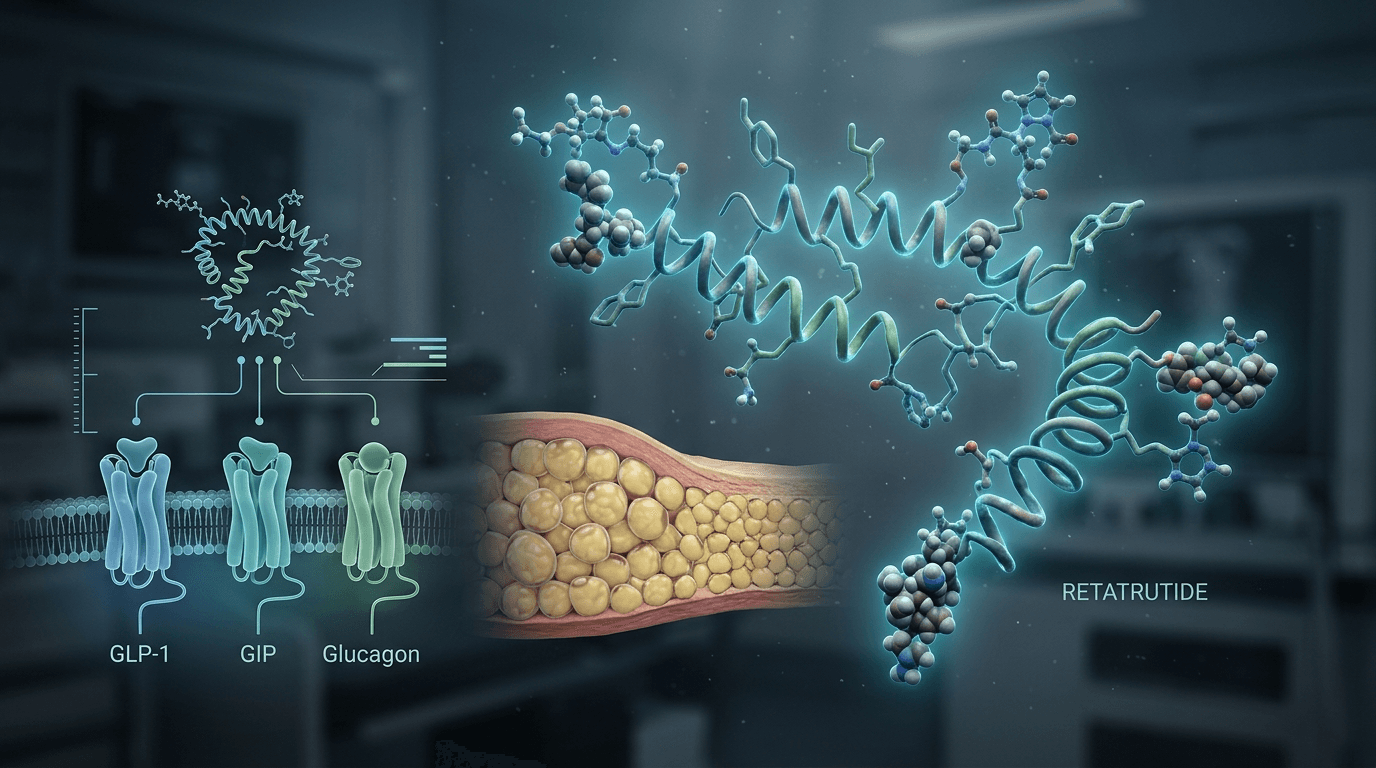
In the rapidly evolving GLP-1 landscape, retatrutide stands apart. While semaglutide (Ozempic/Wegovy) and tirzepatide (Mounjaro/Zepbound) have reshaped the obesity treatment paradigm — targeting one or two hormone receptors — retatrutide (LY3437943) targets three: GLP-1, GIP, and glucagon receptors simultaneously.
The clinical consequence of this triple mechanism? In Phase II trials published in the New England Journal of Medicine in 2023, retatrutide produced 24.2% mean weight loss at 48 weeks in the highest-dose group — a number that eclipses every approved anti-obesity medication in history and begins to rival bariatric surgery outcomes. At the 8mg dose, 100% of participants lost at least 5% body weight, 93% lost at least 15%, and 75% lost at least 20%.
This guide covers everything the 2026 research base tells us about retatrutide: how triple agonism works mechanistically, what the Phase III TRIUMPH trials are showing, how it compares head-to-head to semaglutide and tirzepatide, the safety profile, dosing protocols, and where to source verified research-grade material.
Triple Receptor Agonism: The Mechanistic Case for Retatrutide
Understanding why retatrutide is so potent requires grasping what each of the three receptor pathways contributes — and why their simultaneous activation is more than additive.
GLP-1 Receptor (The Appetite Foundation)
GLP-1 (glucagon-like peptide-1) is an incretin hormone released from intestinal L-cells postprandially. GLP-1R activation achieves: slowed gastric emptying (prolonged satiety), suppression of hypothalamic appetite centers, glucose-dependent insulin stimulation, and reduced postprandial glucagon. This is the backbone of Ozempic — highly effective but produces roughly 10-15% weight loss on average.
GIP Receptor (The Synergy Amplifier)
GIP (glucose-dependent insulinotropic polypeptide) was long considered paradoxical in obesity — GIP infusions alone don't suppress appetite. But co-activation with GLP-1R produces dramatic synergy through: additive insulin potentiation at beta cells, independent hypothalamic signaling governing energy balance, and enhanced adipocyte lipid handling. This dual mechanism is what makes tirzepatide ~6 percentage points more effective than semaglutide in head-to-head trials [4].
Glucagon Receptor (The Thermogenic Edge)
This is what makes retatrutide uniquely powerful. Conventional wisdom holds glucagon as pro-hyperglycemic — so activating glucagon receptors in an obesity drug seems counterintuitive. But in the presence of robust GLP-1/GIP co-agonism, glucagon receptor activation produces fundamentally different effects: increased thermogenesis via brown adipose tissue, enhanced hepatic fat oxidation (particularly relevant for MASH/NAFLD), and increased energy expenditure independent of caloric restriction.
The net result: appetite suppression (GLP-1/GIP), enhanced insulin sensitivity (GLP-1/GIP), plus meaningful increases in energy expenditure and liver fat clearance (glucagon). Three non-overlapping weight loss mechanisms in a once-weekly injection [1,2,3].
Phase II Outcomes: Breaking Every Obesity Drug Record
The landmark 2023 NEJM publication (NCT04881530, Jastreboff et al.) enrolled 338 adults with obesity (BMI ≥30) or overweight (BMI ≥27 + comorbidity), without type 2 diabetes. Participants received once-weekly subcutaneous retatrutide at 1 mg, 4 mg, or 8 mg for 48 weeks, or placebo.
| Group | Mean % Weight Loss | ≥5% Responders | ≥10% Responders | ≥15% Responders | ≥20% Responders |
|---|---|---|---|---|---|
| Placebo | −2.1% | 28% | 11% | 4% | 2% |
| Retatrutide 1 mg | −7.9% | 73% | 48% | 26% | 13% |
| Retatrutide 4 mg | −17.3% | 98% | 91% | 76% | 53% |
| Retatrutide 8 mg | −24.2% | 100% | 100% | 93% | 75% |
| Semaglutide 2.4 mg (STEP 1 ref.) | −14.9% | 86% | 70% | 50% | 32% |
| Tirzepatide 15 mg (SURMOUNT-1 ref.) | −21.0% | 96% | 91% | 76% | 56% |
GLP-1 Agent Mean Weight Loss Comparison
Mean % Body Weight Reduction at Primary Endpoint
Sources: STEP 1 (NEJM 2021), SURMOUNT-1 (NEJM 2022), Jastreboff et al. (NEJM 2023). Different trial populations and durations prevent direct head-to-head comparison.
Phase III TRIUMPH Trials: 2026 Status
Following the exceptional Phase II results, Eli Lilly launched the TRIUMPH Phase III program — a comprehensive package including trials for multiple indications:
- TRIUMPH-1: Obesity without T2D (primary efficacy and safety endpoint)
- TRIUMPH-2: Type 2 diabetes with obesity (glycemic + weight co-primary endpoints)
- TRIUMPH-3: MASH (metabolic dysfunction-associated steatohepatitis) — the glucagon component's primary differentiating indication
- TRIUMPH-CV: Cardiovascular outcomes in high-risk patients (the longest-running trial, results expected 2028+)
As of mid-2026, TRIUMPH-1 and TRIUMPH-2 are in late data collection with results expected H2 2026. The cardiovascular outcomes trial is ongoing. Analysts widely expect TRIUMPH-1 to confirm ≥20% mean weight loss at the highest well-tolerated dose, which would make retatrutide the most effective approved pharmacotherapy for obesity in history if approved.
Key Phase III protocol differences versus Phase II: longer duration (72-week primary endpoint), more diverse populations including older adults and those with cardiovascular comorbidities, and modified titration schedules to improve the GI tolerability seen at higher doses in Phase II.
| Adverse Event | Placebo | 1 mg | 4 mg | 8 mg |
|---|---|---|---|---|
| Nausea | 10% | 32% | 48% | 61% |
| Vomiting | 5% | 13% | 22% | 29% |
| Diarrhea | 13% | 17% | 22% | 26% |
| Constipation | 10% | 15% | 13% | 16% |
| Decreased Appetite | 8% | 28% | 48% | 57% |
| Discontinuation due to GI AEs | 1% | 5% | 6% | 16% |
Retatrutide is not approved for human use and is available only as a research chemical. The glucagon receptor component raises theoretical concerns about hyperglycemia without adequate GLP-1 co-agonism, though no clinically significant hyperglycemia occurred in non-diabetic Phase II subjects. As with all GLP-1 receptor agonists: individuals with a personal or family history of medullary thyroid carcinoma or Multiple Endocrine Neoplasia type 2 (MEN2) should avoid use, based on thyroid C-cell effects observed in rodent models. Acute pancreatitis risk monitoring is standard for all GLP-1-class agents.
| Drug | Targets | Dosing | Max Phase WL | Status 2026 |
|---|---|---|---|---|
| Semaglutide | GLP-1R | Weekly SQ or Daily oral | ~14.9% | FDA Approved (Wegovy/Ozempic) |
| Tirzepatide | GLP-1R + GIPR | Weekly SQ | ~21.0% | FDA Approved (Zepbound/Mounjaro) |
| Retatrutide | GLP-1R + GIPR + GcgR | Weekly SQ | ~24.2% | Phase III (TRIUMPH) |
| Pemvidutide | GLP-1R + GcgR | Weekly SQ | ~15.6% | Phase II |
| Survodutide | GLP-1R + GcgR | Weekly SQ | ~18.7% | Phase II/III |
Research Dosing Protocols
The Phase II dose escalation schedule was designed to minimize GI adverse events, which are the primary dose-limiting toxicity. Research protocols mirror this approach:
- Weeks 1-4: 2 mg once weekly (sub-therapeutic but tolerability building)
- Weeks 5-8: 4 mg once weekly (clinically meaningful weight loss begins)
- Weeks 9-12: 8 mg once weekly if previous dose well-tolerated
- Maintenance: 8-12 mg once weekly (Phase II used up to 12 mg in dose-escalation subgroups)
Administration is subcutaneous injection (abdomen, thigh, or upper arm), using a 29-31 gauge insulin syringe or auto-injector pen. The long half-life (~6-7 days) supports strict once-weekly dosing — consistent day-of-week injection is recommended for steady-state plasma levels.
Most dramatic body weight reductions in Phase II occurred between weeks 12-48 as higher doses were achieved and the cumulative effect of all three receptor pathways became evident. Early termination significantly blunts results.
Where to Source Research-Grade Retatrutide
PeptideTech
Editor's PickRetatrutide 10mg
$89.99
Third-party HPLC tested, lyophilized powder, ships with COA and mass spec
Modified Aminos
Retatrutide LY3437943
$79.99
Rigorous QC protocols, batch COA published online, discrete packaging
AminoUSA
Retatrutide Research Peptide
$84.99
US-sourced raw materials, fast domestic shipping, batch testing published
VANDL Labs
PremiumRetatrutide 10mg Vial
$92.00
Premium lyophilized formulation, extended cold-chain stability, independent lab verification
Retatrutide FAQ
How does retatrutide differ from tirzepatide (Mounjaro/Zepbound)?
Tirzepatide is a dual GLP-1/GIP agonist. Retatrutide adds glucagon receptor (GcgR) agonism as a third mechanism, which increases thermogenesis via brown adipose tissue and enhances hepatic fat oxidation. This third pathway accounts for the additional ~3-4 percentage points of mean weight loss observed in Phase II versus tirzepatide historical data, though direct head-to-head trials are still pending Phase III completion.
Is retatrutide FDA approved?
No. As of mid-2026, retatrutide is in Phase III clinical trials (TRIUMPH program). FDA approval is anticipated in 2027 if trial data confirms Phase II efficacy and an acceptable safety profile. It is currently available only as a research chemical, not as a pharmaceutical product.
What is the maximum retatrutide dose studied in humans?
Phase II trials used doses up to 12 mg once weekly in dose-escalation cohorts, with 8 mg as the primary high dose in the main efficacy analysis. The 8 mg dose produced 24.2% mean weight loss at 48 weeks. Higher doses produced similar efficacy with increased GI adverse events, suggesting 8-12 mg is the optimal range.
Does retatrutide raise blood sugar via glucagon activation?
No clinically significant hyperglycemia was observed in non-diabetic Phase II subjects. The strong GLP-1 and GIP components suppress glucagon's blood-glucose-raising effects while preserving its thermogenic and fat-oxidizing properties. In T2D subjects, retatrutide improved glycemic control across all dose groups, similar to existing GLP-1 agents.
How does retatrutide affect the liver (NAFLD/MASH)?
The glucagon receptor component specifically enhances hepatic fat metabolism, making retatrutide potentially superior to GLP-1 monotherapy for fatty liver disease. TRIUMPH-3 is specifically studying MASH as a primary endpoint. Phase II liver biopsy sub-studies showed significant reductions in liver fat fraction, with greater effect than observed with semaglutide in comparative analyses.
What happens to weight when retatrutide is stopped?
Like all GLP-1 agonists, retatrutide does not appear to create permanent changes to weight set-points. Phase II extension data and GLP-1 class data generally show substantial weight regain (50-60% of lost weight) within 1-2 years of discontinuation. Long-term maintenance dosing appears necessary to sustain weight loss — a pattern consistent across all agents in this class.
The Bottom Line on Retatrutide
Retatrutide represents a genuine pharmacological advance over the current generation of GLP-1 agents. The 24.2% Phase II weight loss number reflects sound mechanistic logic: targeting three non-overlapping hormone receptor pathways that produce complementary effects on appetite, insulin sensitivity, and energy expenditure produces more total weight loss than any two-pathway approach.
The outstanding questions are the standard Phase III unknowns: does this efficacy hold in larger, more diverse populations? Does the glucagon component produce long-term concerns in cardiovascular or metabolic disease populations? How does the weight regain trajectory compare post-discontinuation versus semaglutide and tirzepatide?
If TRIUMPH-1 confirms Phase II efficacy in 2026-2027, retatrutide will likely become the new standard of care for obesity pharmacotherapy — further raising the bar for the next generation of quad-agonists already in early-phase development.
For the complete retatrutide pharmacology profile, trial registry, and peptide database entry, see the PeptideWiki Retatrutide Page. For context on the GLP-1 competitive landscape, see our Semaglutide vs Tirzepatide SURMOUNT-5 guide.
Sources & References
- 1.Jastreboff AM, Kaplan LM, Frías JP, et al.. "Triple-Hormone-Receptor Agonist Retatrutide for Obesity — A Phase 2 Trial" — New England Journal of Medicine, 2023. DOI: 10.1056/NEJMoa2301972.View source
- 2.Coskun T, Urva S, Roell WC, et al.. "LY3437943, a novel triple GIP, GLP-1 and glucagon receptor agonist for glycemic control and weight loss" — Cell Metabolism, 2022. DOI: 10.1016/j.cmet.2022.05.014.View source
- 3.Drucker DJ. "GLP-1 physiology informs the pharmacotherapy of obesity" — Nature Reviews Endocrinology, 2022. DOI: 10.1038/s41574-021-00566-2.View source
- 4.Frías JP, Davies MJ, Rosenstock J, et al.. "Tirzepatide versus Semaglutide Once Weekly in Patients with Type 2 Diabetes" — New England Journal of Medicine, 2021. DOI: 10.1056/NEJMoa2107519.View source
- 5.Wilding JPH, Batterham RL, Calanna S, et al.. "Once-Weekly Semaglutide in Adults with Overweight or Obesity" — New England Journal of Medicine, 2021. DOI: 10.1056/NEJMoa2032183.View source
- 6.Jastreboff AM, Aronne LJ, Ahmad NN, et al.. "Tirzepatide Once Weekly for the Treatment of Obesity (SURMOUNT-1)" — New England Journal of Medicine, 2022. DOI: 10.1056/NEJMoa2206038.View source
- 7.Lincoff AM, Brown-Frandsen K, Colhoun HM, et al.. "Semaglutide and Cardiovascular Outcomes in Obesity without Diabetes (SELECT)" — New England Journal of Medicine, 2023. DOI: 10.1056/NEJMoa2307563.View source
- 8.Nahra R, Wang T, Gadde KM, et al.. "Effects of Cotadutide on Metabolic and Hepatic Parameters in Adults With Overweight or Obesity and Type 2 Diabetes" — Diabetes Care, 2021. DOI: 10.2337/dc20-2103.View source