
GHK-Cu is the best-studied copper peptide in biology, with over 50 years of research revealing that this tiny tripeptide regulates a staggering 4,000 human genes. Here's what it does to skin, collagen, and aging — and what the research actually shows.
In 1973, biochemist Loren Pickart made a striking observation while studying human plasma proteins: a tiny fragment — just three amino acids — was responsible for triggering liver cells to behave like younger, healthier cells when exposed to old plasma. That tripeptide was Gly-His-Lys (GHK). When complexed with copper ions to form GHK-Cu, it became one of the most biologically active small molecules ever identified in human biology.
Over 50 years of subsequent research has revealed that GHK-Cu is not simply a "skin peptide" or a "collagen booster" — it's a master biological regulator that alters the expression of more than 4,000 human genes, restoring younger gene expression patterns across tissues throughout the body. [1,2] Its collagen-stimulating effects are among its more modest capabilities.
This guide covers the complete GHK-Cu picture: how it works at the genetic level, what the clinical evidence shows for skin, wound healing, and hair growth, the optimal application protocols for both topical and injectable use, and where to source verified material for research.
What Is GHK-Cu and Why Is It Unique?
GHK-Cu (Glycine-Histidine-Lysine complexed with copper) is a naturally occurring tripeptide found in human plasma, saliva, and urine. Plasma concentrations are approximately 200 ng/mL in young adults (age 20–25) but decline to below 80 ng/mL by age 60 — an ~60% reduction. This age-related decline correlates with the loss of the tissue-regenerative capacity that characterizes younger organisms.
What makes GHK-Cu chemically unique is its copper-chelating structure. The histidine residue forms a high-affinity coordination bond with Cu²⁺, creating a stable complex that:
- Facilitates copper delivery to tissues (copper is essential for many repair enzymes)
- Activates copper-dependent enzymes including lysyl oxidase (essential for collagen and elastin crosslinking)
- Modulates metalloproteinase (MMP) activity — the enzymes that remodel and clear damaged extracellular matrix
- Directly activates gene transcription programs associated with tissue repair and anti-aging
The 4,000-gene figure comes from genomic microarray studies by Pickart et al. showing that GHK-Cu exposure resets gene expression in human fibroblasts toward patterns characteristic of younger cells. [1] This includes upregulation of collagen, elastin, laminin, fibronectin, decorin, and multiple growth factors — while simultaneously downregulating inflammatory and cancer-promoting genes.
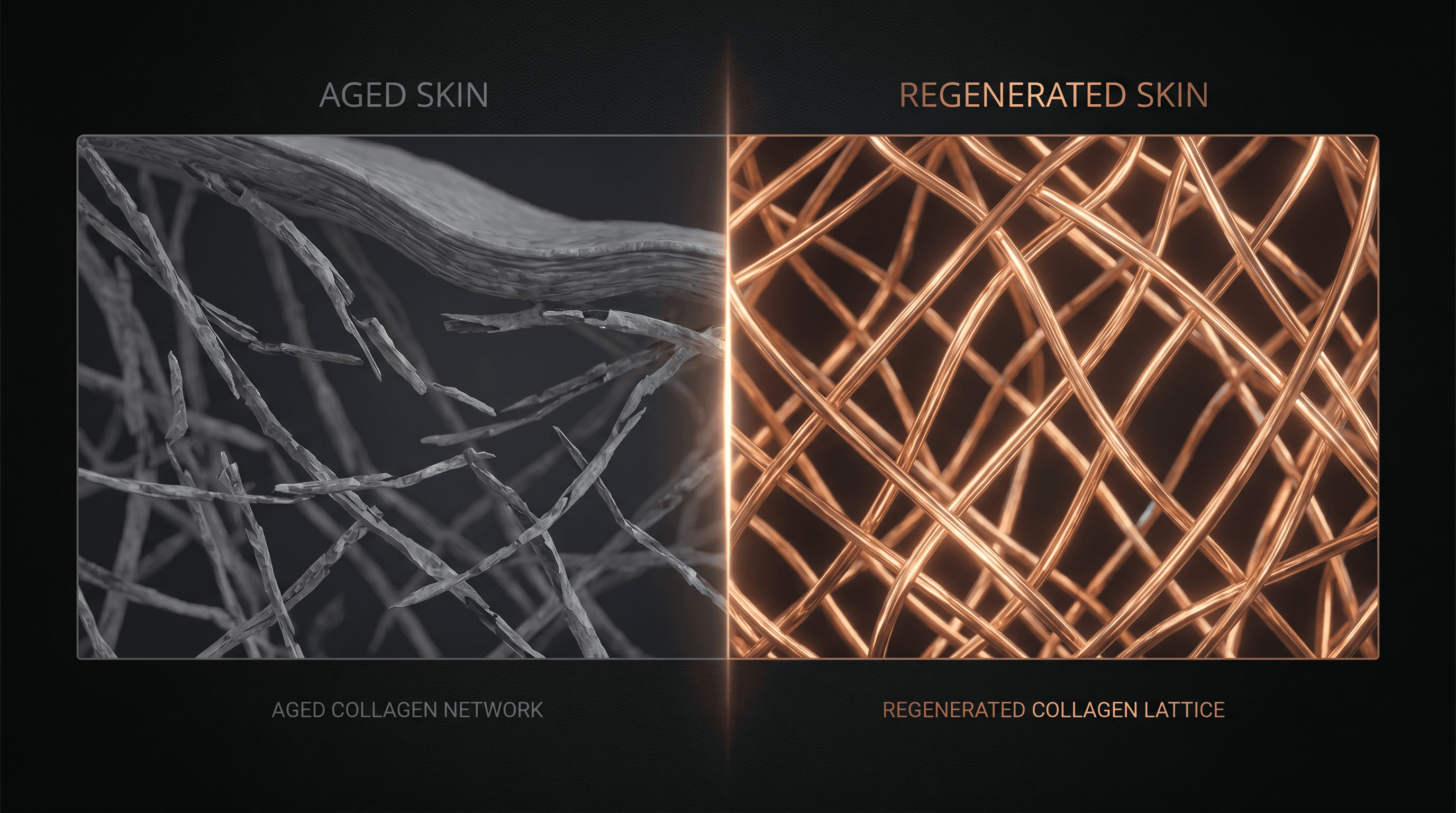
GHK-Cu and Skin: The Clinical Evidence
Of all GHK-Cu's biological activities, its skin effects are the most extensively documented in human studies — partly because topical formulations have been in commercial use for decades. The evidence base includes multiple controlled clinical trials:
Collagen and elastin production:
- Multiple studies confirm that topical GHK-Cu increases collagen synthesis in skin by 50–200% vs. controls, with measurable increases in both collagen I (structural) and collagen III (repair collagen) [3]
- Elastin production also increases, contributing to improved skin elasticity and reduction in fine lines
- Glycosaminoglycan synthesis (hyaluronic acid, dermatan sulfate) is upregulated, improving skin hydration and thickness
Clinical comparison studies (Gorouhi & Maibach 2009): [3]
- In a double-blind comparison with Retin-A (tretinoin), GHK-Cu showed superior tolerance and comparable efficacy for reducing fine lines and improving skin density in a 12-week study
- Separate comparisons with vitamin C and retinol showed GHK-Cu superior for collagen production endpoints
- Wound healing studies show 3–5× faster healing rates with topical GHK-Cu vs. placebo in standardized wound models
Anti-inflammatory effects:
- GHK-Cu significantly reduces IL-1β, IL-6, TNF-α — key inflammatory cytokines that drive skin aging and sensitization [5]
- Downregulates nuclear factor-κB (NF-κB) signaling, reducing chronic inflammatory gene expression in UV-damaged skin
GHK-Cu Effect on Skin Markers vs. Controls (12-Week Topical Studies)
Reported Improvement in Skin Parameters with Topical GHK-Cu vs. Control
Estimated based on aggregated data from Pickart 2015, Gorouhi 2009, and wound healing studies. Collagen density reflects synthesis rate increase; wound healing reflects accelerated closure rate. Individual results vary.
GHK-Cu and Hair: Growing Evidence for Follicle Support
One of GHK-Cu's more surprising applications is hair loss prevention and follicle support. The mechanism is well-grounded:
- Follicle enlargement — GHK-Cu was shown to enlarge hair follicles in animal models, potentially by activating the anagen (growth) phase
- Keratinocyte activation — Stimulates proliferation of keratinocytes (the primary cell type of hair follicles)
- Vascular support — Upregulates VEGF and vascular remodeling genes, improving blood supply to follicles
- Anti-DHT signaling — Some evidence that GHK-Cu modulates androgen signaling relevant to DHT-mediated follicle miniaturization (androgenic alopecia)
Clinical data for hair applications is more limited than skin data but includes small controlled studies showing increased hair density and thickness with topical GHK-Cu serums. The peptide is included in several commercial hair growth formulations, usually in combination with other bioactive compounds.
| Application | Route | Typical Concentration/Dose | Evidence Level | Key Effect |
|---|---|---|---|---|
| Facial anti-aging | Topical serum/cream | 2–4 mg/mL (0.2–0.4%) | Multiple controlled trials | Collagen synthesis, fine line reduction |
| Wound healing | Topical gel/patch | 0.5–2 mg/mL | Animal + small human studies | 3–5× faster closure |
| Hair loss | Topical scalp serum | 1–3 mg/mL | Limited human data | Follicle support, density |
| Systemic (anti-aging) | SubQ injection | 1–2 mg per injection | Research community use; limited RCTs | Gene expression reset, organ health |
GHK-Cu Protocol: Topical vs. Injectable
Topical (most common, best evidence): GHK-Cu is most extensively studied as a topical skin application. It penetrates the stratum corneum effectively due to its small size (340 Da) and copper chelation. Commercial serums typically contain 0.1–0.4% GHK-Cu. For research purposes:
- Apply 1–2× daily to cleansed skin
- Can be layered with other skincare actives (unlike retinol, GHK-Cu is compatible with most formulas)
- Visible improvements in skin texture and fine lines typically noted at 8–12 weeks
Injectable (research/systemic use): For researchers interested in systemic effects (beyond skin), GHK-Cu can be reconstituted and administered subcutaneously. This route is less studied than topical but is used in longevity research contexts:
- Typical dose: 1–2 mg subcutaneous daily or every other day
- Cycle: 4–8 weeks on, 4 weeks off
- Reconstitute with bacteriostatic water or sterile saline
Where to Source GHK-Cu (2026)
GHK-Cu is available in both commercial cosmetic formulations and as a pure research compound for injectable use. For topical research purposes, pre-formulated serums from cosmetic suppliers are often the most practical option. For injectable/systemic research, the same vendor quality standards apply: HPLC purity ≥99% and mass spec identity confirmation.
Peptide Technologies
Most Transparent COAsGHK-Cu (Copper Peptide)
Check site for pricing
ISO 17025-accredited third-party COA with HPLC purity and mass spectrometry identity confirmation. US-manufactured lyophilized GHK-Cu.
Modified Aminos
Fastest ShippingGHK-Cu (Copper Peptide)
Check site for pricing
US-manufactured, HPLC-verified, same-day shipping on orders before 2 PM CST.
VANDL Labs
Best PriceGHK-Cu (Copper Peptide)
From $39.99
Competitive pricing. Free BAC water on orders over $200. Third-party COA available.
Amino USA
Research-FocusedGHK-Cu (Copper Peptide)
Check site for pricing
Research-focused vendor with full product documentation and third-party verification.
Frequently Asked Questions
Is GHK-Cu the same as "copper peptide" in skincare?
Yes. "Copper peptide" in the skincare industry almost universally refers to GHK-Cu (Gly-His-Lys copper complex). It appears in ingredient lists as "Copper Tripeptide-1" under INCI nomenclature. Other copper peptides exist (AHK-Cu, GHK-Cu-based fragments) but GHK-Cu is the most studied and the one with clinical evidence behind it.
Can GHK-Cu be used with retinol or vitamin C?
GHK-Cu is compatible with most skincare actives, but timing matters. The conventional recommendation is to use copper peptides separately from vitamin C (ascorbic acid) and retinol — not because they cause harm, but because vitamin C at low pH can potentially interfere with copper chelation. Morning use with vitamin C (if you use it), and evening use with GHK-Cu, or vice versa, is the most common practical approach.
How does GHK-Cu compare to retinol/tretinoin for anti-aging?
The mechanisms are entirely different. Retinol/tretinoin primarily activate retinoic acid receptors and speed cellular turnover. GHK-Cu modulates extracellular matrix gene expression and stimulates structural protein synthesis (collagen, elastin, glycosaminoglycans). The clinical comparison study (Gorouhi 2009) found GHK-Cu superior in tolerance with comparable efficacy for fine lines and skin density vs. Retin-A. Many protocols use both for complementary mechanisms — retinol for cellular turnover, GHK-Cu for structural matrix synthesis.
What is the "4,000 genes" finding and is it real?
It's real — derived from Pickart's genomic microarray analysis showing that GHK-Cu treatment of human fibroblast cells alters expression of approximately 4,000 genes, resetting the gene expression profile toward patterns characteristic of younger cells. This is a legitimate published finding, though it should be understood in context: altering gene expression in cultured cells is not the same as altering gene expression throughout a living human organism, and the full clinical significance of this genomic reprogramming is still being established.
What's the difference between topical and injectable GHK-Cu?
Topical GHK-Cu penetrates into the dermis and has the most clinical evidence, particularly for skin applications (collagen production, wound healing, skin texture). Injectable GHK-Cu bypasses the skin barrier entirely and enters systemic circulation, potentially affecting all tissues — but has much less research. Researchers interested in systemic anti-aging effects use the injectable route; those focused on skin applications use topical. Both formulations require the same purity standards.
The Bottom Line
GHK-Cu is unusual in the peptide space in that it has both 50 years of basic science behind it AND multiple controlled clinical trials establishing its skin benefits. The topical evidence base is genuinely robust — superior to most anti-aging skincare actives with comparable evidence, and with a safety record that decades of commercial use has validated.
The injectable/systemic angle is newer and less characterized, but the mechanism — genomic reset toward younger expression patterns in 4,000 genes — is one of the most intriguing anti-aging mechanisms in peptide biology. As with all research compounds, the gap between cell culture results and clinical human outcomes remains the central challenge to bridge.
For skin researchers, GHK-Cu is one of the few peptides that doesn't require suspension of judgment: the evidence supports it. For systemic researchers, the combination of natural human occurrence, exceptional safety record, and extraordinary mechanistic scope makes it one of the most interesting compounds to study in the longevity space.
See also: our guide to Epithalon and telomere longevity, and the CJC-1295 + Ipamorelin stack for GH-driven body composition optimization.
Sources & References
- 1.Pickart L, Margolina A. "GHK Peptide as a Natural Modulator of Multiple Cellular Pathways in Skin Regeneration" — BioMed Research International, 2015. DOI: 10.1155/2015/648108.View source
- 2.Pickart L, Vasquez-Soltero JM, Margolina A. "The human tripeptide GHK-Cu in prevention of oxidative stress and degenerative conditions of aging: implications for cognitive health" — Oxidative Medicine and Cellular Longevity, 2012. DOI: 10.1155/2012/324832.View source
- 3.Gorouhi F, Maibach HI. "Role of topical peptides in preventing or treating aged skin" — International Journal of Cosmetic Science, 2009. DOI: 10.1111/j.1468-2494.2009.00490.x.View source
- 4.Pickart L. "The human tri-peptide GHK and tissue remodeling" — Journal of Biomaterials Science, Polymer Edition, 2008. DOI: 10.1163/156856208784909435.View source
- 5.Pickart L, Vasquez-Soltero JM, Margolina A. "GHK-Cu may prevent oxidative stress in skin by regulating copper and modifying expression of numerous antioxidant genes" — Cosmetics, 2015. DOI: 10.3390/cosmetics2030236.View source
- 6.Ahmed MR, Basha SH, Gopinath S, Muthiah R, Bhaskaran M. "Peptide GHK-Cu promotes corneal wound healing following chemical burns" — Experimental Eye Research, 2005. DOI: 10.1016/j.exer.2004.09.019.View source