
What started as a diabetes drug became a weight-loss revolution. Now a landmark 2026 Lancet trial reveals semaglutide can slash heavy drinking days by 41% — and the same mesolimbic dopamine mechanism may explain its effects on nicotine, cocaine, and compulsive behaviors. We break down the neuroscience, the clinical evidence, and what it means for research peptides.
Nobody set out to discover a cure for alcoholism. In 2021, when clinicians began prescribing semaglutide for obesity and type 2 diabetes, a surprising pattern started emerging in the real-world data: patients weren't just losing weight. They were drinking less. Reporting fewer cravings. Losing interest in cigarettes. Finding casino trips suddenly boring.
At first, researchers filed it under "interesting side effects." Then came the randomized controlled trials. Then the systematic reviews. Then, in April 2026, The Lancet published the most rigorous placebo-controlled trial yet: 26 weeks of once-weekly semaglutide 2.4mg — on top of standard cognitive behavioral therapy — reduced heavy drinking days by 41.1%, compared to 26.4% with CBT alone. [1,6]
That 13.7 percentage-point treatment difference may sound modest in isolation. For clinicians treating alcohol use disorder (AUD) — a condition where naltrexone and acamprosate represent the state of the art, and where five-year relapse rates exceed 80% — it represents a genuinely new mechanism in a therapeutic landscape that hasn't seen a meaningful pharmacological advance in over two decades.
This isn't about weight loss side effects anymore. GLP-1 receptor agonists appear to be doing something fundamental to the brain's reward circuitry — the same mesolimbic dopamine system that underlies addiction to alcohol, nicotine, cocaine, opioids, and possibly even behavioral compulsions like gambling. This guide breaks down the neuroscience, the 2026 clinical evidence, and what it all means for research peptides.
What GLP-1 Actually Does in the Brain
Most people know GLP-1 receptor agonists through a metabolic lens — they slow gastric emptying, stimulate glucose-dependent insulin secretion, suppress glucagon, and activate hypothalamic satiety circuits. But the GLP-1 receptor (GLP-1R) is not limited to the pancreas and hypothalamus. It is distributed throughout the central nervous system, including regions with nothing to do with blood sugar and everything to do with reward, motivation, and addiction. [4,7]
The neuroanatomy that matters:
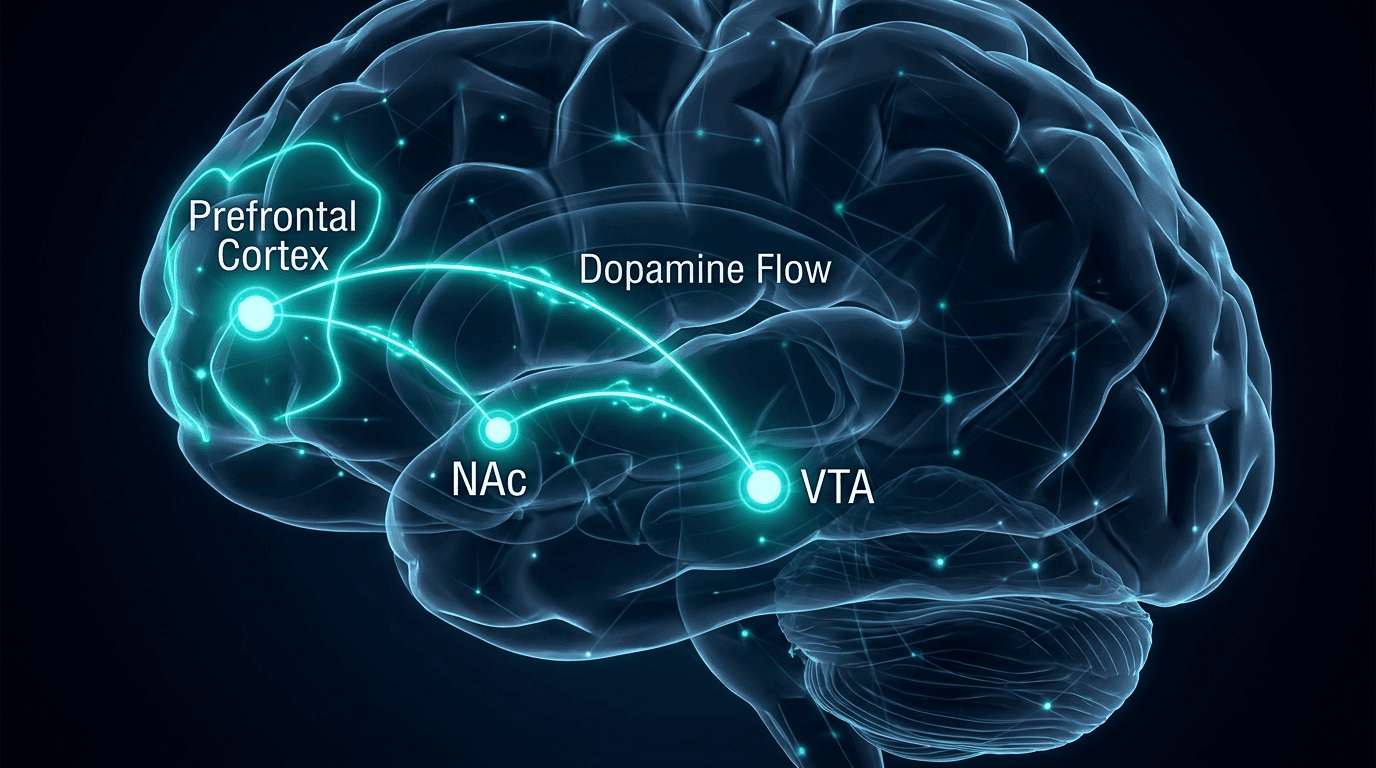
- Ventral Tegmental Area (VTA): The brain's primary dopamine-producing region. GLP-1R activation here directly modulates the firing rate of dopamine neurons projecting into the reward system.
- Nucleus Accumbens (NAc): The core reward processing hub — sometimes called the "pleasure center." It receives dopamine from the VTA and encodes the motivational salience of rewards, including drugs and alcohol. GLP-1R activation here blunts dopamine release in response to reward cues.
- Prefrontal Cortex (PFC): Governs executive function, impulse control, and decision-making — all chronically impaired in addiction. GLP-1R activity in the PFC may enhance top-down inhibitory control over compulsive reward-seeking.
- Amygdala: Encodes the emotional memory of drug-associated environmental cues — a primary driver of cue-triggered cravings and relapse.
- Medial Habenula: A region specifically implicated in the aversive effects of high-dose nicotine. GLP-1R activation here increases nicotine's aversive valence. [4,5,12]
This neuroanatomical distribution explains what was otherwise puzzling: why a metabolic peptide was producing behavioral changes in addiction-relevant domains. GLP-1 appears to function as a natural hedonic brake — a signal that says "enough" not just for food, but for any reward-associated behavior. When pharmaceutical GLP-1R agonists amplify that signal, they're not creating something artificial. They're amplifying an endogenous dampening mechanism that addiction chronically depletes. [3,9]
The dopamine mechanism is well-characterized: GLP-1R activation upregulates the dopamine transporter (DAT), accelerating dopamine reuptake from the synapse. The result is a shorter, lower-amplitude dopamine signal in response to drug use — the same molecules still fire, but the peak is blunted and the "wanting" signal that drives compulsive use grows quieter with each cycle. [4,7]
The Landmark Lancet 2026 Trial: Semaglutide Versus Alcohol Use Disorder
The April 2026 Lancet publication marks a turning point for GLP-1 in addiction medicine. Here are the trial specifics: [1]
- Design: Randomized, double-blind, placebo-controlled — 26 weeks
- Population: Adults with moderate-to-severe alcohol use disorder and comorbid obesity — a population with exceptionally high dual-burden treatment need
- Intervention: Semaglutide 2.4mg subcutaneous once-weekly + CBT versus placebo + CBT
- Primary endpoint: Percentage of heavy drinking days over 26 weeks (defined as more than 4 drinks/day for women, more than 5 for men)
The results were unambiguous: heavy drinking days fell by 41.1 percentage points in the semaglutide group, versus 26.4 percentage points in the placebo group. The treatment difference of −13.7 percentage points was statistically significant (p < 0.001). Secondary outcomes reinforced the primary finding — self-reported cravings were significantly lower throughout the semaglutide arm, and the effect appeared independent of the degree of weight loss achieved, supporting a direct neurobiological mechanism rather than a metabolic one. [1,6]
This wasn't a standalone result. An earlier JAMA Psychiatry trial (2025, n=51) had already shown that 9 weeks of weekly semaglutide significantly reduced both laboratory-measured alcohol consumption and weekly self-reported cravings versus placebo. [2] The Lancet trial extended and confirmed those signals at much larger scale and longer duration. The NIH's accompanying analysis demonstrated that adding weekly semaglutide to CBT produced significantly greater reductions than CBT alone — a clinically important finding confirming that the drug adds signal on top of, not instead of, existing best-practice care. [6]
Safety profile was consistent with established semaglutide data: predominantly gastrointestinal side effects (nausea, vomiting) at dose initiation, diminishing over time. No new safety signals emerged specific to the AUD population. [1]
Heavy Drinking Days Reduction: Semaglutide vs. Placebo — Lancet 2026 RCT
Source: The Lancet, April 2026 [DOI: 10.1016/S0140-6736(26)00305-3]. 26-week double-blind RCT in adults with moderate-to-severe AUD and comorbid obesity. Treatment difference: −13.7 percentage points, p < 0.001.
Beyond Alcohol: Nicotine, Cocaine, Cannabis & Compulsive Behaviors
Alcohol is the most rigorously studied addiction target for GLP-1 agonists — but the preclinical literature and large-scale observational data suggest the reward-circuit mechanism generalizes broadly across substances and behaviors. Here is the current state of evidence: [3,4,5,8]
Nicotine and Smoking
Of all addiction targets outside alcohol, nicotine has the strongest mechanistic story. GLP-1R activation in the medial habenula increases nicotine's aversive valence in animal models — making smoking less rewarding and, at higher exposure, actively unpleasant. This is consistent with a well-documented clinical observation: many patients on GLP-1R agonists for obesity spontaneously reduce or stop smoking without any explicit cessation intervention. Clinical trials specifically targeting nicotine dependence are actively recruiting as of mid-2026. [5]
Cocaine and Stimulants
The dopamine transporter story is particularly compelling here. Cocaine works primarily by blocking DAT, flooding the synapse with dopamine. GLP-1R-mediated DAT upregulation counteracts exactly this mechanism — higher DAT expression means faster dopamine clearance even when cocaine blocks some transporters. In preclinical models, GLP-1R agonists reduced both cocaine-induced dopamine release and cocaine self-administration. A 2026 nested case-control study using the NIH's All of Us research database found that GLP-1 medication use was associated with a 20–26% lower risk of cocaine and stimulant use disorder compared to propensity-matched controls. [8]
Cannabis
The same All of Us analysis found a 14% lower risk of cannabis use disorder in GLP-1 users — a smaller effect than alcohol or stimulants, but directionally consistent and statistically significant. Cannabis primarily engages the endocannabinoid system, but its rewarding effects involve dopaminergic circuits that GLP-1R activation modulates. [8]
Opioids
The evidence here remains most uncertain. Opioids engage mu-opioid receptors (MOR) in the VTA and NAc through pathways that are partially distinct from the dopaminergic circuits most directly targeted by GLP-1R agonists. Preclinical results are mixed — some models show GLP-1R agonists reducing opioid self-administration; others show limited effect. Formal clinical data does not yet exist and this remains an important open research question. [5]
Behavioral Addictions
A systematic analysis of GLP-1 user reports from social media platforms found consistent accounts of reduced engagement with compulsive gambling, binge shopping, and impulsive spending alongside weight loss. [3] This is largely anecdotal but mechanistically plausible — the NAc processes motivational salience regardless of whether the reward is chemical or behavioral. Whether the signal is robust enough to demonstrate in a well-designed clinical trial remains to be established.
| Substance / Behavior | Best Evidence Type | Magnitude of Effect | 2026 Status |
|---|---|---|---|
| Alcohol (heavy use) | Phase 2/3 RCT — Lancet 2026 | −41.1% heavy drinking days | Confirmed [1,2] |
| Nicotine / Smoking | Preclinical + clinical observations | Reduced self-administration in models | Trials recruiting [5] |
| Cocaine / Stimulants | Observational — All of Us 2026 | 20–26% lower disorder risk | Promising [8] |
| Cannabis | Observational — All of Us 2026 | 14% lower disorder risk | Early signal [8] |
| Opioids | Preclinical (mixed) | Variable, model-dependent | Inconclusive — RCT needed [5] |
| Gambling / Compulsive Behavior | Social media / case series | Qualitative anecdotal reports | Anecdotal — trials needed [3] |
The Neuroscience: How GLP-1 Recalibrates the Reward Circuit
Understanding GLP-1's addiction effects requires a tour through the mesolimbic dopamine system — the circuit evolution built to encode what is worth pursuing. [7,12]
The normal cycle: a rewarding stimulus triggers dopamine release from the VTA. That dopamine floods the NAc, creating a "wanting" signal that motivates repeat behavior. Over time, with chronic drug exposure, the circuit undergoes neuroplastic changes. Baseline dopamine tone drops. Receptor density in the NAc decreases. The reward threshold rises — you need more substance just to feel neutral, and life without it feels genuinely flat. This is the neurobiological substrate of addiction: not a character flaw, but a circuit that has been reorganized around a pharmacological reward signal.
GLP-1R agonists appear to interrupt this cycle at multiple nodes simultaneously: [4,7,12]
- VTA modulation: Reduces dopamine neuron firing rate in response to drug-associated cues — the anticipatory "wanting" signal is quieter before the drug is even taken
- NAc attenuation: Blunts dopamine release and reduces the hedonic impact of the reward — the "liking" and "wanting" are both dampened
- PFC enhancement: May strengthen executive inhibitory control, improving the brain's capacity to override compulsive impulses
- Amygdala dampening: Reduces the emotional salience of environmental drug cues — one of the most potent relapse triggers
- DAT upregulation: Speeds dopamine clearance after drug-induced release, shortening the window of elevated dopamine and reducing the reinforcement signal [4]
Critically, GLP-1R agonists do not eliminate dopamine signaling. They do not produce the profound anhedonia or dysphoria associated with dopamine antagonists like antipsychotics. The evidence suggests they recalibrate the gain on reward processing — dampening pathological over-activation while preserving normal hedonic responses. This may explain why patients on GLP-1R agonists typically report that life feels more normal rather than blunted: natural rewards gain relative salience as the substance-reward signal diminishes.
Dr. Nora Volkow, director of NIDA and among the most prominent addiction neuroscientists working today, co-authored a 2025 review in Addiction describing GLP-1R agonists as representing "the most promising new pharmacological direction in addiction medicine in two decades." [3] For a scientist with Volkow's record of measured, evidence-based restraint, that is a meaningful statement.
Research Peptide Synergies: Complementary Compounds for Neurological Support
From a research perspective, GLP-1 agonists address reward circuit dysregulation through dopaminergic modulation — but addiction produces neurobiological damage across several domains that semaglutide alone doesn't directly target. Several research peptides have mechanisms that complement these vulnerabilities: [3,4]
Semax (ACTH 4–10 Analog)
Semax is a heptapeptide derived from ACTH that increases brain-derived neurotrophic factor (BDNF) and nerve growth factor (NGF), and demonstrates nootropic effects including improved attention, memory consolidation, and executive function. Addiction produces well-documented prefrontal cortical dysfunction — precisely the top-down inhibitory failure that allows impulsive drug-seeking to override rational decision-making. By supporting BDNF-mediated neuroplasticity in the PFC, Semax addresses one of the core neurological vulnerabilities underlying relapse risk. In Eastern European clinical literature, Semax has been investigated in the context of opioid withdrawal support and post-stroke neuroprotection.
Selank (Tuftsin Analog)
Selank is an anxiolytic hexapeptide with GABAergic and serotonergic mechanisms that reduce anxiety and stress reactivity without dependency risk. Stress and anxiety are among the most robustly validated precipitants of relapse across all substance use disorders. Selank's ability to reduce baseline anxiety and improve emotional regulation addresses the "stress triggers relapse" pathway directly — a mechanistically distinct complement to the reward-circuit modulation GLP-1R agonists provide.
BPC-157
Alcohol and stimulant use disorders produce substantial gastrointestinal damage, systemic inflammation, and disruption of the gut-brain axis — all of which may perpetuate both the physical and neurological aspects of recovery. BPC-157's cytoprotective and anti-inflammatory effects in gut tissue and the enteric nervous system, combined with its dopaminergic modulatory properties observed in animal models, make it a relevant complementary compound in research contexts examining recovery from substance-related tissue damage.
Sourcing GLP-1 Research Peptides: Verified Vendors
Peptide Tech
Editor's PickGLP-1 "R" 10mg (Semaglutide)
From $149
Third-party SafeCert lab tested, pharmaceutical-grade synthesis, batch-specific COA included with every order
Amino USA
Best ValueSemaglutide 5mg Lyophilized
From $89
HPLC/MS verified purity, endotoxin analysis included, competitive pricing on smaller research vials
Modified Aminos
Fast ShippingResearch Peptides
Competitive
Same-day shipping, 24/7 customer support, premium USA-synthesized research peptides with full COA transparency
VANDL Labs
Widest SelectionResearch Peptides & Compounds
Competitive
Advanced pharmaceutical-grade synthesis, 95+ compound catalog, COA from accredited third-party labs on every batch
Frequently Asked Questions
Does semaglutide actually reduce alcohol cravings, or is it just fewer calories from drinking less?
The Lancet 2026 trial specifically controlled for this. Weight loss was a secondary — not primary — endpoint, and the reduction in heavy drinking days was analyzed independently of metabolic changes. The neurobiological mechanism is well-characterized: GLP-1R activation in the VTA and NAc suppresses dopamine-mediated reward signaling. Participants reported reduced cravings as a primary phenomenological experience, not as an incidental consequence of reduced appetite.
Is semaglutide approved for treating alcohol use disorder?
No. As of June 2026, semaglutide is FDA-approved only for obesity (Wegovy, 2.4mg weekly) and type 2 diabetes (Ozempic, up to 2mg weekly). Use in alcohol use disorder is investigational. A Phase 3 trial by the U.S. Department of Veterans Affairs (NCT07218354) and the ongoing STAR trial (NCT06015893) represent the most advanced programs toward potential FDA approval in this indication. Some addiction medicine physicians prescribe off-label in specific clinical contexts.
Could GLP-1 peptides help with nicotine addiction or smoking cessation?
Preclinical evidence is strong: GLP-1R activation in the medial habenula increases the aversive effects of nicotine, reducing its rewarding properties. Observational data from clinical cohorts support the signal — many patients on GLP-1R agonists for obesity spontaneously reduce smoking without specific cessation interventions. Formal clinical trials targeting nicotine dependence are actively recruiting as of mid-2026 and this is considered one of the most promising near-term GLP-1 addiction applications.
Does tirzepatide have similar addiction-modulating effects to semaglutide?
The GIP receptor component of tirzepatide adds a second mechanism that may have distinct effects in reward circuits — GIP receptors are expressed in the limbic system and have been shown to modulate food reward behavior. Early preclinical data suggests tirzepatide may have comparable or greater reward-modulating effects than semaglutide alone. However, as of 2026 there are no published RCTs specifically testing tirzepatide in alcohol or substance use disorders. This research gap is likely to be addressed in coming years given tirzepatide's expanding clinical profile.
What research peptides complement GLP-1 agonists for neurological support?
Semax (ACTH 4-10 analog) targets BDNF and prefrontal neuroplasticity — addressing the executive function deficits and impaired inhibitory control that contribute to relapse risk. Selank (tuftsin analog) provides GABAergic anxiolytic support that reduces stress-triggered cravings without benzodiazepine-type dependency. BPC-157 addresses gastrointestinal and systemic inflammatory consequences of chronic substance use and has shown dopaminergic modulatory properties in animal models. All are research peptides with no approved indication in addiction treatment.
Bottom Line: GLP-1 Has Become an Addiction Science Story
The GLP-1 receptor agonist story in 2026 has quietly outgrown its metabolic origins. A drug class developed to lower blood sugar, then repurposed for weight loss, has now produced the first landmark randomized controlled evidence of meaningful efficacy in alcohol use disorder — and the neurobiological rationale extends well beyond alcohol alone.
The 2026 Lancet trial is a milestone, not a conclusion. The full scope of GLP-1's effect on the reward circuit is still being mapped. Phase 3 trials in nicotine dependence and stimulant use disorders are underway. The VA's large Phase 3 AUD trial (NCT07218354) will deliver definitive data within the next two years. And the mechanism — VTA and NAc GLP-1R activation suppressing dopamine-mediated reward — is increasingly validated across preclinical models and human data alike.
For researchers following this space, the most important conceptual shift is this: semaglutide, tirzepatide, and next-generation GLP-1 compounds are no longer just metabolic therapies. They are increasingly understood as neuromodulators — compounds that reshape how the brain processes reward, motivation, and the compulsive drive to repeat behaviors that cause harm. The mesolimbic reward circuit now has a pharmacological modulator it didn't have five years ago. Understanding how that modulator works is now central to understanding GLP-1 peptide research in its entirety.
Sources & References
- 1.Hajnal A, et al. (AUD-SEMA Trial Investigators). "Once-weekly semaglutide versus placebo in patients with alcohol use disorder and comorbid obesity: a randomised, double-blind, placebo-controlled trial" — The Lancet, 2026. DOI: 10.1016/S0140-6736(26)00305-3.View source
- 2.Klausen MK, Jensen ME, Møller M, et al.. "Once-Weekly Semaglutide in Adults With Alcohol Use Disorder: A Randomized Clinical Trial" — JAMA Psychiatry, 2025. DOI: 10.1001/jamapsychiatry.2024.4209.View source
- 3.Volkow ND, Blanco C. "GLP-1R agonist medications for addiction treatment" — Addiction, 2025. DOI: 10.1111/add.16626.View source
- 4.Poulsen EB, Thomsen M, Clemmensen C, et al.. "GLP-1 Analogues in the Neurobiology of Addiction: Translational Insights and Therapeutic Perspectives" — International Journal of Molecular Sciences, 2025. DOI: 10.3390/ijms26115338.View source
- 5.Frontera JL, et al.. "The potential role of GLP-1 receptor agonists in substance use disorders — a systematic review" — Frontiers in Pharmacology, 2025. DOI: 10.3389/fphar.2025.1702448.View source
- 6.National Institutes of Health. "Adding weekly GLP-1 to cognitive behavioral therapy further reduces heavy drinking" — NIH News Releases, 2026.View source
- 7.Alshehri FS, et al.. "Mechanisms of GLP-1 in Modulating Craving and Addiction: Neurobiological and Translational Insights" — Medicines (Basel), 2026. DOI: 10.3390/medicines13030136.View source
- 8.Davis JF, et al.. "Association between GLP-1 receptor agonist use and substance use disorders among individuals with type 2 diabetes or obesity: a nested case-control study in the All of Us research program" — Frontiers in Psychiatry, 2026. DOI: 10.3389/fpsyt.2026.1766770.View source
- 9.Brenhouse HC, et al.. "Can GLP-1 Be a Target for Reward System Related Disorders? A Qualitative Synthesis and Systematic Review of Studies on Palatable Food, Drugs of Abuse, and Alcohol" — Nutrients, 2021. DOI: 10.3390/nu13030915.View source
- 10.U.S. Department of Veterans Affairs Office of Research and Development. "Cessation or Reduction of Alcohol Consumption in Veterans: Phase 3 RCT of Semaglutide in AUD (NCT07218354)" — ClinicalTrials.gov, 2026.View source
- 11.ClinicalTrials.gov. "Semaglutide Therapy for Alcohol Reduction (STAR) — NCT06015893" — ClinicalTrials.gov, 2026.View source
- 12.Zhai L, et al.. "Curbing the appetites and restoring the capacity for satisfaction: The impact of GLP-1 agonists on the reward circuitry" — Neuroscience & Biobehavioral Reviews, 2025. DOI: 10.1016/j.nbr.2025.105651.View source