LL-37 is the only cathelicidin expressed in humans — a 37-amino acid host defense peptide that punches through bacterial membranes, dismantles biofilms, recruits immune cells, and accelerates wound healing. It has completed Phase II clinical trials in wound healing and is now under active investigation in cancer immunotherapy and infectious disease. Here's what the evidence shows.
Among the thousands of antimicrobial peptides catalogued across the animal kingdom, humans express exactly one cathelicidin: LL-37. It's a 37-amino acid alpha-helical peptide encoded in the CAMP gene, and it sits at the intersection of two branches of the immune system that were once thought to operate independently — innate immunity (the ancient, fast, non-specific response) and adaptive immunity (the slower, targeted, memory-forming response). LL-37 doesn't just kill bacteria. It recruits T-cells, neutralizes bacterial toxins, dismantles biofilms that conventional antibiotics can't penetrate, promotes angiogenesis for tissue repair, and has even shown activity against cancer cells in early trials.
This is not speculative biology. LL-37 has completed Phase I and Phase IIb randomized, placebo-controlled clinical trials for wound healing, with a multicenter Phase IIb trial published in 2022 confirming the results of the original 2014 trial. It is under active clinical investigation for venous leg ulcers, diabetic foot ulcers, sepsis, and oncology. [1,2,3]
In April 2026, LL-37 was among the 12 peptides reclassified by the FDA, moving from the Category 2 restricted list back to Category 1 — making it eligible for compounding at licensed 503A pharmacies with a physician prescription. This guide explains what LL-37 is, what the clinical trials actually showed, and what the emerging evidence in cancer and infectious disease suggests about where this peptide is heading. [8]
What Is LL-37? The Only Human Cathelicidin
LL-37 is produced by cleaving a precursor protein called hCAP18 (human Cationic Antimicrobial Protein 18). The cleavage, performed by the enzyme proteinase 3 in neutrophils and kallikreins in epithelial cells, releases the active 37-amino acid peptide. The name comes from two leucines (LL) at the N-terminus and the 37-amino acid length.
Its primary sites of expression include:
- Neutrophils: Stored in specific granules and released upon activation — the first line of response to infection
- Epithelial cells: Skin, gut, lung, and urogenital tract — mucosal surfaces in constant contact with the external microbial world
- Macrophages and mast cells: Contributing to ongoing immune surveillance
- Platelets: Positioning LL-37 at sites of vascular injury where infection risk is elevated
The peptide's structure is key to its function. In aqueous solution it is largely unstructured, but in contact with bacterial membranes (which carry negative charge) or in the presence of membrane-mimicking environments, LL-37 folds into an amphipathic alpha-helix. This helix has a positively charged face and a hydrophobic face — the molecular design that allows it to insert into and disrupt bacterial lipid bilayers. [7]
Importantly, human cell membranes carry much less negative surface charge than bacterial membranes, which gives LL-37 selectivity for microbial targets at physiological concentrations — though at very high concentrations it can become cytotoxic, which is one of the challenges in therapeutic development.
LL-37's Mechanisms: Five Ways It Defends the Body
LL-37 is sometimes described simply as an "antimicrobial peptide," but this undersells its pharmacology considerably. It operates across five distinct defensive modes: [7]
1. Direct Membrane Disruption
LL-37 inserts into bacterial cell membranes via electrostatic attraction to the negatively charged lipids found in gram-positive and gram-negative bacteria alike. Once embedded, it disrupts membrane integrity — leaking ions, collapsing the electrochemical gradient, and ultimately causing cell lysis. Unlike most antibiotics that target specific enzymes or proteins (and can be defeated by a single mutation), membrane disruption is a physical mechanism that bacteria have struggled to evolve resistance against.
2. Biofilm Dismantling
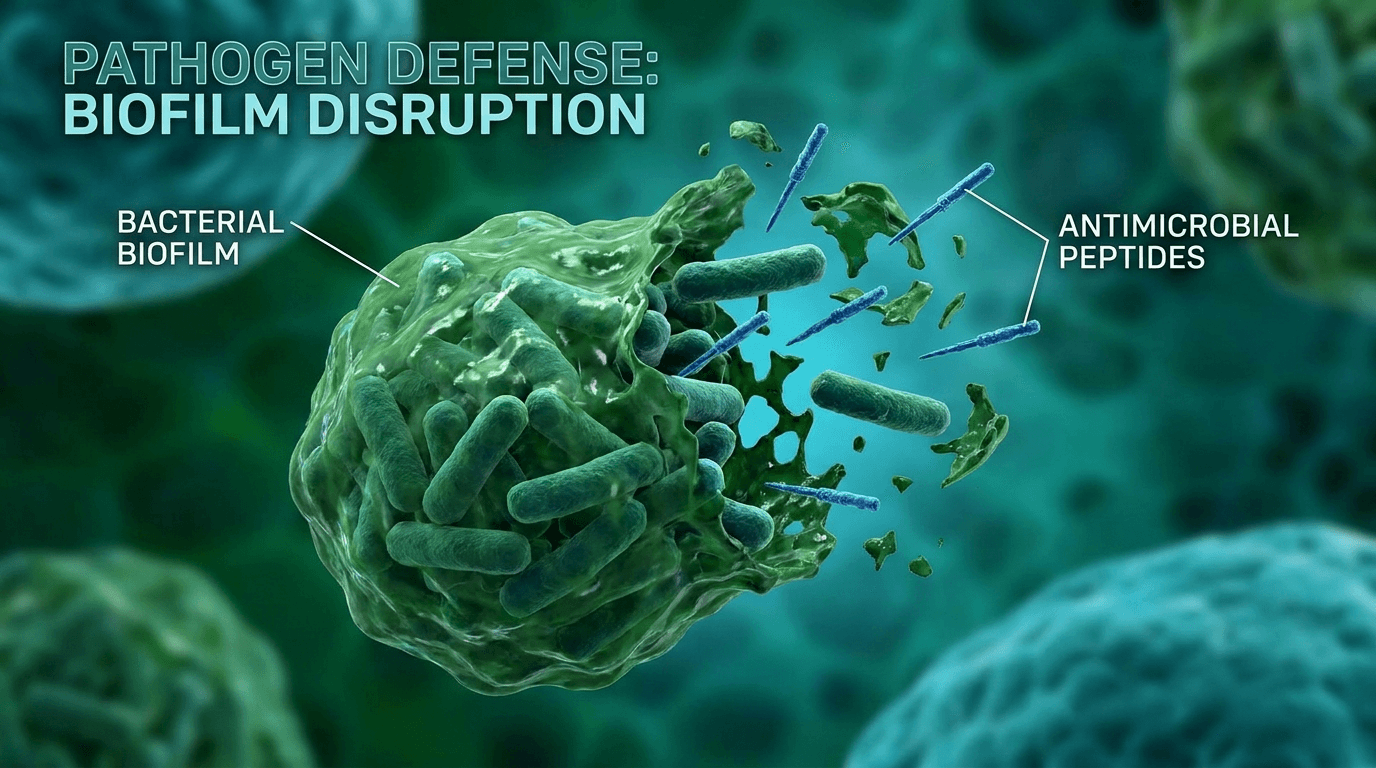
Bacterial biofilms are structured communities encased in polysaccharide matrices that make them 10–1,000x more resistant to antibiotics. Chronic wound infections, endocarditis, and device-associated infections are driven by biofilm formation. LL-37 has been shown to disrupt biofilm integrity at concentrations below those needed for planktonic bacteria killing — making it uniquely valuable in chronic infection contexts where antibiotics have failed. [1]
3. Immunomodulation and Immune Cell Recruitment
LL-37 acts as a chemoattractant for neutrophils, monocytes, T-cells, and mast cells — essentially calling for backup at infection sites. It also polarizes macrophage phenotype toward pro-inflammatory states during early infection, then helps resolve inflammation as the infection clears. This regulatory role in immunological timing prevents both under-response (leaving infection unchecked) and over-response (driving sepsis-like inflammation).
4. Wound Healing Acceleration
LL-37 signals to keratinocytes (skin cells) via the formyl peptide receptor 2 (FPR2/ALX) pathway, stimulating cell migration and proliferation needed for re-epithelialization. It promotes angiogenesis (new blood vessel formation) through VEGF pathway activation. These properties explain its efficacy in the venous leg ulcer trials — a wound type characterized by impaired healing driven by poor local circulation and chronic bacterial contamination. [1,2]
5. Broad-Spectrum Antiviral Activity
LL-37 shows activity against numerous viruses including influenza A (H1N1, H3N2), rhinovirus, HIV, and respiratory syncytial virus (RSV). Mechanistically, it disrupts viral envelopes and inhibits viral attachment to host cells. A 2022 Frontiers in Immunology paper proposed that upregulating LL-37 could reduce COVID-19 severity by limiting viral load and preventing the microthrombosis that characterizes severe disease. [5]
| Trial | Indication | Design | Key Finding |
|---|---|---|---|
| Grönberg 2014 (Phase IIb) | Venous leg ulcers | 80 patients, RCT, 12 weeks | Healing 6× faster at 0.5 mg/mL vs placebo; statistically significant |
| Grönberg 2022 (Phase IIb) | Hard-to-heal VLUs | 148 patients, multicenter RCT | Confirmed 2014 results; superior wound area reduction |
| Arini 2023 (RCT) | Diabetic foot ulcers | 25 patients, double-blind | Greater granulation tissue at all time points (p<0.05) |
| Phase I oncology | Cutaneous melanoma mets | Intra-tumoral injection, Phase I | Acceptable tolerability; variable biological response |
| COVID-19 (Frontiers 2022) | SARS-CoV-2 severity | Review/proposal | Upregulation associated with reduced severity; intervention studies ongoing |
LL-37 in Cancer Research: An Emerging and Paradoxical Story
LL-37's relationship with cancer is one of the most fascinating and paradoxical areas of peptide biology. Depending on the tumor type and the stage of cancer, LL-37 can function as both a tumor-suppressor and a tumor-promoter.
Anti-tumor activities:
- Direct cytotoxicity against cancer cell lines including breast cancer, lung cancer, and leukemia in vitro
- Ability to disrupt cancer cell membranes (cancer cells express more negatively charged lipids than healthy cells, similar to bacteria)
- Intra-tumoral injection of LL-37 in a Phase I melanoma trial showed tumor regression in a subset of patients — the first human data suggesting direct anti-cancer activity [6]
Pro-tumor concerns (context-dependent):
- In ovarian cancer and some breast cancers, LL-37 has been found to promote tumor angiogenesis and cell proliferation — the same wound-healing properties that make it useful in chronic wounds become problematic in an oncological context where angiogenesis feeds tumor growth
- This pro-tumor effect appears tumor-type specific and is an active area of research to define the contexts where LL-37 helps versus harms in oncology
The takeaway: LL-37 is not a tumor compound per se, but its broad biological activity means cancer applications need to be tumor-type specific. The wound-healing and antimicrobial applications are well-supported by clinical data; oncology applications are earlier-stage and require more research before definitive conclusions can be drawn. [6,7]
LL-37 Wound Healing: Clinical Trial Results
Wound Area Reduction vs Placebo in LL-37 RCTs
Sources: Wound Repair and Regeneration 2014 (PubMed 25041740), 2022 (PMC9298190), International Wound Journal 2023 (PMC10514151). Values represent approximate treatment advantage over placebo at primary endpoint.
LL-37 Frequently Asked Questions
Is LL-37 FDA approved?
LL-37 is not FDA-approved for any therapeutic indication. However, it has completed Phase IIb randomized controlled trials for wound healing with positive results. The April 2026 reclassification means it is now eligible for compounding at licensed 503A pharmacies with a physician prescription — a different pathway from FDA drug approval.
Can bacteria become resistant to LL-37?
Resistance to LL-37 is much harder to develop than resistance to conventional antibiotics. Because LL-37 works by disrupting the physical structure of bacterial membranes (rather than targeting a specific enzyme or protein), bacteria would need to fundamentally restructure their membrane lipid composition to evade it — a much more difficult evolutionary challenge. Some bacteria (particularly Staphylococcus aureus) have developed partial resistance mechanisms (modifying their surface charge), but broad-spectrum resistance has not emerged despite LL-37's long evolutionary presence.
What is the connection between vitamin D and LL-37?
Vitamin D directly upregulates LL-37 expression in immune cells and epithelial cells — one of the most well-established molecular mechanisms linking vitamin D to immune function. This explains why vitamin D deficiency is associated with increased susceptibility to respiratory infections and impaired wound healing. Optimizing vitamin D status is a simple way to support endogenous LL-37 levels without exogenous peptide administration.
What makes LL-37 selective for bacteria over human cells?
The key is membrane charge. Bacterial membranes are rich in negatively charged phosphatidylglycerol and cardiolipin lipids. Human cell membranes predominantly expose neutral lipids (phosphatidylcholine, sphingomyelin) on their outer face, with negatively charged lipids sequestered inside. LL-37's positive charge creates selective electrostatic attraction to bacterial surfaces. At therapeutic concentrations in wound healing studies, cytotoxicity to human cells was not observed.
Sources & References
- 1.Grönberg A, Mahlapuu M, Ståhle M, Whately-Smith C, Schmidtchen A. "Treatment with LL-37 is safe and effective in enhancing healing of hard-to-heal venous leg ulcers: a randomized, placebo-controlled clinical trial" — Wound Repair and Regeneration, 2014. DOI: 10.1111/wrr.12227.View source
- 2.Grönberg A, Ståhle M, Schmidtchen A, et al.. "Evaluation of LL-37 in healing of hard-to-heal venous leg ulcers: A multicentric prospective randomized placebo-controlled clinical trial" — Wound Repair and Regeneration, 2022. DOI: 10.1111/wrr.13011.View source
- 3.Arini M, Sukmawati M, Julizade F. "Efficacy of LL-37 cream in enhancing healing of diabetic foot ulcer: a randomized double-blind controlled trial" — International Wound Journal, 2023.View source
- 4.Tripathi S, Wang G, White M, Qi L, Taubenberger J, Hartshorn KL. "Antiviral activity of the human cathelicidin, LL-37, and derived peptides on seasonal and pandemic influenza A viruses" — PLOS ONE, 2015. DOI: 10.1371/journal.pone.0124706.View source
- 5.Bergman P, Raqib R, Rekha RS, Agerberth B, Gudmundsson GH. "Upregulating Human Cathelicidin Antimicrobial Peptide LL-37 Expression May Prevent Severe COVID-19 Inflammatory Responses and Reduce Microthrombosis" — Frontiers in Immunology, 2022. DOI: 10.3389/fimmu.2022.880961.View source
- 6.Mader JS, Hoskin DW. "The Human Cathelicidin Antimicrobial Peptide LL-37 and Mimics are Potential Anticancer Drugs" — Expert Opinion on Investigational Drugs, 2015.View source
- 7.Vandamme D, Landuyt B, Luyten W, Schoofs L. "Antimicrobial Peptides of the Cathelicidin Family: Focus on LL-37 and Its Modifications" — Frontiers in Immunology, 2025.View source
- 8.FDA Pharmacy Compounding Advisory Committee. "PCAC April 2026: LL-37 among 12 peptides reclassified from Category 2 to Category 1" — FDA.gov, 2026.View source