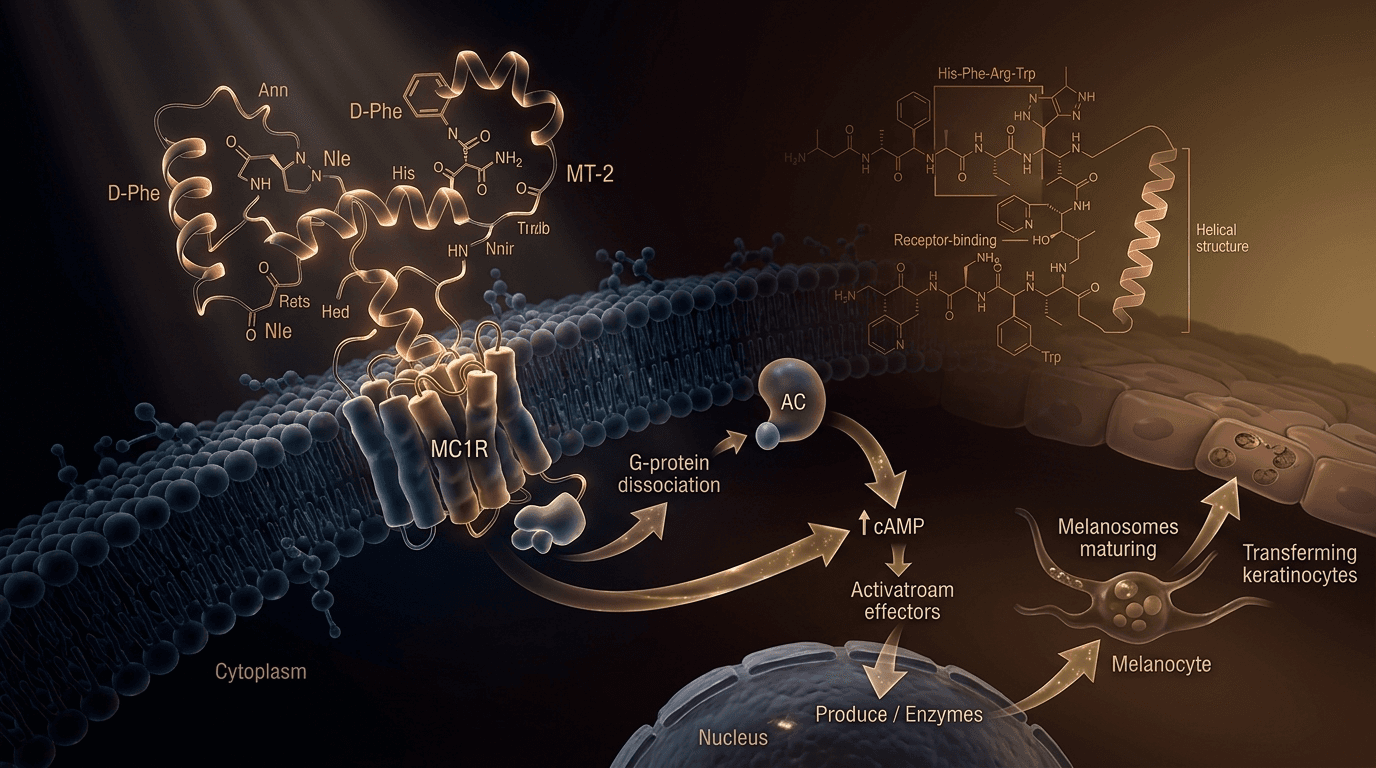
Melanotan II is a synthetic alpha-MSH analog that triggers melanin production for deep UV-independent tanning while also activating libido through MC4R — the same receptor that led to FDA-approved PT-141 (Vyleesi). Complete 2026 guide: mechanism, saturation dosing protocol, side effect management, and mole safety.
Melanotan II occupies an unusual place in peptide research: it began as a skin cancer prevention project at the University of Arizona, became one of the most widely used tanning compounds in the world, and incidentally led to the discovery of an FDA-approved treatment for sexual dysfunction. Few research compounds have such a winding scientific trajectory.
MT-2 works by mimicking alpha-MSH (alpha-melanocyte stimulating hormone), activating melanocortin receptors throughout the body. At the skin level, MC1R activation drives melanin production — creating a genuine tan without requiring hours of UV exposure. At the central nervous system level, MC4R activation drives sexual arousal, which led researchers to develop PT-141 (bremelanotide, now FDA-approved as Vyleesi for hypoactive sexual desire disorder).
Understanding what Melanotan II is, what it does at each receptor, how to dose it safely, and what precautions are non-negotiable is the purpose of this guide. Whether your interest is the tanning application, the sexual health aspect, or both, what follows is a complete, evidence-grounded overview for 2026.
The Arizona Origin: A Tanning Drug Born from Cancer Prevention
The story of Melanotan begins not with aesthetics but with oncology. Dr. Mac Hadley and colleagues at the University of Arizona reasoned in the 1980s that if people could achieve a protective tan with minimal UV exposure, they could reduce their skin cancer risk by avoiding the prolonged sun that causes DNA damage. The vehicle for this protective tan: a synthetic version of alpha-MSH, the body's own melanin-stimulating hormone.
Natural alpha-MSH is a 13-amino-acid peptide from the pituitary gland that activates MC1R on melanocytes to drive melanin production. It's also rapidly degraded in plasma (half-life of minutes), making it impractical as a drug. The Arizona team developed a cyclic, lactam-bridged analog — [Nle4, D-Phe7]-α-MSH — that was both more potent and more stable. The first version became Melanotan I (now afamelanotide, FDA-approved as Scenesse for erythropoietic protoporphyria). The more potent, shorter analog became Melanotan II.
During Phase I trials at the University of Arizona, male participants reported unexpected spontaneous erections. This incidental finding launched a parallel research program that eventually produced bremelanotide (PT-141), demonstrating that the original cancer-prevention peptide had spawned both a tanning compound and the first female sexual dysfunction drug [1,2,3].
Melanocortin Receptors: What Each Target Does
MT-2 is a non-selective melanocortin receptor agonist. The five melanocortin receptors (MC1R-MC5R) govern diverse physiological functions. MT-2 meaningfully activates at least three:
| Receptor | Primary Location | Effect of MT-2 Activation | Clinical Outcome |
|---|---|---|---|
| MC1R | Skin melanocytes, hair follicles | Eumelanin production upregulation | Tanning (brown/black pigment), freckle darkening |
| MC3R | Hypothalamus, adipose tissue | Appetite suppression, energy balance | Mild appetite reduction (commonly reported) |
| MC4R | CNS hypothalamus, limbic system | Sexual arousal, erectile facilitation | Increased libido, spontaneous erections (men) |
| MC5R | Exocrine glands | Sebum and sweat regulation | Occasional oily skin reports at higher doses |
How MT-2 Tanning Works: Beyond UV Exposure
MT-2's tanning mechanism differs fundamentally from UV-induced tanning, which explains why it produces deeper, more even color with dramatically less sun exposure:
Conventional UV tanning: UV radiation damages keratinocyte DNA. Damaged keratinocytes release alpha-MSH and other signals that activate MC1R on adjacent melanocytes. Melanocytes produce melanin and transfer it to surrounding keratinocytes — the visible tan is actually a DNA damage response, with melanin serving as a photoprotective cap over cellular nuclei.
MT-2 tanning: MT-2 directly activates MC1R on melanocytes, bypassing the UV damage requirement entirely. Melanocytes upregulate melanin synthesis proactively. When UV light is then introduced — even minimal amounts (15-30 minutes) — pre-loaded melanocytes produce a dramatically amplified tanning response versus UV alone.
Key practical implications from the clinical data [7]:
- MT-2 can produce visible tanning with 15-30 minutes of sun versus the hours required without it
- Tanning is more even because MT-2 stimulates melanocytes uniformly, not in the patchy UV damage pattern
- MT-2 preferentially stimulates eumelanin (brown-black pigment) over pheomelanin (red-yellow), producing a darker, more "Mediterranean" tone
- Deposited melanin persists for weeks after MT-2 discontinuation, as melanin-loaded keratinocytes gradually cycle out over 4-12 weeks
The Saturation + Maintenance Dosing Protocol
MT-2 dosing follows a classic two-phase approach — saturation to build melanin deposition, maintenance to preserve it:
| Phase | Dose | Frequency | Duration | UV Exposure Notes |
|---|---|---|---|---|
| Test Dose | 0.1-0.25 mg | Single dose (evening) | Day 1 only | No UV needed; assess tolerance |
| Saturation / Loading | 0.25-0.5 mg | Daily | 2-4 weeks | 15-30 min sun or UV lamp daily to activate |
| Accelerated Loading | 0.5-1 mg | Daily | 1-2 weeks | Higher nausea risk; experienced users only |
| Maintenance (summer) | 0.5 mg | 2-3x per week | Ongoing | Regular sun exposure sustains tan |
| Maintenance (winter) | 0.5 mg | 1-2x per week | Ongoing | Minimal UV; higher dose may be needed |
Nausea is the most common and dose-limiting side effect of MT-2, particularly at doses above 0.5 mg. Always begin with a 0.1-0.25 mg test dose. Two strategies dramatically reduce nausea: (1) inject 1-2 hours before sleep so peak plasma levels occur during sleep when nausea awareness is minimal; (2) take diphenhydramine (25 mg, e.g. Benadryl) 30 minutes before injection — an antihistamine that reduces the nausea response for most users. Never start at 0.5 mg without establishing tolerance at a lower dose first. Individual sensitivity varies dramatically regardless of body weight.
Melanin Index Over Time: MT-2 + Minimal UV vs UV Alone
Relative Melanin Pigmentation Index by Week
Illustrative based on Dorr et al. 1996 Phase I tanning data and subsequent observational reports. Individual results vary significantly by Fitzpatrick skin type and MT-2 dose.
Side Effects and Safety Considerations
MT-2's broad melanocortin receptor activity produces a diverse but mostly transient side effect profile:
| Side Effect | Frequency | Mechanism | Management Strategy |
|---|---|---|---|
| Nausea / vomiting | Very common (>50%) | Central MC3R/MC4R stimulation | Evening dosing, titrate slowly, antihistamine pre-dose |
| Facial flushing | Common (30-50%) | Vasodilation via MC receptor | Evening dosing, dose reduction |
| Spontaneous erections (men) | Common (30-50%) | MC4R sexual arousal pathway | Reduce dose, evening administration |
| Fatigue / yawning | Common (20-40%) | Central MC receptor sedation | Leverage with evening injection timing |
| Appetite suppression | Common (20-40%) | MC3R hypothalamic effect | Often a desired secondary effect |
| Darkening of existing moles | Common (any dose) | MC1R melanocyte stimulation | Baseline dermatologist exam required |
| New freckles or spots | Occasional (10-20%) | MC1R melanocyte stimulation | Expected; monitor for changes in existing lesions |
| Headache | Occasional (10-20%) | CNS or vascular effect | Dose reduction, adequate hydration |
MC1R activation by MT-2 stimulates melanocyte proliferation and melanin synthesis in ALL melanocytes — including those within existing moles and nevi. Darkening of pre-existing moles is extremely common and expected. The more serious concern: theoretical risk that MC1R stimulation could accelerate proliferation in dysplastic (atypical) nevi, potentially promoting early-stage melanoma. The evidence for this risk in humans is not definitive, but the theoretical mechanism is sound. Any person with atypical moles, a history of melanoma, or family history of melanoma should consult a dermatologist before using MT-2 and should not proceed without medical supervision. All users should perform monthly self-exams (ABCDE criteria) and see a dermatologist if any mole changes shape, border, color, or size during MT-2 use. This is the most clinically serious risk associated with MT-2 and should not be minimized.
Melanotan II vs PT-141 (Bremelanotide): Understanding the Difference
PT-141 (bremelanotide) was derived directly from Melanotan II research. When spontaneous erections were reported in early MT-2 trials, researchers worked to identify the responsible receptor (MC4R) and develop a more selective compound targeting sexual function with less tanning and reduced nausea. Bremelanotide received FDA approval in 2019 as Vyleesi for hypoactive sexual desire disorder in premenopausal women [5].
The practical difference:
- MT-2: Non-selective; strong tanning effect (MC1R) + libido/sexual arousal (MC4R) + appetite suppression (MC3R); higher nausea incidence; no FDA approval
- PT-141: More MC4R-directed (though not fully selective); minimal tanning effect; FDA-approved for female sexual dysfunction; more extensive human safety data for the sexual health application; still causes nausea at higher doses
If your primary goal is tanning, MT-2 is the appropriate compound. If sexual function is the primary goal and tanning is unwanted or the target is female sexual dysfunction, PT-141 is both more appropriate and better characterized from a safety standpoint. For the complete PT-141 guide, see our PT-141 Bremelanotide Research Guide.
Reconstitution and Administration
MT-2 is supplied as a lyophilized white powder. Reconstitution steps:
- Use bacteriostatic water (BAC water) — not sterile saline, which lacks the preservative required for multi-use vials. BAC water maintains sterility for 28-30 days after opening.
- Common reconstitution: 10mg vial + 2 mL BAC water = 5 mg/mL. Each 0.1 mL then contains 0.5 mg MT-2.
- Inject BAC water slowly into the vial by running it down the glass wall — never spray directly onto the powder.
- Gently swirl until dissolved — never shake. Shaking denatures peptide bonds and reduces activity.
- Store reconstituted solution refrigerated (2-8°C); use within 4-6 weeks for best stability.
- Inject subcutaneously with a 29-31 gauge insulin syringe. Pinch skin at abdomen or thigh, 45-degree angle. Rotate injection sites to prevent lipodystrophy.
Where to Source Research-Grade Melanotan II
PeptideTech
Editor's PickMelanotan II 10mg
$29.99
HPLC-verified MT-2, lyophilized 10mg vials, includes COA and purity documentation
Modified Aminos
Best ValueMelanotan 2 10mg
$27.99
Bundle deals with BAC water kits, best value for multi-cycle orders
AminoUSA
MT-2 (Melanotan II) 10mg
$31.99
Domestic US shipping, batch COA published online, fast 2-3 day delivery
VANDL Labs
PremiumMelanotan II 10mg Premium
$34.99
Premium lyophilization, extended shelf stability, independent mass spec verification
Melanotan II FAQ
How long does it take for Melanotan II to start working?
Most users notice the beginning of skin darkening within 7-14 days of daily saturation dosing, particularly after modest sun exposure (15-30 minutes). The tan deepens over 3-6 weeks. Individual response depends heavily on Fitzpatrick skin type — fair-skinned types (I-II) require longer saturation phases; darker types (IV-VI) respond faster and with more modest dose requirements.
Does Melanotan II work without sun exposure?
MT-2 can produce mild tanning without any UV exposure through direct MC1R activation. However, even minimal UV exposure (15-30 minutes in moderate sun or a tanning lamp) dramatically amplifies the tanning response. Most protocols incorporate brief UV exposure during the saturation phase to maximize results efficiently.
Is Melanotan II the same as Melanotan I (afamelanotide)?
No. Melanotan I (afamelanotide, brand: Scenesse) is a more selective MC1R agonist approved by the FDA for erythropoietic protoporphyria — a rare light-sensitivity disorder. It produces tanning with minimal sexual effects (lower MC4R activity). MT-II is more potent, non-selective, and produces both tanning and significant sexual arousal effects. MT-I has superior regulatory standing and clinical evidence base.
How long does the Melanotan II tan last after stopping?
The tan typically fades over 4-12 weeks after MT-2 discontinuation as melanin-loaded keratinocytes cycle out through normal skin turnover. Maintenance doses (1-2x weekly) are needed to sustain the tan long-term. Regular sun exposure after discontinuation also helps preserve the deposited pigmentation.
Can Melanotan II be used for erectile dysfunction?
MT-2 was studied for erectile dysfunction in early clinical trials, and several systematic reviews confirm significant efficacy via MC4R-mediated central arousal pathways [6]. However, PT-141 (bremelanotide) is a more targeted compound for this application — more selective for the sexual arousal pathway, FDA-approved, and better characterized from a safety standpoint specifically for sexual dysfunction.
Does Melanotan II cause cancer?
No direct causal link between MT-2 and human cancer has been established. The theoretical concern is stimulation of melanocytes in pre-malignant nevi. Paradoxically, the original rationale for MT-2 development was skin cancer prevention — enabling protective tanning with less UV exposure. The evidence base is insufficient for definitive conclusions. Anyone with melanoma risk factors (atypical moles, family history, fair skin) should consult a dermatologist before use.
The Bottom Line on Melanotan II
Melanotan II is one of the most pharmacologically interesting peptides in research use — a compound whose discovery inadvertently launched both a tanning treatment and an FDA-approved sexual dysfunction drug. Its melanocortin receptor biology illustrates how a single molecular mechanism can govern diverse physiological systems from skin pigmentation to appetite to sexual arousal.
For tanning applications, MT-2 is highly effective. It produces eumelanin-based pigmentation deeper and more evenly than UV alone achieves, with a fraction of the UV exposure — and therefore, potentially, a fraction of the UV-related DNA damage. The saturation-then-maintenance protocol is well-established from both clinical trial data and decades of documented use.
The non-negotiable precautions are mole monitoring and the test-dose titration approach. Anyone with melanoma risk factors should consult a dermatologist before starting. Anyone who uses MT-2 should perform regular self-exams and have any changing lesion evaluated promptly. These are not abstract warnings — they reflect the genuine mechanism of MC1R-driven melanocyte stimulation throughout the skin.
For the complete melanocortin receptor biology, clinical trial history, and peptide pharmacology, see the PeptideWiki Melanotan II Database Page. For the PT-141 sexual health application, see our PT-141 Bremelanotide Complete Guide.
Sources & References
- 1.Hadley ME, Dorr RT. "Melanocortin peptide therapeutics: historical milestones, clinical studies and commercialization" — Peptides, 2006. DOI: 10.1016/j.peptides.2005.01.029.View source
- 2.Dorr RT, Lines R, Levine N, et al.. "Evaluation of melanotan-II, a superpotent cyclic melanotropic peptide in a pilot phase-I clinical study" — Life Sciences, 1996. DOI: 10.1016/0024-3205(96)00141-5.View source
- 3.Wessells H, Levine N, Hadley ME, Dorr R, Hruby V. "Melanocortin receptor agonists, penile erection, and sexual motivation: human studies with Melanotan II" — International Journal of Impotence Research, 2000. DOI: 10.1038/sj.ijir.3900582.View source
- 4.King SH, Mayorov AV, Balse-Srinivasan P, Hruby VJ, Vanderah TW, Wessells H. "Melanocortin receptors, melanotropic peptides and penile erection" — Current Topics in Medicinal Chemistry, 2007.View source
- 5.Bremelanotide (PT-141) FDA Approval Documentation. "Vyleesi (bremelanotide): FDA Drug Approval Package" — FDA.gov, 2019.View source
- 6.Liang C, Tian X, Fu R, et al.. "Efficacy and safety of melanotan in men with erectile dysfunction: a systematic review and meta-analysis" — Andrology, 2022. DOI: 10.1111/andr.13141.View source
- 7.Levine N, Sheftel SN, Eytan T, et al.. "Induction of skin tanning by subcutaneous administration of a potent synthetic melanotropin" — Journal of the American Medical Association, 1991. DOI: 10.1001/jama.1991.03460060061031.View source