Dihexa is a synthetic peptide derived from angiotensin IV, developed at Washington State University, that showed synaptogenic activity 10 million times more potent than BDNF in vitro. It crosses the blood-brain barrier orally. It reversed cognitive decline in animal Alzheimer's models. And it has zero validated human clinical trial data — plus a 2024 retraction of one of its key mechanistic papers. Here's the complete, honest picture.
In 2013, a paper from Washington State University made a claim that stopped the nootropics research community in its tracks: a synthetic peptide called Dihexa showed synaptogenic activity 10 million times more potent than BDNF (brain-derived neurotrophic factor) in hippocampal cell culture assays. It reversed cognitive deficits in animal Alzheimer's models. It could be taken orally and still reach the brain.
Dihexa (N-hexanoic-Tyr-Ile-(6) amino hexanoic amide, also written as N-hexanoyl-L-tyrosyl-L-isoleucine (6) aminohexanoic acid amide) is a hexapeptide derived from the angiotensin IV (Ang IV) fragment of the renin-angiotensin system. The original interest in Ang IV wasn't cognitive at all — researchers noticed it had unusual effects on memory formation and spatial learning in rodents, and a WSU team spent years engineering a more stable analog that could actually be used as a drug. Dihexa was that analog. [1,6]
The 2026 picture is more complicated. One of the key mechanistic papers from the WSU group was retracted in 2024. No human clinical trials have been initiated or completed. Solubility challenges have created questions about the reliability of in vitro potency data. And a theoretical cancer risk (via c-Met pathway promotion) has been raised — though not substantiated in animal studies.
This guide covers what the evidence actually says, what it doesn't, where the caveats are, and what researchers using Dihexa in 2026 should understand about its unusual pharmacology.
Background: From Angiotensin IV to Dihexa
The renin-angiotensin system (RAS) is primarily known for blood pressure regulation. But a lesser-known branch of the RAS — the angiotensin IV (Ang IV) fragment and its AT4 receptor — was found in the early 2000s to play a role in learning and memory. The AT4 receptor (now identified as IRAP, insulin-regulated aminopeptidase) is highly expressed in memory-relevant brain regions including the hippocampus and cortex. [6]
The problem with native Ang IV as a drug candidate was its metabolic instability: it was cleaved too rapidly by peptidases to maintain therapeutic concentrations in vivo. The Wright/Harding lab at Washington State University spent years synthesizing and screening metabolically stable analogs. Dihexa (also called PNB-0408) was their lead compound: it bound AT4/IRAP with high affinity, was resistant to enzymatic breakdown, and — crucially — could cross the blood-brain barrier after peripheral administration, including orally. [1]
Why the HGF/c-Met angle matters:
The 2013 paper proposed that Dihexa doesn't work directly through AT4/IRAP — rather, it activates the hepatocyte growth factor (HGF) / c-Met receptor signaling pathway, which then drives synaptogenesis. HGF/c-Met is known to regulate neurite outgrowth, synaptic plasticity, and neuronal survival. The proposed mechanism was that Dihexa mimics HGF's pro-synaptogenic signaling — producing new synaptic connections at extraordinarily low concentrations. [2]
The 2014 retraction complicates this picture: the paper making the strongest mechanistic case for the HGF/c-Met pathway was formally retracted, weakening (though not eliminating) the proposed molecular mechanism. The earlier 2010 animal cognition data and the 2014 animal study of procognitive effects remain in the literature. [4,5]
What the Evidence Actually Shows
The Dihexa evidence base consists entirely of preclinical studies — in vitro cell culture and rodent in vivo experiments. There are no published human clinical trials. Here's what the animal data shows, and what it doesn't: [1,2,3]
In vitro: Synaptogenesis
In hippocampal cell culture, Dihexa produced synaptogenic effects at concentrations approximately 10 million-fold lower than BDNF in specific assay conditions. This headline figure drove enormous interest in the compound. Caveat: Dihexa has poor aqueous solubility, and researchers have flagged that precipitation artifacts in low-concentration in vitro studies may have inflated apparent potency. The absolute potency number should be interpreted with this uncertainty in mind.
In vivo (rats): Cognition in scopolamine-impaired model
Oral Dihexa reversed scopolamine-induced memory deficits in rats on the Morris Water Maze task. Treated animals performed comparably to unimpaired controls. This model is commonly used to screen Alzheimer's candidates. [1]
In vivo (rats): Aged rodent cognition
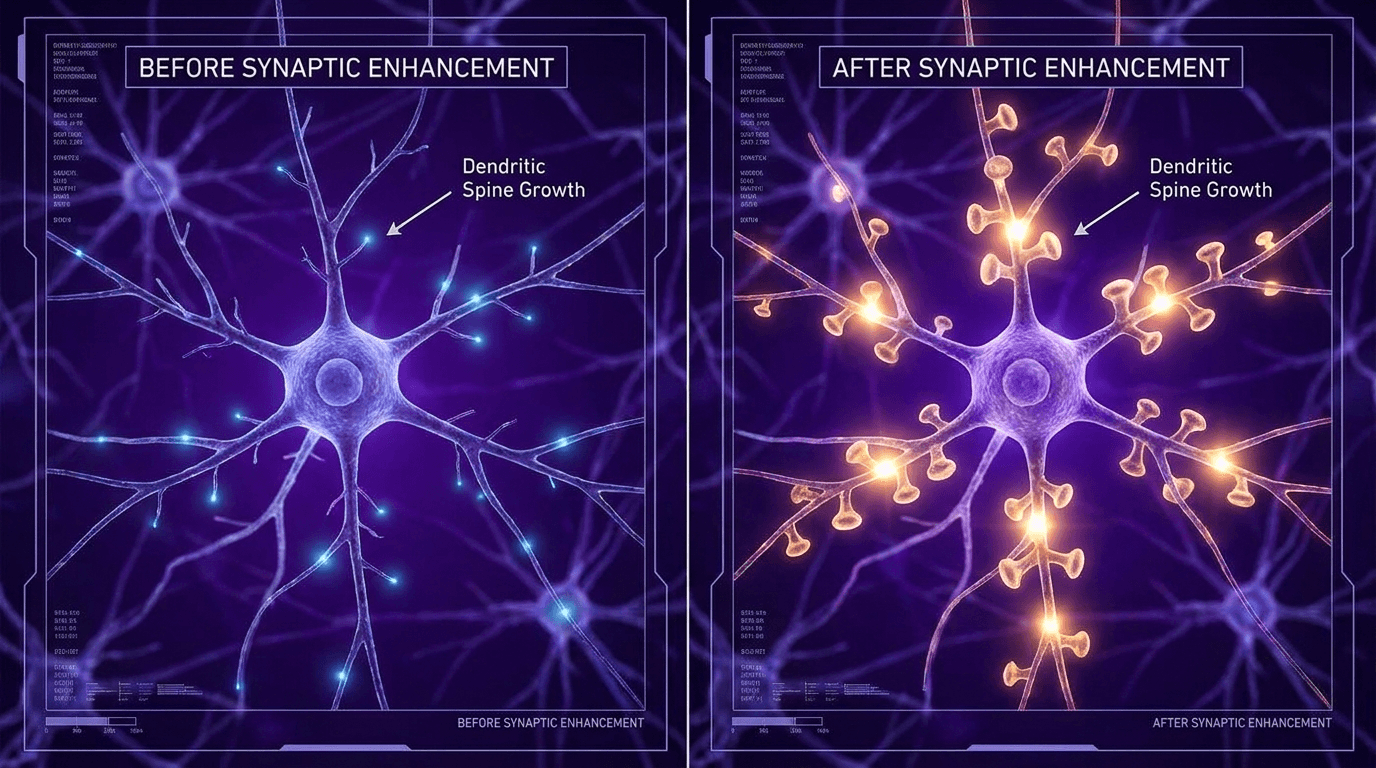
Aged rats showed improved spatial memory after Dihexa treatment, with histological evidence of increased hippocampal dendritic spine density — consistent with the proposed synaptogenic mechanism. [2]
What is NOT in the evidence base:
- No Phase 1 safety study in humans
- No Phase 2 efficacy study in humans
- No pharmacokinetic data in humans (plasma levels, CNS penetration in humans)
- No dose-response data in humans
- No long-term safety data in any species
- No data on cancer risk with chronic use (c-Met pathway activation is theoretically oncogenic in the context of pre-existing cancer)
| Evidence Type | Status | Quality | Notes |
|---|---|---|---|
| In vitro synaptogenesis | Positive | Low (solubility caveats) | Claimed 10M× BDNF potency — precipitation artifacts possible |
| Rodent cognitive impairment (scopolamine) | Positive | Moderate | Reversed deficits on Morris Water Maze |
| Aged rodent cognitive improvement | Positive | Moderate | Increased spine density; improved spatial memory |
| HGF/c-Met mechanism (key paper) | Retracted (2024) | N/A | Strongest mechanistic claim — paper formally retracted |
| Human Phase 1 safety | None | N/A | No human trial initiated or published |
| Human Phase 2 efficacy | None | N/A | No human trial initiated or published |
| Long-term safety (any species) | None | N/A | Not assessed in published literature |
Oral Bioavailability and Blood-Brain Barrier Penetration
One of Dihexa's most pharmacologically interesting properties is its ability to cross the blood-brain barrier after oral administration. Most research peptides require injection to achieve CNS activity — the GI tract destroys them before absorption, or the BBB blocks them even if they reach plasma. Dihexa bypasses both obstacles.
This is achieved through two structural modifications relative to native Ang IV:
- N-hexanoyl capping: Adding a hexanoic acid group to the N-terminus makes the peptide more lipophilic, improving membrane permeability and resisting peptidase cleavage from the N-terminus
- C-terminal hexanoic amide: Similarly protects the C-terminus from carboxypeptidase degradation and enhances lipophilicity
These modifications allow Dihexa to survive oral administration, be absorbed through intestinal mucosa, circulate in plasma, and penetrate the BBB — all without the injection that virtually all other research peptides with CNS targets require. In rodent studies, oral and subcutaneous administration produced comparable cognitive effects. [1]
For researchers, this means Dihexa can theoretically be administered as a transdermal cream, sublingually, or orally — though dissolution challenges (the same solubility issues that affect in vitro studies) affect the practical reliability of oral dosing.
Dihexa Dosing: Extrapolations Without Clinical Validation
No validated human dosing protocol exists for Dihexa. All dose estimates in current use are extrapolated from animal data using allometric scaling. The community-reported doses are:
- Common range: 5–10 mg per day (oral or transdermal)
- Higher protocols: Some researchers report 15–20 mg, but no safety justification exists for this range
- Animal studies used: ~1 mg/kg in rodents; allometric scaling to humans suggests approximately 150–175 mcg/kg as a rough equivalent — but interspecies extrapolation for CNS compounds is notoriously unreliable
- Cycle length: Anecdotal protocols typically run 7–14 days, then assess, due to concern about persistent synaptogenic effects
Solubility is a practical challenge. Dihexa has poor water solubility but dissolves in DMSO and propylene glycol — hence the popularity of transdermal formulations. Oral capsules require careful formulation to ensure dissolution before the peptide is degraded.
Given the absence of human pharmacokinetic data, researchers cannot be certain that any given oral dose actually reaches the CNS at an effective concentration — or what that concentration would be in humans.
Dihexa FAQ
Why was the key Dihexa paper retracted in 2024?
The 2012 paper by Bheel et al. — which proposed that Dihexa's synaptogenic effects are mediated through HGF/c-Met receptor activation — was retracted by the journal in 2024 after concerns about the reliability of specific experimental data. This doesn't eliminate the earlier cognition data from the 2010 McCoy paper or the 2014 Benoist paper, which remain in the literature. But it weakens the strongest mechanistic claim and should prompt caution about extrapolating the in vitro potency numbers.
Can Dihexa actually be taken orally?
Based on the animal literature, yes — oral administration appears to produce central nervous system effects in rodents. The structural modifications that make Dihexa more lipophilic (N-hexanoyl cap, C-terminal amide) allow GI survival and BBB penetration. Practical concerns include poor aqueous dissolution that may limit consistent oral bioavailability. Transdermal application (dissolved in DMSO or propylene glycol) is a common alternative used by researchers for this reason.
Is there a cancer risk with Dihexa?
This is a legitimate theoretical concern that has not been studied in practice. Dihexa is proposed to activate c-Met receptor signaling. c-Met is overexpressed in numerous cancers, and c-Met pathway activation has been shown to promote cancer cell migration, invasion, and proliferation. Crucially, this concern applies to individuals with pre-existing cancer or high cancer risk — chronic c-Met activation in the context of a normal, non-cancerous biology may pose negligible risk. But without long-term safety data in any species, this question cannot be definitively answered.
How does Dihexa compare to Semax or Selank for cognitive enhancement?
Semax and Selank have more human data (primarily from Russian clinical studies) than Dihexa. Semax is a melanocortin analog with BDNF-upregulating properties and documented use in stroke recovery in Russia; Selank is an anxiolytic with mild cognitive benefits. Dihexa's theoretical synaptogenic potency far exceeds either in the animal literature — but it also has far less human evidence, a retracted mechanism paper, and the unresolved cancer risk question. For researchers prioritizing established evidence, Semax or Selank present a more characterized risk/benefit profile.
Sources & References
- 1.McCoy AT, Benoist CC, Wright JW, et al.. "Evaluation of metabolically stabilized angiotensin IV analogs as procognitive/antidementia agents" — Journal of Pharmacology and Experimental Therapeutics, 2010. DOI: 10.1124/jpet.109.161356.View source
- 2.Benoist CC, Bheel NE, Bheel M, Wright JW, Harding JW. "The procognitive and synaptogenic effects of angiotensin IV-derived peptides are dependent on activation of the hepatocyte growth factor/c-met system" — Journal of Pharmacology and Experimental Therapeutics, 2014. DOI: 10.1124/jpet.114.218735.View source
- 3.Wright JW, Harding JW. "The brain hepatocyte growth factor/c-Met receptor system: A new target for the treatment of Alzheimer's disease" — Journal of Alzheimer's Disease, 2015. DOI: 10.3233/JAD-141947.View source
- 4.Peptide Protocol Wiki Editorial. "Dihexa Research Status 2026: Retraction, Solubility Issues & Cancer Risk Assessment" — PeptideProtocolWiki.com, 2026.View source
- 5.Bheel NE, Bheel M, Wright JW, Harding JW. "Erratum/Retraction Notice — synaptogenic HGF/c-Met paper (2012)" — Journal of Pharmacology and Experimental Therapeutics, 2024.View source
- 6.Wright JW, Harding JW. "Contributions of the Brain Angiotensin IV-AT4 Receptor Subtype System to Spatial Learning" — Neuroscience & Biobehavioral Reviews, 2004. DOI: 10.1016/j.neubiorev.2004.01.012.View source