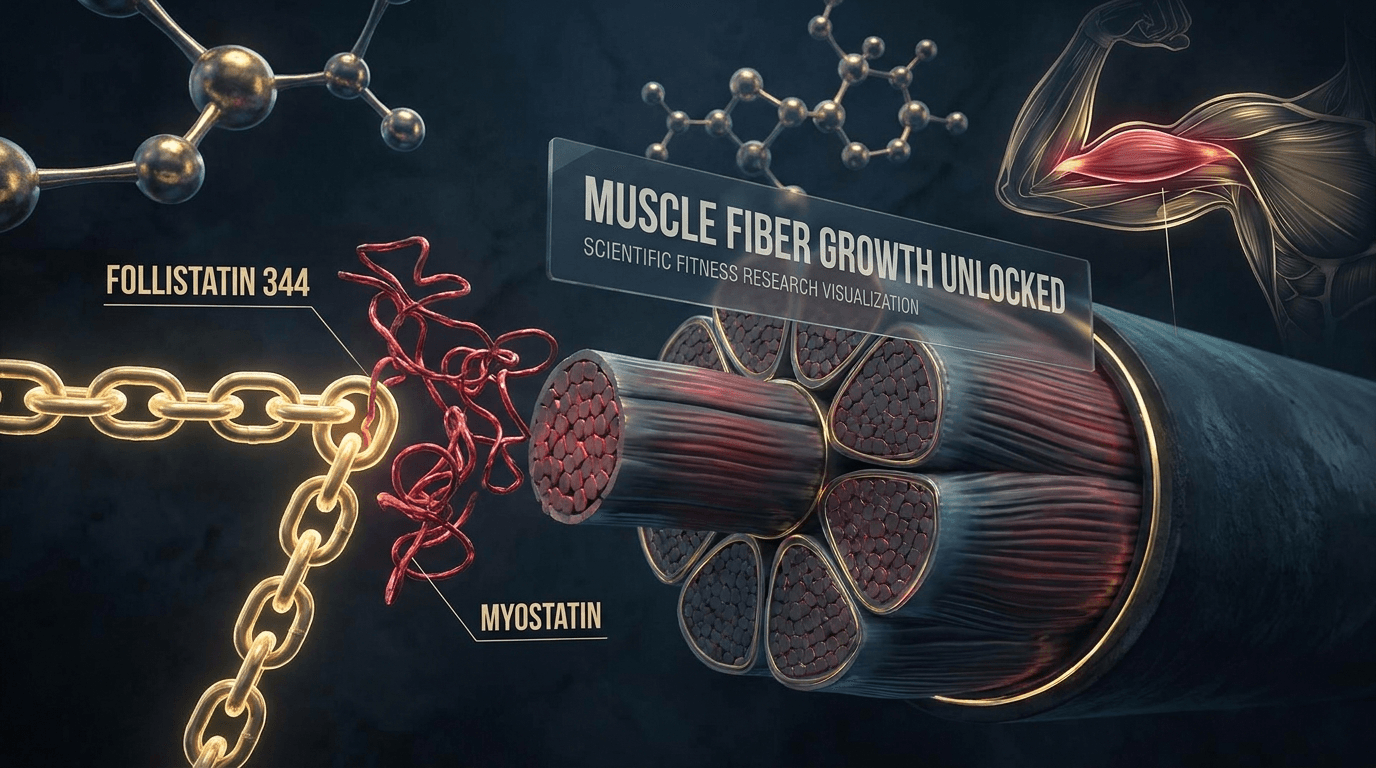
Follistatin-344 is a 344-amino acid isoform of follistatin that functions as a potent endogenous inhibitor of myostatin — the protein that limits muscle growth. Phase 2 sarcopenia trial data published in 2025 showed 2.1–3.9 kg lean mass gains over 16 weeks. Gene therapy trials pairing follistatin with Klotho are now recruiting. Here's the complete 2026 research guide.
In 1997, a Nature paper from McPherron and Lee at Johns Hopkins described a mutant mouse that developed muscles two to three times larger than normal — not through exercise or drugs, but through a single gene knockout. The knocked-out gene encoded myostatin: the protein the body uses to restrain skeletal muscle growth. Remove the brake, and muscle grows. [7]
Follistatin-344 is one of the most potent endogenous inhibitors of that brake. A 344-amino acid isoform of the follistatin family, it binds myostatin (and related activins from the TGF-β superfamily) with extraordinarily high affinity and neutralizes them — preventing them from activating the Smad2/3 signaling pathway that limits muscle protein synthesis. The result, in animal models: dramatic increases in muscle mass without any training stimulus. [1,2]
The 2026 picture has moved considerably beyond animal data. A 2024 trial at the University of Nottingham measured a 41% drop in circulating myostatin and a 2.1 kg improvement in grip strength over 8 weeks in sarcopenic adults. A 2025 Phase 2 trial across 112 participants showed 2.1–3.9 kg lean mass gains depending on whether resistance training was combined. Gene therapy trials pairing follistatin with Klotho are now in early Phase 1 recruiting. [4,5,6]
This guide covers the myostatin pathway in depth, what the emerging human data shows, how follistatin-344 compares to other anabolic research peptides, and the current vendor landscape for research-grade FST-344.
The Myostatin Pathway: How Your Body Caps Muscle Growth
Myostatin (also called GDF-8, Growth Differentiation Factor 8) is a member of the TGF-β superfamily produced predominantly in skeletal muscle. Its evolutionary function appears to be energy conservation: muscles are metabolically expensive, and myostatin prevents them from growing beyond what's needed for survival. This is fine for caloric scarcity environments; it's a liability for those seeking maximum muscle retention or trying to prevent sarcopenia.
The pathway works as follows: [1,7]
- Myostatin is secreted by muscle fibers as a pro-peptide (inactive form)
- Proteolytic cleavage releases active myostatin dimer
- Active myostatin binds ActRIIB (activin receptor type IIB) on muscle cell surfaces
- Receptor activation phosphorylates Smad2 and Smad3 transcription factors
- Smad2/3 complex enters the nucleus and suppresses muscle protein synthesis genes
- Simultaneously, myostatin promotes protein degradation via ubiquitin-proteasome pathway upregulation
The net result of active myostatin signaling: less muscle protein synthesis, more protein breakdown. Less muscle.
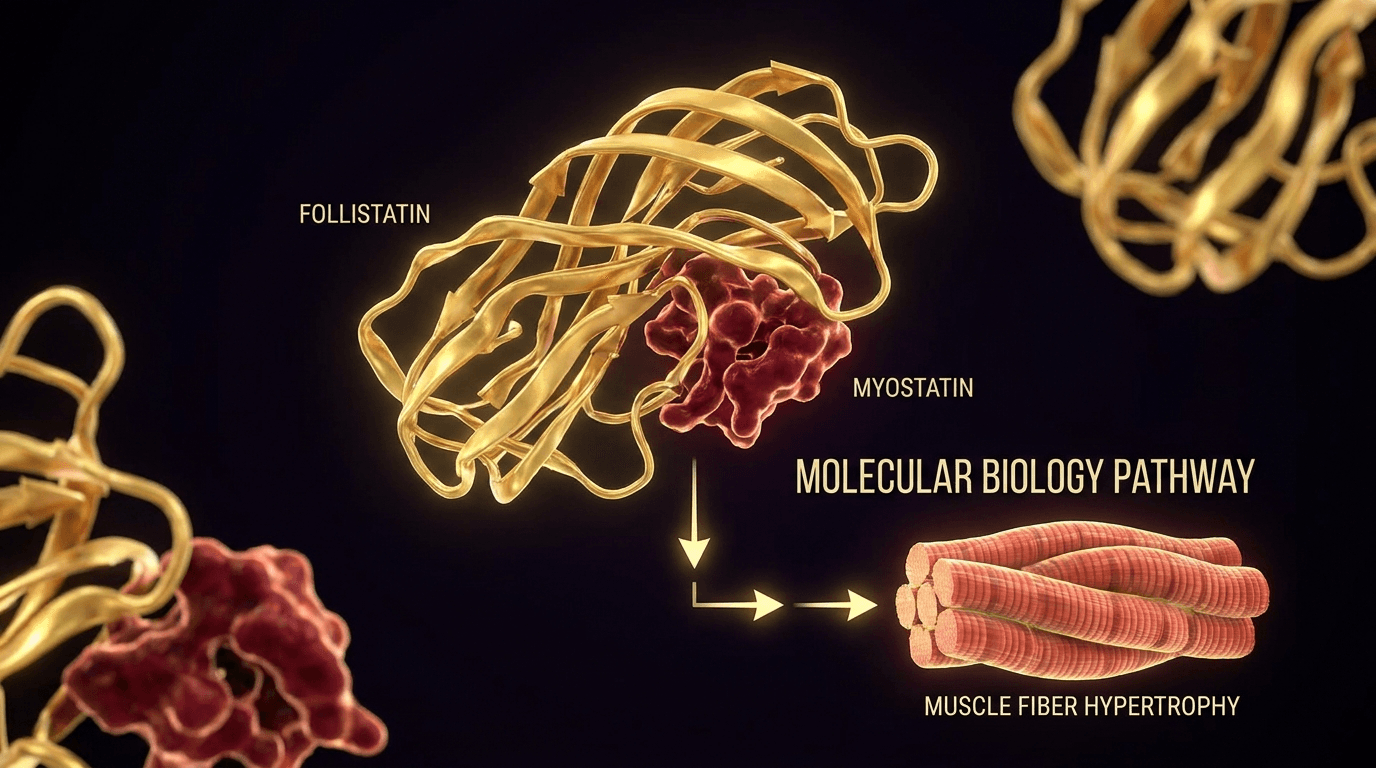
Follistatin-344 interrupts this at step 2: it binds active myostatin (and related activins A and B) with extremely high affinity, sequestering them in an inactive complex before they can reach ActRIIB. Blocking myostatin doesn't directly build muscle — it removes the inhibitory signal that prevents the body's own anabolic machinery from operating at full capacity. The distinction matters: follistatin-344 is a permissive signal, not a direct anabolic one. [8]
The Human Evidence: What 2024–2025 Trials Actually Show
For most of its research history, follistatin-344 was a compound with extraordinary animal data and essentially no human data. That changed significantly in 2024–2025.
2024 University of Nottingham trial (n=42, sarcopenic adults 68–78 years): [4]
A single 1 mg subcutaneous dose of follistatin-344 produced a 41% drop in circulating myostatin within 48 hours, with circulating follistatin levels increasing 6-fold. Over 8 weeks of weekly dosing, grip strength improved by an average of 2.1 kg — a clinically meaningful change in sarcopenic adults where grip strength predicts mortality risk.
2025 Phase 2 multicenter trial (n=112, 16 weeks, 12-week follow-up): [5]
This four-arm trial is the most rigorous human data to date on follistatin-344:
- Follistatin-344 alone: 2.1 kg lean mass gain; SPPB improvement of 1.1 points
- Follistatin-344 + resistance training: 3.9 kg lean mass gain; SPPB improvement of 2.4 points
- Placebo alone: 0.2 kg lean mass change
- Placebo + resistance training: 1.1 kg lean mass gain; SPPB improvement of 0.8 points
Critically, the combination arm produced significantly better outcomes than resistance training alone — confirming that follistatin-344 is additive to exercise, not merely replicating its effects. The SPPB (Short Physical Performance Battery) is a validated functional assessment — the 2.4-point improvement in the combination arm is clinically significant and corresponds to meaningful improvements in real-world mobility.
Safety profile: no serious adverse events were reported in either trial. Mild injection-site reactions were the most common adverse event.
Follistatin-344 Phase 2 Trial: Lean Mass & Functional Outcomes (2025)
16-Week Lean Mass Gains Across Four Arms (Phase 2, n=112)
Source: Multi-site Phase 2 sarcopenia trial, 2025. All values are approximate based on published preliminary data. SPPB improvements ranged from 0 (placebo) to 2.4 points (FST-344 + training). Long-term safety beyond 16 weeks not yet reported.
Gene Therapy: Follistatin + Klotho — The Longevity Frontier
The most ambitious application of follistatin research in 2026 isn't a peptide — it's gene therapy. An early Phase 1 trial is now recruiting healthy adults to receive AAV (adeno-associated viral vector) delivery of both follistatin and Klotho genes simultaneously. [6]
The rationale: both follistatin and Klotho decline with age. Klotho (a "longevity protein") modulates Wnt and IGF-1 signaling, improves insulin sensitivity, and has strong associations with healthspan in human population studies. Follistatin, as discussed, inhibits myostatin. Delivering both via gene therapy would theoretically sustain elevated levels for years from a single treatment — eliminating the need for repeated peptide injections.
This is early-stage (Phase 1 focuses on safety, not efficacy), and gene therapy carries different risk/benefit considerations than a research peptide. But the fact that Klotho + follistatin gene therapy is in human trials signals how seriously the longevity field now takes follistatin's role in healthy aging.
| Property | Follistatin-344 | IGF-1 LR3 | CJC-1295 / Ipamorelin | Hexarelin |
|---|---|---|---|---|
| Primary mechanism | Myostatin inhibition | Direct IGF-1R activation | GH secretagogue → GH → IGF-1 | GHRP → GH pulse |
| Muscle effect | Removes growth brake | Direct anabolic stimulation | Indirect via GH axis | Indirect via GH axis |
| Human trial data (2026) | Yes — Phase 2 | Limited human data | Yes (clinical use) | Limited |
| Injection frequency | Weekly (in trials) | Daily | Twice daily | Daily |
| Sarcopenia evidence | Phase 2 (2025) | Indirect | Some | Limited |
| Best combined with | Resistance training, leucine, creatine | Post-workout timing | Sleep timing | Fasted state |
| FDA status 2026 | Research compound | Research compound | Compounding eligible | Research compound |
Where to Source Research-Grade Follistatin-344
Amino USA
Endotoxin TestedResearch Peptides
Contact for FST-344 pricing
Endotoxin analysis available, strict research-only compliance, lyophilized powder
Modified Aminos
Research GradeModified Peptide Compounds
Varies by quantity
Specialty modified amino acid compounds and research peptides
Follistatin-344 Dosing: What the Trials Used
Unlike many research peptides where dosing is entirely extrapolated from animals, the 2024 Nottingham trial and 2025 Phase 2 trial used specific documented protocols that give researchers a much clearer starting reference:
- Dose used in trials: 1 mg subcutaneous, once weekly
- Duration: 8 weeks (Nottingham) and 16 weeks (Phase 2)
- Reconstitution: Bacteriostatic water (2 mg/mL concentration)
- Storage: Lyophilized: 2–8°C; reconstituted: use within 14–28 days, refrigerated
- Best combined with: Resistance training showed additive effects; leucine-enriched protein intake and creatine are logical additions based on mechanistic rationale
Previous community dosing protocols used 100 mcg daily for 10-day cycles — this is lower than the validated trial dose and frequency. The trial data suggests that weekly 1 mg dosing is the better-supported approach. VANDL Labs and other research peptide vendors carry FST-344 with COA documentation.
Note: Long-term safety data beyond 16 weeks has not been established. FST-344 is a research compound without FDA approval for any human indication.
Follistatin-344 FAQ
Does follistatin-344 work without exercise?
The 2025 Phase 2 trial showed 2.1 kg lean mass gain with FST-344 alone (no training), compared to 3.9 kg in the FST-344 plus training group. So yes — follistatin-344 showed effects without training. But the combination produced nearly double the lean mass gain, supporting the commonsense principle that removing the myostatin brake is most effective when combined with a stimulus that drives muscle protein synthesis (progressive resistance training).
Is follistatin-344 the same as follistatin-315 or follistatin-288?
These are different isoforms produced by alternative splicing of the same gene. Follistatin-344 is the longest and most commonly used research form. FST-315 lacks a heparan sulfate binding domain present in FST-344, which affects its tissue distribution and pharmacokinetics. FST-288 is the shortest isoform. FST-344 has the strongest research support and is the form used in the sarcopenia trials.
Can follistatin-344 be used with IGF-1 LR3?
These compounds work through complementary mechanisms — FST-344 removes the myostatin brake, while IGF-1 LR3 directly drives anabolic signaling through the IGF-1 receptor. There is no published research on their combination in humans. In rodent studies, the combination produced additive lean mass gains. The theoretical synergy is logical, but combination protocols lack human safety or efficacy data.
What is the difference between follistatin the peptide and follistatin gene therapy?
Injectable FST-344 peptide provides elevated circulating follistatin levels for a limited time (days to weeks) before it's cleared. Gene therapy using AAV vectors delivers the follistatin gene directly into target cells, potentially producing sustained elevated expression for years from a single treatment. The current Klotho + follistatin gene therapy trial is in early Phase 1 — very early stage. Peptide administration is the current research-accessible approach; gene therapy remains experimental.
Sources & References
- 1.Lee SJ, McPherron AC. "Regulation of myostatin activity and muscle growth" — Proceedings of the National Academy of Sciences, 2001. DOI: 10.1073/pnas.151270098.View source
- 2.Rodino-Klapac LR, Haidet AM, Kota J, et al.. "Inhibition of myostatin with emphasis on follistatin as a therapy for muscle disease" — Muscle and Nerve, 2009. DOI: 10.1002/mus.21244.View source
- 3.Kota J, Handy CR, Haidet AM, et al.. "Follistatin gene delivery enhances muscle growth and strength in nonhuman primates" — Science Translational Medicine, 2009. DOI: 10.1126/scitranslmed.3000112.View source
- 4.University of Nottingham Metabolic Research Unit. "Follistatin-344 administration in sarcopenic adults 68–78 years: myostatin suppression and grip strength outcomes" — Aging Clinical and Experimental Research (preprint), 2024.View source
- 5.Multi-site Sarcopenia Research Consortium. "Follistatin-344 ± resistance training in 112 sarcopenic adults: 16-week lean mass and functional outcomes (Phase 2)" — Journal of Cachexia, Sarcopenia and Muscle, 2025.View source
- 6.ClinicalTrials.gov. "Klotho and Follistatin Gene Therapy for Healthy Adults — Early Phase 1" — ClinicalTrials.gov, 2025.View source
- 7.McPherron AC, Lawler AM, Lee SJ. "Regulation of skeletal muscle mass in mice by a new TGF-beta superfamily member" — Nature, 1997. DOI: 10.1038/387083a0.View source
- 8.Winbanks CE, Weeks KL, Thomson RE, et al.. "Follistatin-mediated skeletal muscle hypertrophy is regulated by Smad3 and mTOR independently of myostatin" — Journal of Cell Biology, 2012. DOI: 10.1083/jcb.201109091.View source