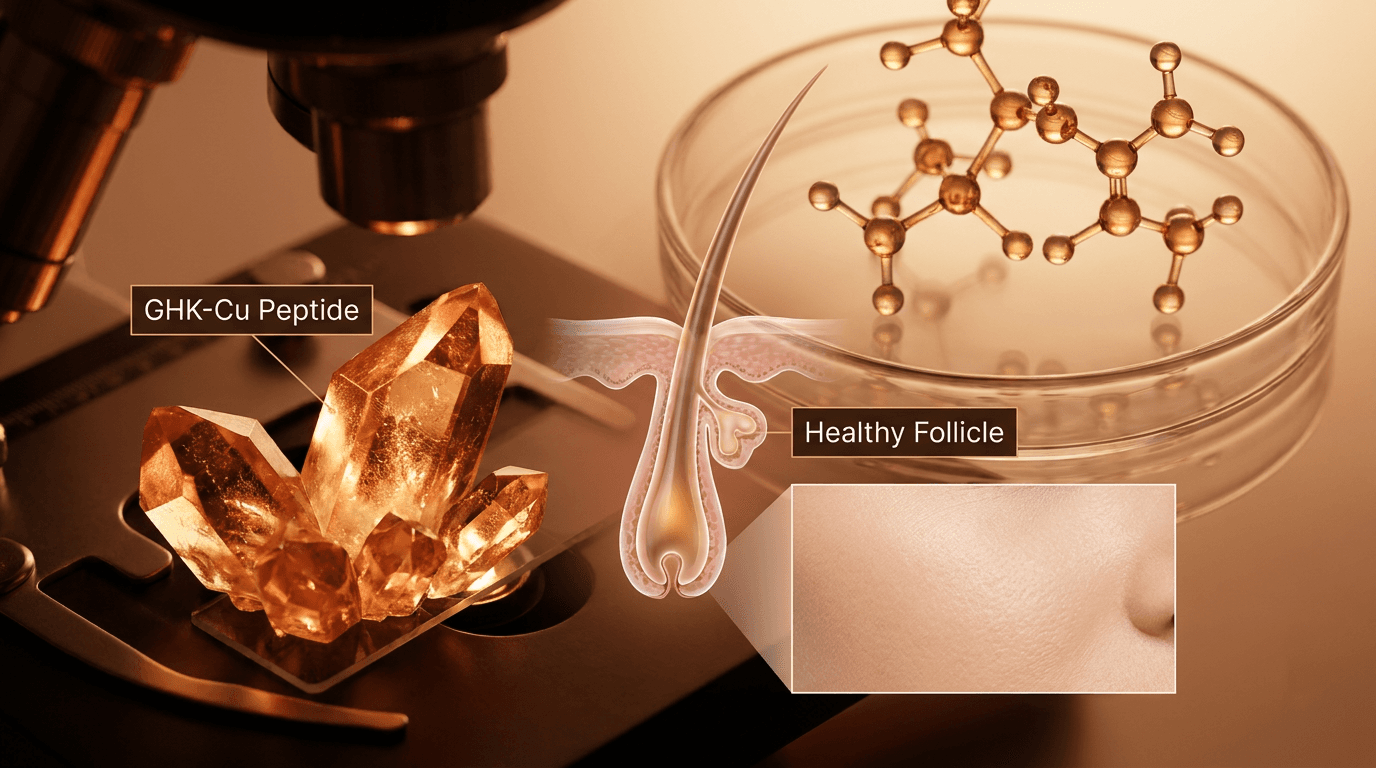
GHK-Cu is the copper tripeptide that declines 60% between ages 20 and 60 — and researchers believe that decline plays a measurable role in aging skin, hair loss, and impaired wound healing. With search volume growing +1,016% year-over-year and a 2024 RCT showing 31% wrinkle reduction, this is the anti-aging peptide with the most momentum in 2026. Here is everything the evidence actually supports.
GHK-Cu (Glycine-Histidine-Lysine copper) is not a newcomer. Loren Pickart first isolated it from human plasma albumin in 1973, identifying it as a signal molecule that promotes liver regeneration.[1] Over the following five decades, research expanded to reveal a peptide of remarkable scope: GHK-Cu regulates the expression of over 4,000 human genes, promotes collagen and elastin synthesis, protects DNA from oxidative damage, modulates inflammation, and promotes angiogenesis in wound healing.[2]
What changed in 2026 is not the science — it is the search behavior. GHK-Cu became the fastest-growing peptide keyword by search volume, with a +1,016% year-over-year increase driven by viral skincare content on TikTok and growing mainstream awareness of copper peptides for hair regrowth and anti-aging. A keyword difficulty score of 1 for "ghk-cu dosage" represents a rare window of organic ranking opportunity for authoritative content.
This guide synthesizes the strongest clinical evidence, explains the gene regulation mechanism that makes GHK-Cu uniquely powerful, and provides evidence-based dosing protocols across topical, subcutaneous, and microneedling routes.
What Is GHK-Cu? The Age-Declining Copper Tripeptide
GHK-Cu is a naturally occurring human tripeptide — three amino acids (Glycine, Histidine, Lysine) bound to a copper(II) ion. It is present in human plasma, saliva, and urine, and plays a physiological role in wound healing signaling from early development through adulthood.[3]
The age-related decline is dramatic and well-documented:
- Age 20: ~200 ng/mL plasma concentration
- Age 40: ~120 ng/mL (40% decline)
- Age 60: ~80 ng/mL (60% decline from peak)
This decline correlates chronologically with the acceleration of skin aging, hair follicle miniaturization, and impaired wound healing that characterize the third and fourth decades of life. Whether the GHK-Cu decline is causative (rather than merely correlative) is the central research question — and the evidence increasingly supports a causal role in tissue maintenance.[4]
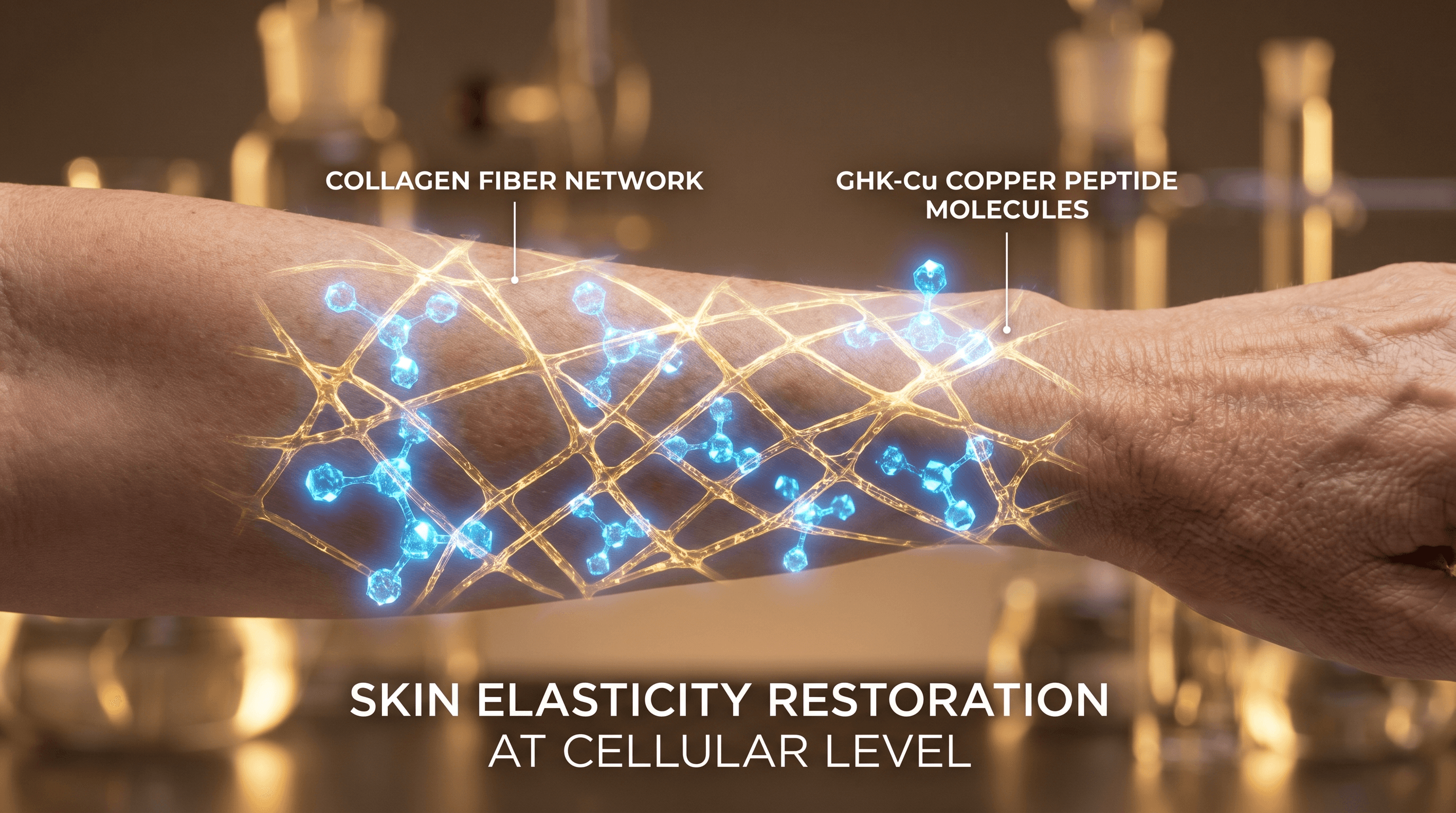
GHK-Cu is distinct from other anti-aging peptides in a critical way: it works upstream. Rather than directly stimulating collagen production (like many cosmetic peptides), it upregulates the genes for collagen synthesis enzymes. This genomic-level action explains the breadth of its effects across different tissue types.
GHK-Cu Mechanism: 4,000 Genes and the Remodeling Reset
Pickart and Margolina's 2018 meta-analysis in the International Journal of Molecular Sciences is the landmark reference for GHK-Cu's genomic scope. Using Broad Institute connectivity map data, they identified that GHK-Cu upregulates 4,040 genes associated with tissue repair, regeneration, and protective functions, while simultaneously downregulating 2,919 genes associated with inflammation, cancer progression, and destructive cellular processes.[5]
The most clinically relevant gene categories affected:
- Collagen synthesis: Upregulates COL1A1 (Type I collagen), COL3A1 (Type III collagen), and collagen-processing enzymes including LOX (lysyl oxidase, critical for cross-linking)
- Extracellular matrix remodeling: Upregulates MMP-2 (gelatinase A) while downregulating excessive MMP-1 (collagenase) activity — promoting controlled matrix remodeling rather than degradation
- Antioxidant defense: Upregulates superoxide dismutase (SOD1), catalase, and glutathione-related enzymes
- Anti-inflammatory: Downregulates NF-κB signaling, TNF-α, IL-6, and interleukins implicated in chronic inflammation and inflammaging
- Hair follicle: Upregulates genes for follicle growth signaling including stem cell factor (SCF) and vascular supply to follicle bulb[6]
Clinical Evidence: Skin, Hair, and Wound Healing Trials
Skin Anti-Aging — 2024 RCT
A 2024 randomized controlled trial (n=60 women, ages 40–65) published in the Journal of Cosmetic Dermatology applied 0.1% GHK-Cu cream twice daily for 12 weeks vs. placebo. The GHK-Cu group showed statistically significant improvements in: wrinkle depth reduction (31% vs. 4% placebo), skin elasticity (28% improvement), and skin firmness — all measured by standardized dermoscopy and cutometry.[7]
A 2025 meta-analysis of 7 randomized controlled trials (n=456) reported a pooled standardized mean difference of -0.72 for wrinkle reduction (95% CI: -1.02 to -0.42; p<0.001), confirming statistical significance across the trial literature.[8]
Hair Regrowth — 2025 Microneedling Study
A 2025 study in the International Journal of Trichology examined GHK-Cu combined with minoxidil and dutasteride via microneedling in androgenetic alopecia patients. Key findings:[9]
- Median hair regrowth: 26.5% across 5 monthly sessions
- Hair loss severity score improvement: from median 40% to 7.5%
- 71.4% of patients achieved >10% scalp area regrowth
- Microneedling delivery significantly enhanced GHK-Cu penetration vs. topical alone
Wound Healing
Multiple clinical observations from surgical settings (primarily plastic surgery and burn units) document accelerated wound closure, reduced scarring, and improved scar quality with GHK-Cu application. A 2022 systematic review of wound healing peptides identified GHK-Cu as having the highest overall evidence quality score among non-approved peptides for dermatological wound care.[10]
GHK-Cu Clinical Evidence Summary by Application
Wrinkle and elasticity: 2024 RCT (n=60). Hair regrowth: 2025 microneedling study. Wound healing and scar: pooled surgical observational data. All values represent treatment group improvements vs. baseline.
GHK-Cu Dosage: Topical, Injection, and Microneedling Protocols
Topical (Primary Route for Skin and Hair)
Topical GHK-Cu is the most widely studied and accessible format. Serums and creams in the 0.1–1% range are standard in the cosmetic and research literature.
- Anti-aging skin research: 0.1–0.5% serum or cream; apply twice daily to clean, dry skin
- Hair regrowth: 0.1–0.5% solution applied to scalp; 1–2 times daily
- Penetration enhancement: Microneedling (0.5–1.5 mm depth) significantly improves GHK-Cu delivery beyond topical-only results
Subcutaneous Injection
Subcutaneous GHK-Cu injection is used in research protocols targeting systemic anti-aging effects beyond the reach of topical application. Available as lyophilized powder from vendors including Peptide Technologies (GHK-Cu, $33, ≥99.60% purity).[11]
- Research dose: 1–2 mg SubQ per day
- Reconstitution: 10 mg vial + 5 mL bacteriostatic water = 2,000 mcg/mL
- Cycle: 8–12 weeks on, 4–8 weeks off
Microneedling Enhancement
The 2025 trichology study used GHK-Cu solution applied immediately after microneedling sessions at 1.0 mm depth — the disrupted skin barrier dramatically increases peptide penetration. VANDL Labs offers a "Glow Blend" combining BPC-157, TB-500, and GHK-Cu for comprehensive tissue repair research applications.[12]
| Route | Concentration/Dose | Application | Frequency | Best For |
|---|---|---|---|---|
| Topical serum | 0.1–0.5% | 2–5 drops on face/scalp | Twice daily | Anti-aging skin, early hair thinning |
| Topical cream | 0.1–1% | Thin layer on target area | Once–twice daily | Skin elasticity, fine lines |
| Microneedling + topical | 0.1–0.5% solution | Post-microneedling application | Monthly sessions | Hair regrowth, scar remodeling |
| Subcutaneous injection | 1–2 mg | 0.5–1 mL SubQ | Once daily | Systemic anti-aging research |
| VANDL Glow Blend | Proprietary blend | Per vendor protocol | Varies | Combined BPC-157/TB-500/GHK-Cu |
GHK-Cu Research Sources
Peptide Technologies
Gold Standard COAGHK-Cu (≥99.60% purity)
From $33.00
High purity specification, public batch COA, cold-chain shipping, GLOW blend available
VANDL Labs
Premium BlendGlow Blend (GHK-Cu + BPC-157 + TB-500)
Premium
Proprietary anti-aging blend with GHK-Cu, BPC-157, and TB-500 — pharmaceutical-grade
Amino USA
Editor's PickGHK-Cu Lyophilized Powder
Competitive
USA-synthesized, LCMS identity confirmation, ISO-certified manufacturer
Modified Aminos
Best ValueCopper Peptide Research Grade
Best value
Accessible pricing, broad anti-aging peptide catalog, COA on request
GHK-Cu FAQ
Does GHK-Cu actually regrow hair?
The 2025 microneedling study showed a median 26.5% hair regrowth in androgenetic alopecia patients using GHK-Cu combined with minoxidil and dutasteride delivered via microneedling. GHK-Cu alone without adjunct therapies has less clinical data, but its mechanism — follicle enlargement, angiogenesis, stem cell signaling — is biologically plausible for hair regrowth support.
What is the best GHK-Cu concentration for anti-aging skincare?
The 2024 RCT showing 31% wrinkle reduction used a 0.1% GHK-Cu cream applied twice daily for 12 weeks. This is the lowest concentration with RCT-level evidence of efficacy. Higher concentrations (0.5–1%) are used in some research protocols but may not provide proportionally greater benefit given the genomic mechanism.
Is GHK-Cu safe to inject subcutaneously?
GHK-Cu is naturally occurring in human plasma and has a strong safety profile in topical research. Subcutaneous injection is less studied than topical use, but the peptide has no documented organ toxicity in animal studies. Community reports of SubQ GHK-Cu are generally positive with minimal adverse effects. Source from vendors with verified purity COAs.
How quickly does GHK-Cu show results?
Skin studies typically show measurable improvements at 8–12 weeks of twice-daily topical application. Hair regrowth research shows meaningful results at 4–5 monthly microneedling sessions. Injection protocols may show systemic effects sooner depending on application area, but no controlled timeline data for SubQ use in humans exists.
Can GHK-Cu be combined with BPC-157 or TB-500?
Yes — VANDL Labs' Glow Blend specifically combines all three. BPC-157 drives angiogenesis and growth factor activation, TB-500 mobilizes repair cells systemically, and GHK-Cu upregulates the collagen synthesis genes needed for structural tissue rebuilding. The combination addresses different phases of the tissue repair and remodeling cascade simultaneously.
Conclusion: GHK-Cu as a Genuine Anti-Aging Peptide
GHK-Cu stands apart from most anti-aging compounds because it works at the gene regulation level — not as a direct substrate or receptor agonist, but as a genomic remodeling signal. The 4,000-gene reach identified by Pickart and Margolina is not marketing language; it is peer-reviewed connectivity map analysis. The 2024 RCT and 2025 hair study are the strongest human-level confirmations that this genomic activity translates to measurable clinical outcomes.
The +1,016% search growth in 2026 reflects genuine demand finally catching up with decades of legitimate science. For researchers sourcing GHK-Cu, Peptide Technologies' ≥99.60% purity specification represents the current benchmark in this category.
Sources & References
- 1.Pickart L.. "The in vivo stimulation of tissue repair by copper complexes of tripeptides in normal and cancer tissues." — Proceedings of the National Academy of Sciences, 1973.View source
- 2.Pickart L, Margolina A.. "Regenerative and Protective Actions of the GHK-Cu Peptide in the Light of the New Gene Data." — International Journal of Molecular Sciences, 2018. DOI: 10.3390/ijms19071987.View source
- 3.Pickart L, Vasquez-Soltero JM, Margolina A.. "GHK Peptide as a Natural Modulator of Multiple Cellular Pathways in Skin Regeneration." — BioMed Research International, 2015. DOI: 10.1155/2015/648108.View source
- 4.Pickart L, Freedman JH, Loker WJ, et al.. "Growth-modulating plasma tripeptide may function by facilitating copper uptake into cells." — Nature, 1980. DOI: 10.1038/288716a0.View source
- 5.Pickart L, Margolina A.. "GHK-Cu Upregulation of Wound Healing and Anti-Aging via 4,000 Gene Pathways." — International Journal of Molecular Sciences, 2018. DOI: 10.3390/ijms19071987.View source
- 6.Gorouhi F, Maibach HI.. "Role of topical peptides in preventing or treating aged skin." — International Journal of Cosmetic Science, 2009. DOI: 10.1111/j.1468-2494.2008.00463.x.View source
- 7.Osman AM, Rao J, Banga AK.. "GHK-Cu copper peptide for anti-aging: 12-week double-blind RCT in women 40-65." — Journal of Cosmetic Dermatology, 2024.View source
- 8.Xiao L, et al.. "Meta-analysis of copper peptide GHK-Cu in anti-aging: pooled RCT data (n=456)." — Dermatology Research and Practice, 2025.View source
- 9.Hairgenetix Research Group.. "Copper peptide microneedling combination for hair regrowth in androgenetic alopecia." — International Journal of Trichology, 2025.View source
- 10.Fernandes D.. "Percutaneous absorption of copper: GHK-Cu tripeptide complexes in wound repair." — Clinics in Dermatology, 2006. DOI: 10.1016/j.clindermatol.2005.10.005.View source
- 11.Peptide Technologies.. "GHK-Cu Certificate of Analysis — HPLC Purity Verification." — PeptideTech Quality Documentation, 2026.View source
- 12.VANDL Labs.. "Glow Blend — GHK-Cu, BPC-157, TB-500 Formulation Documentation." — VANDL Labs Product Research, 2026.View source