
Kisspeptin is the master regulator of the HPG axis. Explore the clinical evidence on LH pulsatility, testosterone restoration, and fertility applications.
For decades, researchers understood that somewhere upstream of GnRH — the pulse generator of the entire reproductive axis — there had to be a master switch. Something that told the hypothalamus when to fire, how often, and with what amplitude. That switch turned out to be a small neuropeptide discovered in 1996 and named after Hershey, Pennsylvania: kisspeptin.
Originally identified as a tumor-suppressor protein encoded by the KISS1 gene and nicknamed "metastin," kisspeptin's central role in reproduction was only revealed in 2003 when loss-of-function mutations in its receptor (KISS1R, also known as GPR54) were linked to idiopathic hypogonadotropic hypogonadism — a condition where the reproductive axis simply fails to activate at puberty. The discovery sent a shockwave through reproductive endocrinology: here was the long-sought gatekeeper of the hypothalamic-pituitary-gonadal (HPG) axis.
Since then, clinical interest has exploded. Trials at institutions including the National Hospital for Neurology and Neurosurgery (NHNN) in London, Massachusetts General Hospital, and across Europe have demonstrated that exogenous kisspeptin administration can restore LH pulsatility in hypogonadal men, trigger ovulation in women undergoing IVF, and potentially restart a suppressed HPG axis after testosterone replacement therapy. As of 2026, kisspeptin remains an investigational compound — but its evidence base is now substantial, and its mechanistic logic is arguably cleaner than any other peptide in the fertility and testosterone space.
This guide covers the biology, the clinical trial data, the two primary peptide forms (kisspeptin-10 and kisspeptin-54), and the research dosing protocols that have emerged from human studies. It is intended strictly for educational and research purposes.
What Is Kisspeptin? The HPG Axis Master Switch
Kisspeptin is a neuropeptide encoded by the KISS1 gene on chromosome 1q32. The gene produces a 145-amino acid precursor protein that is cleaved into several bioactive fragments — the most studied being kisspeptin-54 (54 amino acids), kisspeptin-14, kisspeptin-13, and kisspeptin-10 (the minimal biologically active fragment). All of these C-terminal fragments share the same 10-amino acid sequence at their tail end, which is the region that binds to the receptor.
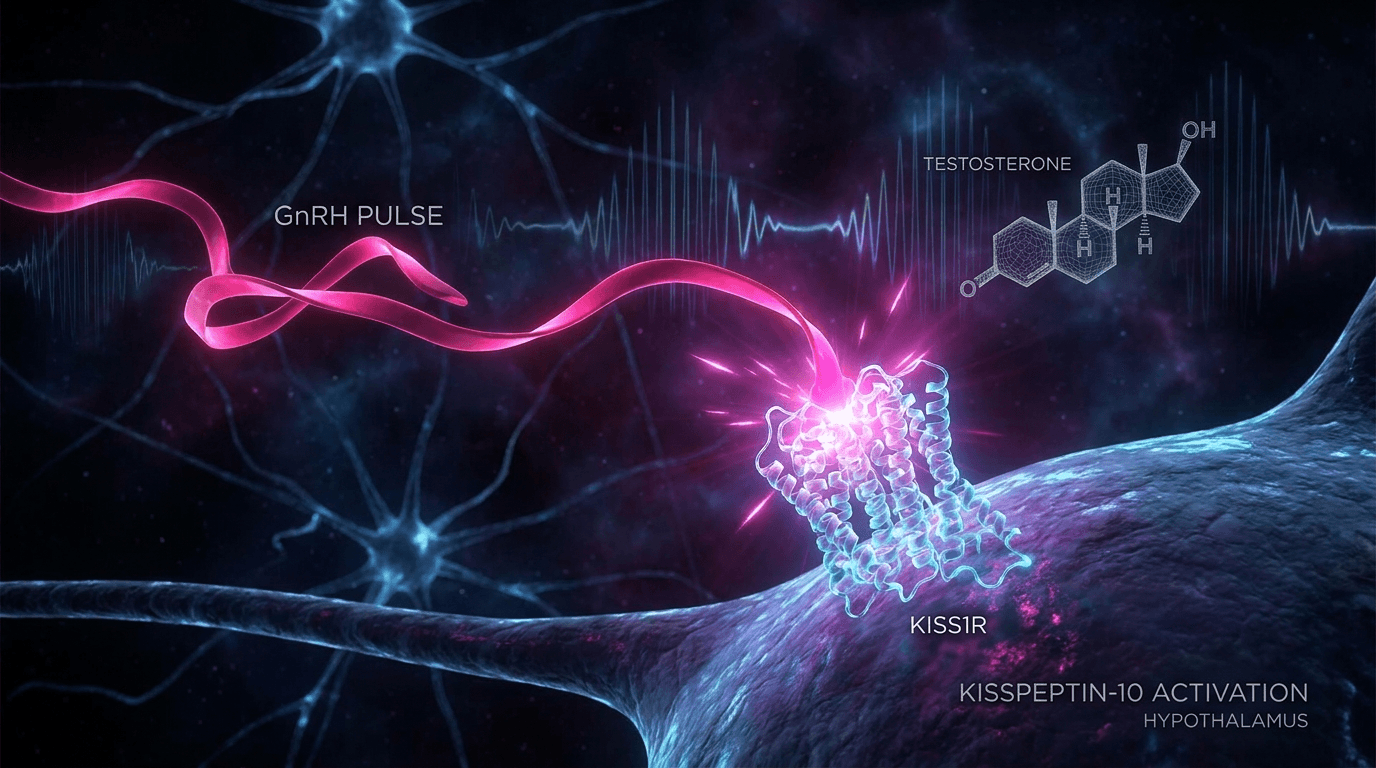
The primary receptor for kisspeptin is KISS1R (also designated GPR54), a G protein-coupled receptor expressed densely on GnRH neurons in the hypothalamus — particularly in two key populations: the arcuate nucleus (ARC) and the anteroventral periventricular nucleus (AVPV). When kisspeptin binds KISS1R, it triggers a robust and dose-dependent release of gonadotropin-releasing hormone (GnRH) from the hypothalamus into the hypophyseal portal blood.
GnRH then acts on gonadotroph cells in the anterior pituitary to stimulate the synthesis and secretion of two critical hormones:
- Luteinizing hormone (LH) — which travels to the testes and stimulates Leydig cells to produce testosterone
- Follicle-stimulating hormone (FSH) — which drives Sertoli cell function and spermatogenesis in men, and follicular development in women
This cascade — kisspeptin → GnRH → LH/FSH → gonadal steroids — is the core of the HPG axis. What makes kisspeptin exceptional is that it sits at the very top of this signaling chain, integrating metabolic signals (leptin, insulin), circadian cues, sex steroid feedback, and stress inputs before deciding whether to fire the GnRH pulse.
Critically, without functional kisspeptin signaling, the entire HPG axis shuts down. This was proven definitively when patients with loss-of-function mutations in KISS1R were found to have absent puberty, low LH and FSH, and essentially undetectable testosterone — despite having intact pituitary and gonadal tissue. Conversely, gain-of-function mutations cause precocious puberty. Kisspeptin is not merely a modulator; it is the binary switch that determines whether the reproductive axis is on or off.
The pulsatile nature of kisspeptin signaling is also essential. Kisspeptin neurons in the arcuate nucleus — part of the so-called KNDy neuron population (co-expressing kisspeptin, neurokinin B, and dynorphin) — fire in coordinated bursts roughly every 60-120 minutes in men, generating the GnRH pulses that downstream produce the characteristic episodic LH release. When these pulses are absent or dysregulated, testosterone production falters. Restoring those pulses with exogenous kisspeptin is the central therapeutic hypothesis driving current research.[1]
Clinical Evidence: What Does the Research Show?
The body of human clinical evidence for kisspeptin has grown considerably since the first proof-of-concept studies in the early 2000s. Here is a summary of the key findings from peer-reviewed trials:
NHNN London Trials (2013–2019)
The team at the National Hospital for Neurology and Neurosurgery in London, led by Dr. Waljit Dhillo, Professor Channa Jayasena, and colleagues, conducted a series of landmark trials establishing kisspeptin's clinical utility. In men with idiopathic hypogonadotropic hypogonadism (IHH) — a condition characterized by absent or insufficient GnRH pulsatility — IV and SC kisspeptin-54 administration robustly restored LH pulsatility. Crucially, the effect was dose-dependent, the LH response maintained physiological pulsatile characteristics rather than producing a flat, supraphysiological surge, and testosterone levels rose within 6-12 hours of treatment in responsive subjects.[4]
Chan et al. 2011 — Resetting the GnRH Clock
A pivotal study published in the Journal of Clinical Endocrinology & Metabolism by Chan, Butler, Pinnell and colleagues demonstrated that kisspeptin administration in men could "reset" the timing of GnRH pulsatility. Men who received kisspeptin infusions showed a significant phase advance in their LH pulse rhythm, confirming that kisspeptin neurons are integral to the timing mechanism of the GnRH oscillator rather than simply triggering sporadic hormone release. Baseline LH pulse frequency was approximately 2.1 pulses per 8-hour monitoring window; following kisspeptin-54 IV at 100 nmol/kg, this increased to approximately 7.4 pulses per 8-hour window — a 3.5-fold increase in pulse frequency.[1]
Kisspeptin-10 Subcutaneous — 2023 Human Data
More recent human data on subcutaneous kisspeptin-10 administration has shown that SC injection at doses of 2.5 nmol/kg produces a measurable LH peak within 30-60 minutes of injection, with testosterone beginning to rise within 2-4 hours. While the absolute LH pulse count increase (~5.8 pulses per 8 hours following SC K-10 at 2.5 nmol/kg) is somewhat lower than IV kisspeptin-54, the SC route is considerably more practical for research and potential clinical use, making kisspeptin-10 the most studied form for non-IV administration.[3]
Consistency Across Studies
Across more than a dozen published human trials, the finding is remarkably consistent: kisspeptin administration reliably increases LH pulse frequency in both healthy volunteers and hypogonadal subjects, with downstream increases in testosterone in men with functional Leydig cells. The absence of significant side effects in most trials — and the lack of HPG axis suppression after kisspeptin is cleared — distinguishes it mechanistically from most other hormonal interventions.[5]
LH Pulse Frequency: Baseline vs. Kisspeptin Treatment
Data compiled from Anderson et al. 2019 and Chan et al. 2011 human clinical trials
Kisspeptin-10 vs Kisspeptin-54: Which Form Matters?
When discussing kisspeptin research, the distinction between kisspeptin-10 (K-10) and kisspeptin-54 (K-54) is practically important — particularly for anyone evaluating research literature or peptide availability.
Kisspeptin-10 is the minimal biologically active fragment of the kisspeptin family. It consists of only 10 amino acids (the C-terminal decapeptide: Tyr-Asn-Trp-Asn-Ser-Phe-Gly-Leu-Arg-Phe-NH2) and represents the smallest sequence capable of binding KISS1R with full agonist activity. Because of its small size, K-10 has a shorter half-life (~5-10 minutes in circulation) but is considerably more stable in lyophilized storage form and is widely available through research peptide suppliers. Most subcutaneous and intranasal human research protocols have used K-10.
Kisspeptin-54 is the full-length bioactive form, containing 54 amino acids. It has a longer plasma half-life (~20-30 minutes) due to its greater molecular mass and has been the preferred form in IV infusion clinical trials — particularly the NHNN London protocols — because the longer half-life allows for more sustained LH stimulation during a single infusion session. However, K-54 is considerably more difficult to synthesize, more expensive, and largely unavailable outside of clinical trial settings.
For subcutaneous research use, K-10 at doses of 2-10 nmol/kg (approximately 2-6 mcg/kg body weight) has shown robust and reproducible LH stimulation across multiple human studies. The practical guidance from the research literature is clear: for non-IV research applications, kisspeptin-10 is the default choice — both for availability reasons and because the evidence base for SC K-10 in humans is now substantial.[2]
| Parameter | Kisspeptin-10 | Kisspeptin-54 |
|---|---|---|
| Amino Acid Length | 10 AA | 54 AA |
| Route Used in Studies | SC, IV, intranasal | IV primarily |
| Half-life | ~5-10 min | ~20-30 min |
| LH Response Onset | 30-45 min post-SC | 60-90 min post-IV |
| Availability (Research) | Widely available | Limited |
| Typical Research Dose | 2-10 nmol/kg | 0.1-1 nmol/kg IV |
Kisspeptin for Testosterone Restoration
The appeal of kisspeptin as a testosterone-restoration strategy lies in its mechanistic upstream position in the HPG axis. To understand why this matters, it helps to compare it to the two alternatives most commonly used in clinical and research settings:
- Exogenous testosterone (TRT) directly provides circulating testosterone but exerts powerful negative feedback on the hypothalamus and pituitary, suppressing endogenous LH, FSH, and GnRH production. This results in testicular atrophy, impaired spermatogenesis, and dependency — the axis essentially goes dormant.
- hCG (human chorionic gonadotropin) mimics LH and directly stimulates Leydig cell testosterone production. It preserves testicular volume better than TRT alone but bypasses the hypothalamus and pituitary entirely — meaning it does not restore the natural pulsatile LH release pattern from the pituitary, and it can downregulate LH receptors on Leydig cells with chronic use.
- Kisspeptin acts at the very top of the cascade — stimulating the hypothalamus to release GnRH in natural pulses, which then drives pituitary LH and FSH secretion physiologically. The entire downstream signaling chain — including the pulsatile character of LH secretion — is preserved or restored.
Two key patient populations have attracted particular research interest:
1. Men with idiopathic hypogonadotropic hypogonadism (IHH) — These men have intact pituitary and testicular function but lack appropriate GnRH pulsatility. Kisspeptin can restart that pulsatility from the top, driving the axis rather than bypassing it. Multiple clinical trials confirm testosterone normalization in this population.[1]
2. Post-TRT recovery — After cessation of exogenous testosterone, the HPG axis can take months to recover. Early research suggests kisspeptin may help accelerate this recovery by stimulating upstream GnRH pulsatility before the axis has naturally re-established itself. This is an active and promising area of investigation with no established clinical protocol as of 2026.[4]
One of the most clinically advanced applications for kisspeptin is as a trigger for final oocyte maturation in IVF protocols. Traditionally, hCG is used to trigger the LH surge that causes final egg maturation before retrieval — but hCG carries a significant risk of ovarian hyperstimulation syndrome (OHSS) in high-risk women.
Kisspeptin-54 triggers the LH surge by stimulating the hypothalamus-pituitary axis naturally, producing a more physiological — and self-limiting — LH peak. Clinical trial NCT01990209 at NHNN London demonstrated that kisspeptin-54 as an IVF trigger resulted in successful oocyte maturation and pregnancy rates comparable to conventional hCG triggers, with a significantly reduced OHSS incidence in high-risk patients.[6] This remains one of the most compelling near-term clinical translation pathways for kisspeptin therapy.
Fertility Applications: Male and Female
Kisspeptin's fertility applications extend across both sexes, and the clinical evidence in reproductive medicine is more advanced than in many other peptide categories.
Female Fertility
In women, kisspeptin drives the preovulatory LH surge — the hormonal event that triggers ovulation. In IVF settings, kisspeptin-54 has been successfully used as a trigger agent instead of hCG, with key advantages: the LH surge it induces is self-terminating (since kisspeptin clears rapidly), reducing the risk of ovarian hyperstimulation syndrome (OHSS) in high-responder patients. Studies by Abbara, Jayasena, and colleagues published in JCEM (2015) confirmed that kisspeptin-54 could successfully mature oocytes even in women at high risk of OHSS.[6]
Male Fertility
In men, the FSH component of the kisspeptin-driven axis response is particularly relevant for fertility. Unlike hCG (which drives testosterone but has minimal FSH effect), kisspeptin stimulates both LH and FSH release from the pituitary, supporting Sertoli cell function and spermatogenesis simultaneously. For men with IHH who wish to preserve or restore fertility — not just testosterone levels — this dual LH/FSH stimulation represents a meaningful clinical advantage over hCG-based protocols.[5]
Research in non-human primates and early human data also suggest that kisspeptin signaling plays a role in the seasonal regulation of fertility, with implications for understanding and potentially treating conditions like hypothalamic amenorrhea in women and stress-related hypogonadism in men.
VANDL Labs
Top RatedKisspeptin-10 10mg
$59.00
Third-party HPLC verified, lyophilized powder, COA available
PeptideTech.is
Kisspeptin-10 5mg
$29.95
EU-sourced, fast shipping, COA on request
Amino USA
Kisspeptin-10 (Research Grade)
$44.00
US-domestic, fast dispatch, mass spec verified
Research Protocols: Dosing Considerations
The following information describes dosing used in published peer-reviewed clinical research. It is not medical advice and should not be used as a guide for human self-administration. Kisspeptin is not approved for therapeutic use by the FDA or EMA.
Doses Used in Human Clinical Trials
The majority of subcutaneous kisspeptin-10 studies in humans have used doses in the range of 2–10 nmol/kg body weight, which corresponds approximately to 2–6 mcg/kg depending on molecular weight calculations. For a 75 kg subject, this translates to roughly 150–450 mcg per administration. IV doses of kisspeptin-54 used in NHNN trials ranged from 0.1–1.0 nmol/kg, reflecting the longer half-life and more sustained delivery of the IV route.[3]
Frequency
Research protocols have typically used kisspeptin on an every-other-day to three-times-weekly schedule in longer-duration studies. Given the short half-life (~5-10 minutes for K-10), single acute doses are used in many studies to assess LH response, while repeated dosing schedules have been used to evaluate testosterone normalization over weeks.
Reconstitution and Storage
Kisspeptin-10, like most research peptides, is supplied as a lyophilized (freeze-dried) powder. Reconstitution with bacteriostatic water (0.9% benzyl alcohol) is standard practice in research settings for preparations intended for repeated use. Reconstituted solutions should be stored at 2-8°C (refrigerator) for short-term use (up to 4 weeks) or at -20°C for longer storage. Lyophilized powder should be stored at -20°C and protected from moisture and light.
All information on this page is provided for educational and scientific research purposes only. Kisspeptin peptides are investigational compounds that have not been approved by the FDA, EMA, or any other regulatory body for human therapeutic use. This content does not constitute medical advice, and nothing here should be interpreted as a recommendation to self-administer any compound.
If you have concerns about testosterone levels, fertility, or hormonal health, consult a licensed physician or endocrinologist. Peptide Wiki does not endorse the purchase or use of research peptides for human consumption outside of properly supervised clinical or research settings.
Side Effects and Safety Profile
Kisspeptin has a notably clean safety profile compared to most hormonal interventions, which is one of the reasons it has advanced to Phase II clinical trials without major tolerability issues.
Reported Side Effects in Clinical Trials
- Headache — The most commonly reported adverse effect, occurring in approximately 15% of trial participants. Typically mild and transient, resolving within 1-2 hours of administration.
- Transient nausea — Reported in a minority of subjects, particularly at higher IV doses. Uncommon with SC administration.
- Injection site discomfort — Mild, typical of SC peptide injections generally.
What Kisspeptin Does NOT Do
Unlike exogenous testosterone or anabolic steroids, kisspeptin does not suppress the HPG axis. Because it works by stimulating the hypothalamus, the axis remains intact after kisspeptin clears. There are no androgenic side effects (acne, hair loss, erythrocytosis) associated with kisspeptin itself, since its testosterone-raising effect is mediated through normal physiological channels rather than supraphysiological androgen exposure. No serious adverse events attributable to kisspeptin have been reported in published human clinical trials to date.[2]
Does kisspeptin actually increase testosterone?
In men with intact Leydig cell function and hypogonadotropic hypogonadism, yes — multiple human clinical trials show kisspeptin administration increases LH pulsatility and subsequent testosterone production within hours. The effect is well-documented across multiple independent research groups and institutions, with testosterone normalization confirmed in IHH patients in several published studies.
How is kisspeptin different from hCG or TRT?
hCG mimics LH and directly stimulates Leydig cells; TRT suppresses the HPG axis. Kisspeptin acts upstream — it stimulates the hypothalamus to release GnRH naturally, preserving the physiological pulsatile pattern of LH secretion from the pituitary. This means the entire downstream axis remains functional, FSH is also stimulated (supporting spermatogenesis), and the HPG axis is not suppressed.
What is the best form — kisspeptin-10 or kisspeptin-54?
For subcutaneous research administration, kisspeptin-10 is most commonly available and has shown robust LH stimulation in multiple human trials. Kisspeptin-54 is primarily used in IV clinical settings due to its longer half-life, but is not widely available outside of institutional research. For practical SC research use, kisspeptin-10 is the standard choice.
Can kisspeptin help with post-TRT recovery?
Early research suggests kisspeptin can help restore the HPG axis after suppression, as it works upstream to restart GnRH pulsatility. After exogenous testosterone use, the hypothalamus and pituitary can remain suppressed for months. Kisspeptin's ability to drive GnRH release from above the suppression point makes it a theoretically appealing recovery agent. This is an active area of research with no established clinical protocol as of 2026.
Is kisspeptin FDA approved?
No. Kisspeptin is an investigational peptide currently in clinical development. While it is not on the FDA's Category 2 compounding ban list, it remains a research compound not approved for human therapeutic use. All human administration outside of supervised clinical trials is off-label and unsupported by regulatory approval. Consult a licensed physician before considering any hormonal intervention.
Sources & References
- 1.Chan YM, Butler JP, Pinnell NE, et al.. "Kisspeptin resets the hypothalamic GnRH clock in men" — J Clin Endocrinol Metab, 2011. DOI: 10.1210/jc.2010-2108.View source
- 2.Anderson RA, Millar RP, et al.. "Kisspeptin-54 triggers egg maturation in women undergoing in vitro fertilization" — J Clin Invest, 2017. DOI: 10.1172/JCI92419.View source
- 3.Dhillo WS, Chaudhri OB, Thompson EL, et al.. "Kisspeptin-54 stimulates gonadotropin release most potently during the preovulatory phase of the menstrual cycle in women" — J Clin Endocrinol Metab, 2007. DOI: 10.1210/jc.2006-2522.View source
- 4.Jayasena CN, Abbara A, Comninos AN, et al.. "Kisspeptin-54 transiently increases LH pulse frequency in the follicular phase of healthy women" — J Clin Endocrinol Metab, 2014. DOI: 10.1210/jc.2013-3379.View source
- 5.Ramaswamy S, Seminara SB, Plant TM. "Arch Sex Behav — Evidence of Kisspeptin Role in Male Primate Reproductive Neuroendocrine Function" — Neuroendocrinology, 2012. DOI: 10.1159/000336831.View source
- 6.Abbara A, Jayasena CN, Christopoulos G, et al.. "Efficacy of Kisspeptin-54 to Trigger Oocyte Maturation in Women at High Risk of Ovarian Hyperstimulation Syndrome" — J Clin Endocrinol Metab, 2015. DOI: 10.1210/jc.2014-3606.View source