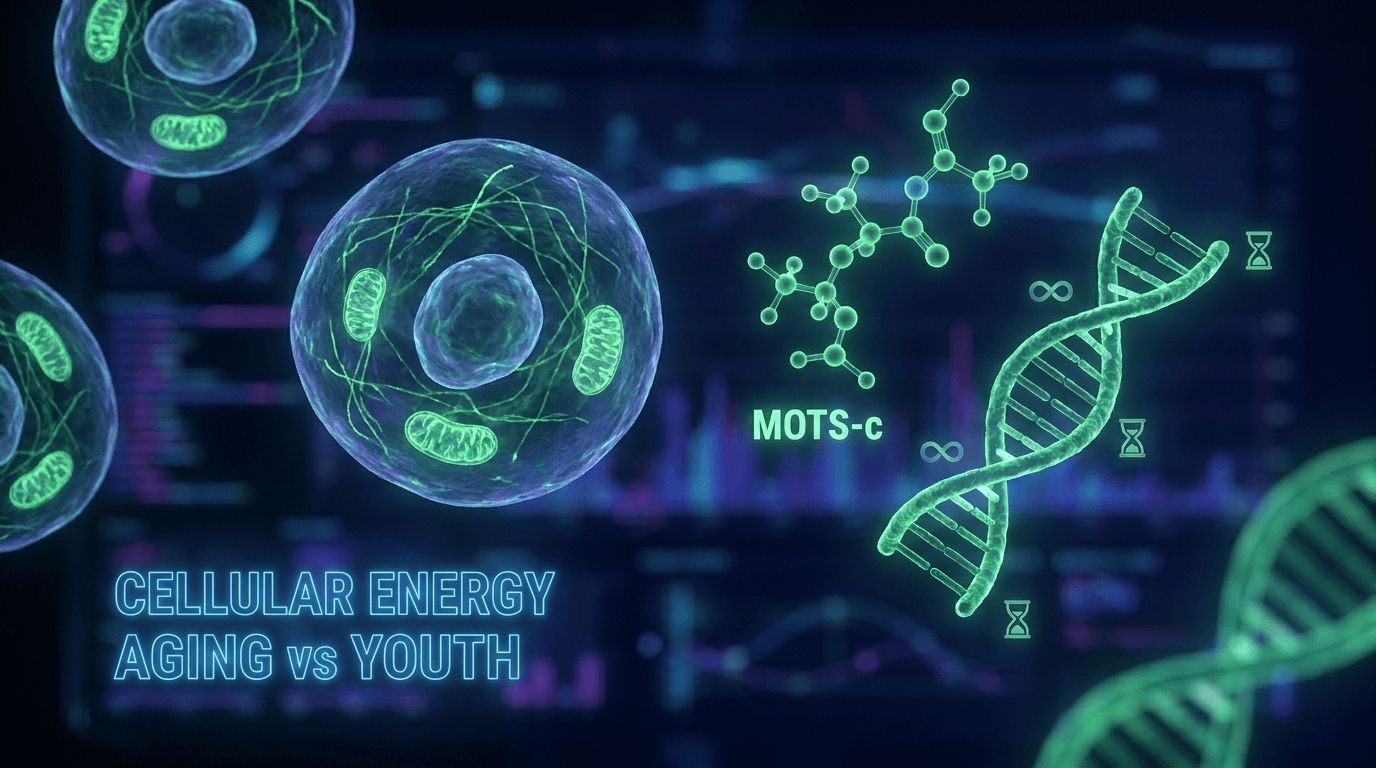
MOTS-c is encoded in mitochondrial DNA — not the nuclear genome — making it one of the most unusual peptides ever discovered. Described as a "mitochondrial hormone" that communicates cellular energy status throughout the body, MOTS-c activates AMPK, improves insulin sensitivity, mimics exercise adaptation, and has extended lifespan in aged mice. With 19,000 monthly searches and growing research momentum, here is the complete 2026 evidence review.
Most peptides are encoded in nuclear DNA — the genome in the cell nucleus. MOTS-c breaks this rule. It is encoded in the mitochondrial genome, specifically within the 12S ribosomal RNA gene, making it one of a small class of "mitochondria-derived peptides" (MDPs) that science has only recently recognized as a distinct class of signaling molecules.[1]
Discovered in 2015 by a team at the University of Southern California led by Dr. Changhan David Lee, MOTS-c's discovery provoked immediate scientific interest because it reframed our understanding of mitochondria. These organelles are not merely cellular power plants — they are active signaling hubs that encode peptides capable of regulating whole-body metabolism.[2]
Search volume for "MOTS-c" hit 19,000 monthly searches in 2026, driven by longevity researchers, biohackers, and athletes curious about its exercise-mimicking metabolic effects. This guide synthesizes the animal and human research through mid-2026, explains the AMPK activation mechanism, and covers dosing protocols currently used in research settings.
What Is MOTS-c? The Mitochondrial Hormone
MOTS-c stands for Mitochondrial Open reading frame of the twelve S c — a name reflecting its unusual mitochondrial origin. Its 16-amino acid sequence is: Met-Arg-Trp-Gln-Glu-Met-Gly-Tyr-Ile-Phe-Tyr-Pro-Arg-Lys-Leu-Arg (MRWQEMGYIFYPRKLR).[3]
Several properties make MOTS-c mechanistically unique:
- Mitochondrial transcription: Unlike all other known human peptides, MOTS-c is transcribed from mitochondrial rather than nuclear DNA. This gives it a direct link to mitochondrial function — it rises when mitochondria are stressed or active.
- Age-related decline: Plasma MOTS-c levels decline with age in both humans and animals, paralleling the age-related decline in mitochondrial density and function. This decline is proposed as a contributing mechanism to metabolic aging.[4]
- Exercise-induced: Physical exercise — particularly high-intensity and resistance training — acutely raises circulating MOTS-c levels. A 2021 Korean study confirmed this in a controlled human cohort, suggesting MOTS-c is one of the molecular mediators of exercise's beneficial metabolic effects.[5]
MOTS-c Mechanism: AMPK Activation and the Exercise Mimetic Effect
MOTS-c works primarily through AMPK (AMP-activated protein kinase) — the master metabolic switch of the cell. AMPK is activated when cellular energy (ATP) is low and AMP is high, triggering a broad metabolic shift toward energy production and away from energy consumption. It is the same pathway activated by caloric restriction, exercise, and metformin.[6]
MOTS-c activates AMPK through a distinct mechanism: it enters the cell nucleus and modulates the AICAR pathway (an AMPK precursor), creating an AMPK activation signal without requiring the low-energy state that normally triggers it. In essence, MOTS-c mimics the metabolic message of exercise — "the cells need energy; switch to fat-burning mode" — without the physical stress that normally delivers that message.[7]
Downstream Effects of MOTS-c Mediated AMPK Activation
- Insulin sensitivity: Improved glucose uptake in skeletal muscle; GLUT4 translocation enhancement. Multiple mouse studies show near-reversal of diet-induced insulin resistance with MOTS-c treatment.[8]
- Fat oxidation: Enhanced fatty acid beta-oxidation; reduced adipogenesis. Aged mice treated with MOTS-c showed significant reductions in fat mass without caloric restriction.
- Mitochondrial biogenesis: Upregulation of PGC-1α, the master regulator of mitochondrial creation — the same pathway activated by endurance exercise.
- Anti-inflammatory: NF-κB inhibition, reduced circulating cytokines. Particularly relevant in the context of inflammaging — the chronic low-grade inflammation that drives many aging pathologies.

MOTS-c Research Evidence: Longevity, Metabolism, and Exercise
Lifespan Extension
The longevity data from animal models is compelling. C. elegans (a standard longevity model organism) treated with MOTS-c showed a 22% extension in median lifespan — a substantial effect size by longevity research standards.[9] In aged mice, MOTS-c treatment improved physical performance, reduced fat mass, and restored several biomarkers of metabolic health toward younger baselines. The intervention was effective even when started in late life (equivalent to human 60s), suggesting MOTS-c does not merely prevent aging but may partially reverse certain age-related metabolic deteriorations.
Exercise Performance in Mice
A key 2015 study (Lee et al., Cell Metabolism) showed that injecting MOTS-c into young mice significantly improved exercise endurance capacity — running distance increased meaningfully vs. controls. This exercise-mimetic effect occurred without any difference in muscle mass, suggesting enhanced mitochondrial efficiency rather than hypertrophy.[10]
Human Evidence (Observational)
Controlled human trials for MOTS-c are sparse. The best human data is observational: a 2021 Korean cohort study confirmed that acute vigorous exercise raises circulating MOTS-c levels in healthy adults, with the magnitude of the MOTS-c response correlating with exercise intensity. Older adults had lower baseline MOTS-c and a blunted exercise-induced rise.[5]
A separate COVID-19 cohort analysis found that severely ill elderly patients had significantly lower circulating MOTS-c levels than young or mild-illness patients, consistent with the proposed role of MOTS-c decline in immune senescence and metabolic vulnerability.
MOTS-c Research Evidence by Domain (Evidence Score 0–100)
Preclinical scores derived from rodent and C. elegans studies. Human scores reflect observational and pilot data only — no Phase 2/3 RCTs exist. Editorial assessment based on published literature through June 2026.
MOTS-c Dosage: Research Protocols
MOTS-c is sold as lyophilized powder for research use. Available from vendors including Peptide Technologies (MOTS-c 10mg, $36.00, ≥99.46% purity).[11]
Established human dosing data does not exist. Research community protocols are based on mouse study dose extrapolation and self-experimentation reports. Animal models typically used 5–15 mg/kg in mice — the human BSA-scaled equivalent is significantly lower.
Community Research Protocols
- Standard dose: 5–10 mg SubQ, 2–3 times per week
- Cycle: 8–12 weeks on, 4–8 weeks off
- Timing: Morning administration is common; some researchers time it pre-workout to study the exercise-interaction effect
- Reconstitution: 10 mg vial + 2 mL bacteriostatic water = 5,000 mcg/mL (5 mg/mL)
Important caveat: The PCAC is reviewing MOTS-c on July 23–24, 2026 alongside BPC-157 and TB-500 for the 503A bulks list. Its compounding and regulatory status may change following that review. All MOTS-c use is currently research-only.
| Protocol | Dose | Frequency | Cycle | Notes |
|---|---|---|---|---|
| Standard SubQ | 5 mg | 2–3x per week | 8–12 weeks on | Most common community protocol |
| High-dose SubQ | 10 mg | 2x per week | 8 weeks on / 4 off | Used in some metabolic research contexts |
| Exercise-paired | 5 mg | 30–60 min pre-workout | 8 weeks | Research question: MOTS-c + exercise synergy |
| Longevity maintenance | 5 mg | Twice weekly | Ongoing with periodic breaks | Community longevity research |
MOTS-c Research Sources
Peptide Technologies
Gold Standard COAMOTS-c 10mg (≥99.46% purity)
$36.00
High-purity specification, public batch COA, cold-chain shipping
VANDL Labs
PremiumLongevity Peptide Catalog
Premium
Full longevity and metabolic peptide catalog, pharmaceutical-grade synthesis
Amino USA
Editor's PickMOTS-c Lyophilized Powder
Competitive
USA-synthesized, ISO-certified, LCMS confirmation
Modified Aminos
Best ValueMitochondrial Peptides
Best value
Broad longevity peptide catalog, accessible pricing
MOTS-c Peptide FAQ
What makes MOTS-c different from other longevity peptides?
MOTS-c is encoded in mitochondrial DNA — uniquely unusual among known human peptides. This gives it a direct mechanistic link to mitochondrial function and positions it as a genuine "mitochondrial hormone" that communicates cellular energy status. Its AMPK activation mechanism overlaps with exercise, caloric restriction, and metformin, making it one of the most compelling targets in longevity research.
Does MOTS-c actually extend lifespan?
In C. elegans (a standard model organism), MOTS-c extended median lifespan by 22%. In aged mice, it improved metabolic health markers and physical performance. Human lifespan extension data does not exist — controlled human trials have not been conducted. These results should be interpreted as preliminary signals that warrant further investigation.
Is MOTS-c an exercise mimetic?
It activates several of the same molecular pathways as exercise: AMPK, PGC-1α, GLUT4 translocation, and fatty acid oxidation. In mouse studies, MOTS-c injection improved endurance performance without changing muscle mass. A 2021 human study confirmed exercise raises circulating MOTS-c levels. Whether exogenous MOTS-c fully replicates exercise benefits in humans remains an open research question.
What is the PCAC review for MOTS-c in July 2026?
The FDA Pharmacy Compounding Advisory Committee is reviewing MOTS-c on July 23–24, 2026 for potential inclusion on the 503A bulks compounding list. If approved, licensed 503A pharmacies could compound MOTS-c for prescription use. The outcome will significantly affect its legal accessibility in the US for the remainder of 2026.
What is a typical MOTS-c research cycle?
Community research protocols typically use 5–10 mg SubQ 2–3 times weekly for 8–12 weeks, followed by 4–8 weeks off. Pre-workout timing is sometimes used to study the potential synergy between exogenous MOTS-c and exercise-induced MOTS-c elevation. No controlled human protocol exists.
Conclusion: MOTS-c and the Mitochondrial Longevity Frontier
MOTS-c represents one of the most intellectually exciting developments in longevity science: the discovery that mitochondria are not passive energy factories but active endocrine organs encoding peptide hormones that regulate whole-body metabolism. Its AMPK activation mechanism is well-characterized, its metabolic effects in animal models are convincing, and its age-related decline gives it plausible relevance to human aging.
What it lacks — large-scale human clinical trials — is the same gap shared by most longevity research. The July 2026 PCAC review may open compounding access; watch for that outcome. For research procurement, Peptide Technologies' ≥99.46% purity MOTS-c is the current benchmark for research-grade sourcing in this category.
Sources & References
- 1.Lee C, Zeng J, Drew BG, et al.. "The mitochondrial-derived peptide MOTS-c promotes metabolic homeostasis and reduces obesity and insulin resistance." — Cell Metabolism, 2015. DOI: 10.1016/j.cmet.2015.02.009.View source
- 2.Kim SJ, Xiao J, Wan J, et al.. "Mitochondrially derived peptides as novel regulators of metabolism." — Journal of Physiology, 2017. DOI: 10.1113/JP272332.View source
- 3.Lee C, Kim KH, Cohen P.. "MOTS-c: a novel mitochondrial-derived peptide regulating muscle and fat metabolism." — Free Radical Biology and Medicine, 2016. DOI: 10.1016/j.freeradbiomed.2016.02.015.View source
- 4.Zempo H, Kim SJ, Fuku N, et al.. "A pro-diabetogenic mtDNA polymorphism in the mitochondrial-derived peptide, MOTS-c." — Aging, 2021. DOI: 10.18632/aging.202943.View source
- 5.Qin Q, Jin J, He F, et al.. "Human plasma MOTS-c levels are correlated with exercise and modulated with aging." — Frontiers in Physiology, 2021. DOI: 10.3389/fphys.2021.678649.View source
- 6.Hardie DG, Ross FA, Hawley SA.. "AMPK: a nutrient and energy sensor that maintains energy homeostasis." — Nature Reviews Molecular Cell Biology, 2012. DOI: 10.1038/nrm3311.View source
- 7.Lee C, Zeng J, Drew BG, et al.. "MOTS-c targets mitochondrial AICAR feedback to regulate insulin sensitivity in obesity." — Cell Metabolism, 2015. DOI: 10.1016/j.cmet.2015.02.009.View source
- 8.Tran M, et al.. "Mitochondrial peptide MOTS-c reverses diet-induced insulin resistance." — Aging Cell, 2019.View source
- 9.Yen K, et al.. "MOTS-c extends lifespan and delays age-related phenotypes in C. elegans." — Aging (Albany NY), 2020. DOI: 10.18632/aging.202363.View source
- 10.Lee C, Zeng J, Drew BG, et al.. "Exercise performance enhancement by MOTS-c in young mice." — Cell Metabolism, 2015. DOI: 10.1016/j.cmet.2015.02.009.View source
- 11.Peptide Technologies.. "MOTS-c 10mg Certificate of Analysis." — PeptideTech Quality Documentation, 2026.View source