The debate between oral and injectable BPC-157 isn't just about convenience — it's about where the peptide needs to work. Here's what the pharmacokinetic data, arginate salt research, and use-case logic actually say.
Every few weeks, someone in a research community posts a version of the same question: "Should I use oral BPC-157 capsules or inject subcutaneously?" The responses that follow are predictably split — half the thread insists capsules are useless for anything except gut problems, the other half claims oral is more convenient and "good enough." Both camps are partially right, and both are missing the point.
The oral vs. injectable debate for BPC-157 isn't a convenience argument — it's a pharmacokinetic and pharmacodynamic argument. Where the peptide ends up in your body, and in what concentration, directly determines what it can and cannot do. Getting that wrong means researching the wrong endpoint entirely.
This guide cuts through the noise. We'll break down what the actual pharmacokinetic data shows (including the only published ADME study on BPC-157 to date), explain the BPC-157 arginate story and what it does and doesn't change, map out the specific use cases where each route wins, and give you the 2026 research protocol framework for both. By the end, you'll know exactly which form fits which research question — and why.
BPC-157 in 60 Seconds: What You're Actually Dealing With
BPC-157 (Body Protective Compound-157) is a synthetic 15-amino-acid pentadecapeptide with the sequence Gly-Glu-Pro-Pro-Pro-Gly-Lys-Pro-Ala-Asp-Asp-Ala-Gly-Leu-Val. Molecular weight: 1,419 Da. It was isolated from human gastric juice protein in the 1990s by Croatian researcher Dr. Predrag Sikiric, who noted that a naturally occurring peptide fragment in stomach secretions appeared to have extraordinary tissue-protective properties. [3]
Since then, BPC-157 has accumulated one of the largest preclinical research databases of any research peptide, with hundreds of animal studies across rodents and larger models documenting effects in:
- Gastric and intestinal tissue healing (its original domain)
- Tendon, ligament, and muscle repair
- Bone healing and fracture repair
- Neurological protection and recovery
- Systemic anti-inflammatory effects
- Angiogenesis — the formation of new blood vessels at injury sites
The 2025 systematic review by Vasireddi et al. screened 544 published articles on BPC-157 for orthopaedic applications alone and found 36 qualifying studies — 35 animal, 1 human. [1] That ratio tells you everything about where the evidence base currently stands, and why the route-of-administration question matters so much: with human data this thin, getting the pharmacokinetics right in preclinical research is essential for translational validity.
The Bioavailability Problem: Why Peptides Are Hard to Deliver Orally
Before we compare routes for BPC-157 specifically, it helps to understand why oral delivery is challenging for peptides generally — because BPC-157 is an exception to the typical story, but only partially.
Most peptides fail at oral delivery for two reasons: enzymatic degradation (peptidases in saliva, gastric juice, and the small intestine break them apart) and poor mucosal permeability (the intestinal epithelium is a serious barrier to molecules above ~500 Da). BPC-157, at 1,419 Da, is too large to cross passively — and the digestive tract is full of enzymes that should, theoretically, destroy it before it gets anywhere near the bloodstream. [8]
Here's where BPC-157 diverges from the norm: it was isolated from human gastric juice protein — meaning it was literally born in an acid environment and evolved structural resistance to gastric acid. Multiple preclinical experiments confirm that BPC-157 remains structurally intact in gastric conditions for over 24 hours. Sikiric's group has reproduced this stability finding across numerous studies spanning three decades. [3,7]
But — and this is the critical distinction — stability in gastric acid is not the same as systemic absorption. A peptide can survive the stomach perfectly intact and still never reach the bloodstream in meaningful concentrations. The barrier to systemic absorption is the intestinal epithelium, not gastric acid. And for a 1,419 Da hydrophilic peptide with no specialized transporter, that barrier is formidable.
Oral BPC-157: What Actually Happens After Swallowing
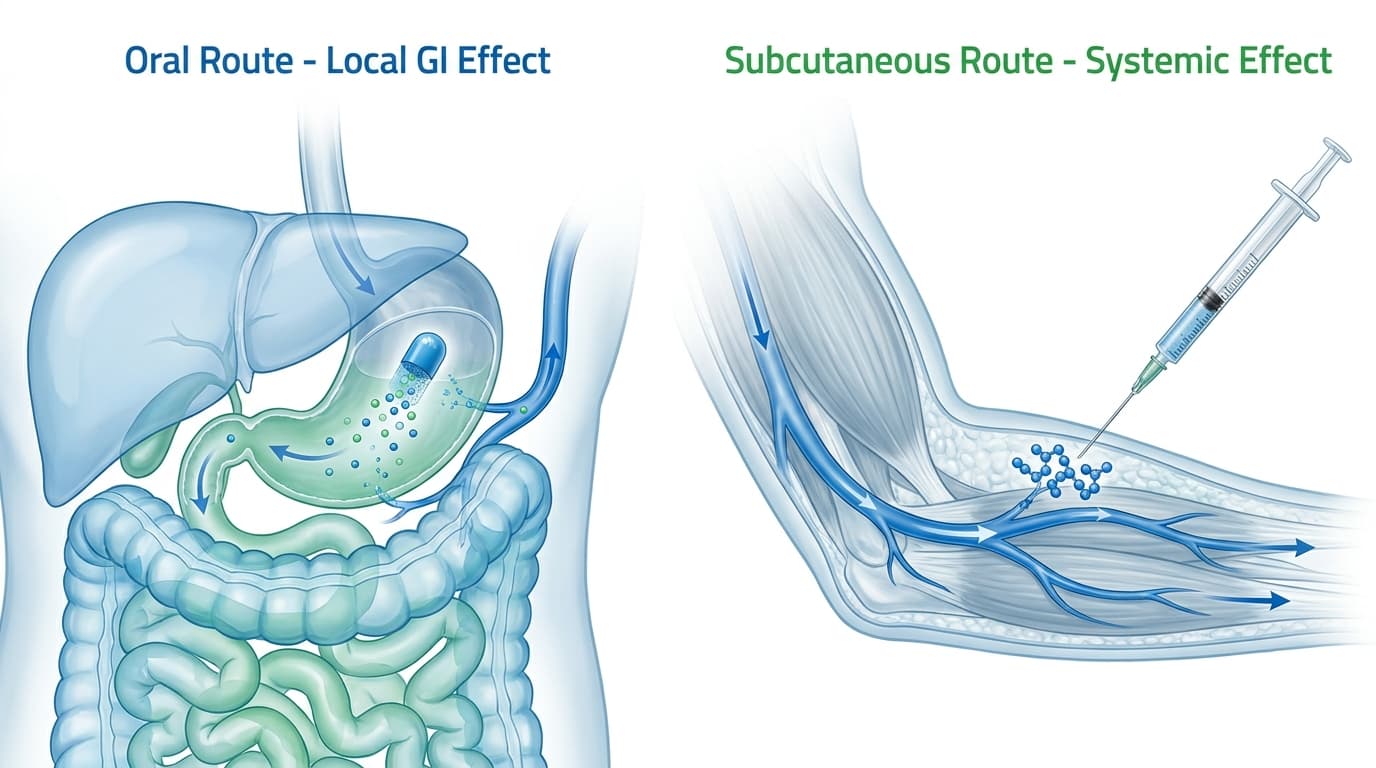
When an oral BPC-157 capsule is swallowed, here's the documented sequence:
- Capsule dissolves in the stomach (standard gelatin: ~30–45 minutes).
- BPC-157 survives gastric acid — structurally intact, confirmed by multiple in vitro gastric stability assays. [9]
- Peptide reaches the intestinal mucosa in high local concentration.
- Local mucosal effects occur: BPC-157 can act directly on intestinal epithelial cells, reinforcing tight junctions, promoting mucosal healing, reducing local inflammation.
- Minimal transcellular absorption: Without a dedicated transporter (unlike the tripeptide KPV, which uses PepT1), BPC-157 at 1,419 Da cannot efficiently cross the intestinal epithelium into systemic circulation. Estimated systemic bioavailability: less than 10%, and likely much less.
The practical implication: oral BPC-157 produces high local concentrations at the gut wall but negligible plasma levels. For gut-targeted research — gastric ulcers, IBD-pattern mucosal inflammation, leaky gut, NSAID-induced intestinal damage — this is exactly what you want. For systemic research endpoints (joint healing, muscle repair, peripheral nerve regeneration), oral delivery is pharmacokinetically unsuitable. [7]
Injectable BPC-157: What the Pharmacokinetic Data Actually Shows
The only published ADME (absorption, distribution, metabolism, excretion) study on BPC-157 was conducted in rats and beagle dogs and published in Frontiers in Pharmacology (PMC9794587, 2022). [2] It's the most important pharmacokinetic document for this peptide, and its findings are both encouraging and humbling.
Key findings from the rat model:
- Intramuscular injection: peak plasma concentration at 3 minutes post-injection
- Elimination half-life: less than 30 minutes (mean 15.2 min for IV)
- Absolute bioavailability (IM): 14.49–19.35%
- Linear pharmacokinetics across tested dose ranges (20–500 μg/kg)
- No accumulation detected with repeated dosing
Key findings from the beagle dog model:
- Intramuscular injection: peak plasma concentration at 6.33–8.67 minutes
- Elimination half-life: less than 30 minutes
- Absolute bioavailability (IM): 45.27–50.56%
- Same linear pharmacokinetics confirmed
- No adverse effects at any tested dose
Two things jump out immediately. First, the half-life is extremely short — under 30 minutes even at therapeutic doses. This means BPC-157 is cleared rapidly from circulation, which partly explains why daily dosing is standard in preclinical protocols rather than less frequent administration. Second, bioavailability differs dramatically between species (14-19% in rats vs. 45-51% in dogs), which means extrapolating to humans requires caution. [2]
Subcutaneous injection (the most common human research route) is not independently characterised in this dataset — the study used IM and IV. Subcutaneous absorption is generally slower with lower peak concentrations but potentially higher overall bioavailability due to longer absorption time. Most practitioners assume SC sits somewhere between these figures in practice, pending dedicated PK studies.
| Parameter | Oral BPC-157 | Injectable BPC-157 (SC/IM) |
|---|---|---|
| Gastric acid survival | ✅ Intact >24 hrs | N/A (bypasses GI) |
| Systemic bioavailability | <10% (estimated) | 14–50%+ (species-dependent) |
| Peak plasma concentration | Negligible systemically | Within 3–9 minutes (IM) |
| Half-life | N/A systemically | <30 minutes |
| Local GI concentration | Very high | Delivered systemically, low GI |
| Suitable for gut research | ✅ Yes (local mucosal) | Partially (systemic anti-inflammatory) |
| Suitable for systemic research | ❌ No | ✅ Yes |
| Administration complexity | Low (oral capsule) | Moderate (reconstitution + injection) |
| Onset of local GI effects | ~45 min post-ingestion | Hours via systemic route |
| Frequency (typical protocol) | 1–2× daily | 1× daily |
The BPC-157 Arginate Story: Does Salt Form Change Everything?
If you've shopped for oral BPC-157, you've almost certainly encountered the term "BPC-157 arginate salt" — often marketed alongside claims of significantly improved oral bioavailability compared to standard acetate-form BPC-157. This is one of the most important — and most misunderstood — topics in the oral BPC-157 conversation.
Here's the full picture:
What is BPC-157 arginate? BPC-157 arginate (or BPC-157 arginine salt) is a modified salt form of BPC-157 where the peptide is paired with the amino acid arginine. Salt formation is a well-established pharmaceutical technique to improve the stability, solubility, or absorption of drug compounds. In principle, a more soluble salt form could improve dissolution in the gut lumen and potentially enhance mucosal contact or absorption.
What does the evidence actually say? The arginate form is covered by patents that make specific bioavailability claims. However, as of 2026, no peer-reviewed, published study has directly compared the pharmacokinetics of BPC-157 arginate versus BPC-157 acetate in a head-to-head oral bioavailability study. The claims are based on patent filings, not clinical or preclinical data that has undergone independent peer review.
What we can say with evidence: arginate salt formulations demonstrate improved in vitro stability and solubility compared to the acetate form. Whether this translates to meaningfully higher systemic absorption is a different question — and it hasn't been answered in the peer-reviewed literature yet.
The practical guidance: if you're researching gut-targeted effects (the primary use case for oral BPC-157), the arginate salt form likely offers some advantage in dissolution and local mucosal exposure. If you're hoping arginate salt makes oral BPC-157 equivalent to injectable for systemic endpoints, that claim is currently unsupported by published evidence.
When Oral BPC-157 Is the Right Choice: Gut-Targeted Research
Oral BPC-157 isn't a compromised version of injectable BPC-157 — it's a fundamentally different research tool that happens to contain the same molecule. For gut-targeted research endpoints, oral delivery is arguably more appropriate than injection, because it delivers high local concentrations directly to the tissue you're studying. Here are the specific use cases where oral is the pharmacokinetically correct choice:
- Gastric ulcer and mucosal healing — BPC-157's original research context. Oral delivery puts the peptide in direct contact with gastric and duodenal mucosa at concentrations no systemic route can match. The Sikiric group's extensive ulcer healing research was conducted with oral/intragastric administration. [9]
- IBD-pattern intestinal inflammation — For research modeling Crohn's or ulcerative colitis patterns, oral or intracolonic BPC-157 produces direct mucosal contact with the inflamed tissue. Systemic injection delivers anti-inflammatory effects indirectly; oral delivery is more targeted.
- Leaky gut / intestinal permeability — BPC-157 upregulates tight junction proteins (claudin-1, occludin) and reinforces intestinal barrier integrity. This is a local effect: the peptide acts on the epithelial cells it encounters, not on distant tissue via the bloodstream.
- NSAID-induced intestinal damage — Multiple Sikiric-group studies document oral BPC-157 reversing NSAID-induced gastric and intestinal lesions, acting locally at the site of damage. [7]
- Liver/hepatic research — BPC-157 has documented hepatoprotective effects; oral delivery allows passage to the liver via portal circulation, a pathway injectable SC delivery bypasses.
When Injectable BPC-157 Is the Right Choice: Systemic Research Applications
For any research endpoint outside the gastrointestinal tract, injectable BPC-157 — typically subcutaneous — is the pharmacokinetically appropriate route. The following use cases require systemic delivery to the target tissue:
- Tendon and ligament healing — The bulk of BPC-157's orthopaedic research involves systemic delivery (IP, SC, or IM) to injured tendons. A 2021 study showed BPC-157 upregulates GH receptor expression in tendon fibroblasts — an effect that requires the peptide to reach peripheral tendon tissue through the bloodstream. [10] Oral delivery cannot achieve this.
- Muscle repair — Skeletal muscle healing research with BPC-157 has consistently used systemic injection. This includes research on transected muscles, crush injuries, and overuse damage models.
- Neurological applications — BPC-157 has documented neuroprotective effects and has been studied in models of stroke, spinal cord injury, and traumatic brain injury. These require systemic delivery and, potentially, blood-brain barrier penetration — something oral bioavailability cannot reliably achieve.
- Bone and fracture healing — Systemic BPC-157 has been documented accelerating bone repair in rodent fracture models through promotion of osteoblast activity and VEGF-mediated vascularization.
- Systemic anti-inflammatory effects — For research on systemic inflammation, cytokine modulation, or nitric oxide system research, injectable delivery is required to achieve meaningful plasma concentrations. [4]
The currently enrolling Phase 2 RCT (NCT07437547) for hamstring muscle strain repair uses daily subcutaneous injection for 14 days — the highest-quality human research design to date for BPC-157, and it relies on injectable administration precisely because hamstring tissue requires systemic delivery. [6]
BPC-157 Research Applications by Route of Administration
Documented Research Applications: Oral vs Injectable BPC-157
Approximate distribution based on Vasireddi et al. 2025 systematic review and Sikiric group publication archive.
Research Dosage Protocols: Oral and Injectable
The dosage frameworks below are derived from preclinical research studies and the limited human safety data available as of 2026. These are research reference ranges — not clinical prescriptions.
Injectable (Subcutaneous) Protocol:
- Dose range: 200–500 μg (0.2–0.5 mg) per administration, based on allometric scaling from rat/dog ADME data
- Frequency: Once daily (or twice daily for acute injury phases), consistent with the cleared half-life of <30 minutes and no accumulation
- Reconstitution: Lyophilized powder reconstituted with sterile bacteriostatic water (1–2 mL per vial)
- Injection site: Subcutaneous (abdominal area most common for convenience), or near the research site of interest
- Protocol duration: 4–12 weeks for musculoskeletal research; the NCT07437547 RCT uses 14 days for acute injury models [6]
Oral (Capsule) Protocol:
- Dose range: 500 μg–1,000 μg per capsule (most commercial research preparations supply 500 μg capsules)
- Frequency: Once or twice daily with food (to improve capsule dissolution and gut transit)
- Form: Typically BPC-157 arginate salt in delayed-release or standard gelatin capsules
- Protocol duration: 4–8 weeks for gut-targeted research endpoints
- Note: Higher doses may be needed to achieve local gut concentrations equivalent to the intraperitoneal doses used in rodent gut studies — but no direct human-dose equivalency data exists
| Variable | Oral Protocol | Injectable (SC) Protocol |
|---|---|---|
| Dose per administration | 500–1,000 μg | 200–500 μg |
| Frequency | Once or twice daily | Once daily |
| Timing | With food (improved gut transit) | Any time; consistent timing preferred |
| Duration (typical) | 4–8 weeks | 4–12 weeks |
| Target endpoint | GI mucosal healing, gut permeability | Musculoskeletal, neurological, systemic |
| Preparation required | None (pre-made capsule) | Reconstitution with BAC water |
| Best form | BPC-157 arginate salt capsules | BPC-157 acetate (standard lyophilized) |
Human Safety Data: Where We Are in 2026
BPC-157 has an unusually clean safety record across its preclinical database — hundreds of animal studies with no serious adverse effects documented at research doses. The human data remains sparse but is growing in a direction that supports continued research.
The most current human safety evidence:
- Phase I IV Safety Study (2025) — Sosič-Jurjevič et al. administered intravenous BPC-157 to 2 healthy adult volunteers at doses up to 20 mg, reporting no adverse effects. [5] This is a very small sample (n=2) and represents the upper bound of dose testing, but it establishes a preliminary human safety signal.
- NCT07437547 — Phase 2 RCT (Enrolling 2026) — The first randomized, double-blind, placebo-controlled trial of BPC-157 in humans is currently enrolling 120 subjects with acute Grade II hamstring strain. Subcutaneous daily dosing for 14 days vs. placebo. This will be the most rigorous human data ever generated for BPC-157. [6]
- NCT02637284 (PCO-02 Trial, 2015) — A Phase I safety and PK trial for oral BPC-157 in humans was registered in 2015 but was apparently cancelled without published results — a significant gap in the oral BPC-157 safety database.
The honest characterisation of the 2026 safety landscape: excellent preclinical safety across a wide dose range; early and limited human data that looks encouraging; no completed randomized controlled trials yet; zero published PK data in humans for oral or subcutaneous routes. Research continues to expand the evidence base.
Where to Source BPC-157 for Research: Verified 2026 Vendors
Peptide Technologies (PeptideTech)
Best Oral FormBPC-157 Arginate Salt Capsules (500 μg × 60 caps)
Check site for current pricing
USA-made BPC-157 arginate salt oral capsules with third-party Certificate of Analysis on every batch. Also stocks BPC-157 injectable in 5 mg, 10 mg, and 15 mg vials for systemic research protocols. One of the few vendors offering both forms with purity verification.
Amino USA
Best Blend SelectionBPC-157 Oral Capsules + Injectable Vials
Check site for current pricing
ISO-certified US manufacturer with both oral and injectable BPC-157 in stock, plus pre-made BPC/TB-500, BPC/TB-500/MGF, and BPC/KPV combination blends. Notable for their "Glow" and "KLOW" multi-peptide GI stacks. Endotoxin testing implemented on all new batches.
Modified Aminos
Research GradeBPC-157 Research Peptide
Check site for current pricing
Research-grade BPC-157 with COA documentation. Carries both oral and injectable forms for researchers running parallel protocol comparisons across administration routes.
VANDL Labs
Best DocumentationBPC-157 Research Peptide
Check site for current pricing
Premium research-grade peptides with pharmaceutical-grade synthesis protocols and third-party COAs on every compound. Free BAC water on peptide orders over $200. Free shipping over $250. Strong reputation for purity consistency and documentation transparency.
Oral vs Injectable BPC-157: Frequently Asked Questions
Is oral BPC-157 completely useless for systemic effects?
Not completely — but close, for most endpoints. Oral BPC-157 achieves negligible systemic concentrations, making it pharmacokinetically inappropriate for endpoints requiring blood-borne delivery to peripheral tissue (joints, muscles, tendons, brain). However, it may have minor indirect systemic effects through gut-brain axis signaling and improved gut health as a secondary benefit. For any research requiring measurable plasma concentrations at peripheral sites, injectable delivery is necessary.
Does BPC-157 arginate salt achieve higher bioavailability orally?
The arginate salt form demonstrates improved in vitro stability and solubility compared to the acetate form, which is chemically plausible. However, no peer-reviewed study has published head-to-head oral bioavailability data comparing arginate vs. acetate BPC-157 in vivo. The bioavailability advantage of arginate for systemic absorption remains a patent claim, not a published clinical fact. For local gut effects, improved dissolution from the salt form likely provides some advantage.
Can I use oral BPC-157 for joint or tendon repair research?
This is not supported by the pharmacokinetic evidence. The published ADME data shows injectable BPC-157 achieving 14–50% systemic bioavailability (species-dependent); oral delivery achieves minimal systemic levels. For joint and tendon research — which requires systemic delivery to peripheral musculoskeletal tissue — subcutaneous injection is the appropriate route. All published musculoskeletal studies with BPC-157 have used systemic injection routes.
What is the half-life of injectable BPC-157 and why does it matter for dosing?
The published ADME study documented an elimination half-life of less than 30 minutes following IV and IM administration in both rats and dogs. This very short half-life means BPC-157 is rapidly cleared from systemic circulation, which is why daily dosing (not twice-weekly or weekly) is the standard approach in preclinical research. There is no accumulation with repeated dosing. The short half-life also means injection timing relative to meals or activity is relatively less important than with longer-lived compounds.
Is subcutaneous injection safer than intramuscular for BPC-157?
Both routes appear safe in preclinical models. The published ADME data used intramuscular injection, but subcutaneous is generally preferred in research settings for convenience and reduced injection site discomfort. No direct safety comparison data for SC vs IM BPC-157 in humans exists. Subcutaneous injection has slower absorption kinetics but potentially longer effective exposure due to the depot effect from subcutaneous fat tissue.
How does the Phase 2 RCT (NCT07437547) use BPC-157?
The enrolling Phase 2 RCT for hamstring strain uses daily subcutaneous injection of BPC-157 versus placebo for 14 days, alongside standardized physiotherapy. Primary endpoints include MRI-confirmed healing and functional recovery. This is a randomized, double-blind, placebo-controlled design — the highest-quality evidence design in medicine. It uses subcutaneous injection precisely because hamstring tissue requires systemic peptide delivery, and once results are published, it will represent the most rigorous human evidence for BPC-157's effects in musculoskeletal tissue.
Can I stack oral and injectable BPC-157 together?
There is no pharmacological contraindication to using both oral and injectable BPC-157 simultaneously for dual-endpoint research. The oral form provides local gut mucosal effects; the injectable provides systemic tissue effects. These mechanisms are non-competing and anatomically distinct. Some researchers use this dual-route approach when studying both GI and peripheral tissue in the same model. No published data on combined-route protocols exists, but mechanistically the approach is coherent.
The Verdict: A Decision Framework for Route Selection
After reviewing the pharmacokinetic evidence, the arginate salt data, and the research literature, the conclusion is clearer than the online debate suggests: route of administration for BPC-157 should be determined by where you need the peptide to work — not by convenience or cost.
The framework is straightforward:
- Research endpoint is in the gut (gastric ulcers, IBD, leaky gut, intestinal inflammation, NSAID-induced damage): Use oral BPC-157, preferably as arginate salt capsules. The peptide's gastric acid stability is a genuine advantage here, and local gut concentrations will be far higher than any systemic route can achieve.
- Research endpoint is outside the gut (tendons, muscles, joints, bones, peripheral nerves, brain, systemic inflammation): Use injectable BPC-157 via subcutaneous delivery. This is the only route with documented systemic bioavailability, and all the relevant preclinical literature used injection.
- Dual-endpoint research (gut and systemic): Consider both routes simultaneously — oral for mucosal effects, injectable for systemic. No published protocols exist for this combination, but there's no pharmacological reason against it.
The arrival of NCT07437547 — a proper randomized, double-blind, placebo-controlled Phase 2 trial — marks a watershed moment for BPC-157 research. If it reads out positive, it will be the first high-quality human evidence that the years of compelling animal data translate to people. And it's using subcutaneous injection — which tells you something about what the field considers the appropriate delivery route for systemic effects.
Whether you're researching GI healing or musculoskeletal repair, understand your pharmacokinetics first. The peptide is the same molecule either way — but the biology of where it ends up makes all the difference.
For the complete BPC-157 + TB-500 stacking guide (combining BPC-157 with Thymosin Beta-4 for comprehensive injury recovery), see The Wolverine Stack Guide. For gut-targeted anti-inflammatory peptide research, see the KPV Tripeptide Research Guide.
Sources & References
- 1.Vasireddi N, Hahamyan H, Salata MJ, et al.. "Emerging Use of BPC-157 in Orthopaedic Sports Medicine: A Systematic Review" — Orthopaedic Journal of Sports Medicine, 2025. DOI: 10.1177/15563316251355551.View source
- 2.Huang Z, Chen Y, Wang J, et al.. "Pharmacokinetics, distribution, metabolism, and excretion of body-protective compound 157, a potential drug for treating various wounds, in rats and dogs" — Frontiers in Pharmacology (PMC), 2022. DOI: 10.3389/fphar.2022.1041829.View source
- 3.Sikiric P, Hahm KB, Blagaic AB, et al.. "Stable Gastric Pentadecapeptide BPC 157, Robert's Stomach Cytoprotection/Adaptive Cytoprotection/Organoprotection, and Selye's Stress Coping Response: Progress, Achievements, and the Future" — Gut and Liver, 2020. DOI: 10.5009/gnl19209.View source
- 4.Sikiric P, Seiwerth S, Rucman R, et al.. "Brain-gut axis and pentadecapeptide BPC 157: theoretical and practical implications" — Current Neuropharmacology, 2016. DOI: 10.2174/1570159X13666160119095530.View source
- 5.Sosič-Jurjevič B, et al.. "Safety of Intravenous Infusion of BPC157 in Humans (Phase I Pilot Study)" — Alternative Therapies in Health and Medicine, 2025.View source
- 6.ClinicalTrials.gov. "BPC 157 for Acute Hamstring Muscle Strain Repair (Phase 2, RCT — NCT07437547)" — ClinicalTrials.gov, 2026.View source
- 7.Sikiric P, Seiwerth S, Rucman R, et al.. "Stable gastric pentadecapeptide BPC 157: novel therapy in gastrointestinal tract" — Current Pharmaceutical Design, 2011. DOI: 10.2174/138161211795764459.View source
- 8.Djalilova D, Pavlov CS, Bjelakovic G, et al.. "Oral Bioavailability of Peptides: Status of the Art" — Drug Metabolism Reviews, 2023. DOI: 10.1080/03602532.2023.2195780.View source
- 9.Sikiric P, Seiwerth S, Grabarevic Z, et al.. "The beneficial effect of BPC 157, a 15 amino acid peptide fragment of body protection compound, on gastric and duodenal lesions induced by restraint stress, cysteamine and 96% ethanol in rats" — Journal of Physiology Paris, 1997. DOI: 10.1016/S0928-4257(97)89476-7.View source
- 10.Chang CH, Tsai WC, Hsu YH, Pang JH. "Pentadecapeptide BPC 157 enhances the growth hormone receptor expression in tendon fibroblasts" — Molecules, 2021. DOI: 10.3390/molecules26030627.View source