
Three hundred and fifty million people live with arthritis worldwide — yet the standard treatment toolkit of NSAIDs, steroids, and hyaluronic acid injections is essentially unchanged from 1990. Research peptides are offering something different: not symptomatic suppression, but targeted modulation of the inflammatory cascade and actual connective tissue repair. This is what the 2026 evidence actually shows about BPC-157, TB-500, KPV, and GHK-Cu for joint health.
Three hundred and fifty million people worldwide live with arthritis. In the United States alone, more than 58 million adults — roughly 1 in 4 — carry an arthritis diagnosis, making it the leading cause of work disability and one of the top drivers of quality-of-life loss in adults over 40. The economic toll exceeds $600 billion annually when medical costs and lost productivity are combined. [12]
Yet the treatment toolkit has barely evolved in thirty years. NSAIDs mask inflammation without addressing its molecular source. Corticosteroids are devastatingly effective at suppressing symptoms — and devastatingly damaging to cartilage and bone over time. Hyaluronic acid injections offer modest, temporary relief at best. Total joint replacement is transformative for severe cases but leaves a vast middle ground of patients with chronic, moderate joint pain and nowhere meaningful to go except the anti-inflammatory carousel.
Research peptides are offering something different. Not symptomatic suppression, but targeted modulation of the actual molecular machinery driving inflammation and tissue destruction — with evidence that they actively promote repair of the very cartilage, tendons, and synovial tissue that arthritis degrades. BPC-157, TB-500, KPV, and GHK-Cu are the four most researched compounds in this space. They are not FDA-approved therapies. The human evidence is thin. The preclinical data is, in some cases, remarkable — and the gap between the two defines the current state of the field.
This guide cuts through the noise: what these peptides actually do, what the science genuinely shows (including its limitations), and how a rational research approach might be structured. Every claim is cited.
The Biology of Joint Pain: Why Conventional Treatments Keep Missing the Target
To understand why research peptides are generating such intense interest in joint health, you first need to understand what's actually happening inside an arthritic joint — and why conventional drugs handle it so imperfectly.
Osteoarthritis (OA) — the most common form, affecting over 500 million people globally — is not simply "wear and tear." It's an active pathological process driven by dysregulated inflammation within the joint. When cartilage is damaged by injury, aging, obesity, or mechanical overload, chondrocytes — the cells that maintain cartilage — shift into a destructive inflammatory mode. They upregulate matrix metalloproteinases (MMP-1, MMP-3, MMP-13), enzymes that degrade the extracellular matrix scaffolding of cartilage. They release pro-inflammatory cytokines — IL-1β, TNF-α, IL-6 — that activate the synovial membrane, trigger joint swelling, and sensitize pain receptors. [6]
The central orchestrator of this cascade is nuclear factor kappa B (NF-κB), a transcription factor that controls the expression of over 200 inflammatory genes. When NF-κB becomes constitutively active — as it does in arthritic joints — cartilage destruction, synovial inflammation, and pain signals become self-sustaining even without new mechanical insults.
NSAIDs block COX enzymes downstream of NF-κB. They reduce prostaglandins and pain but don't touch the cytokine cascade destroying cartilage. Corticosteroids suppress NF-κB more broadly — which explains their dramatic effectiveness for acute flares — but they simultaneously suppress the anabolic signaling (collagen synthesis, chondrocyte repair functions) that cartilage needs to heal. Long-term steroid use accelerates the very bone loss and cartilage thinning they initially relieve.
This is the therapeutic gap that research peptides are attempting to fill: agents that modulate the inflammatory cascade selectively, promote genuine tissue repair signaling, and potentially interrupt the disease cycle rather than masking its output.
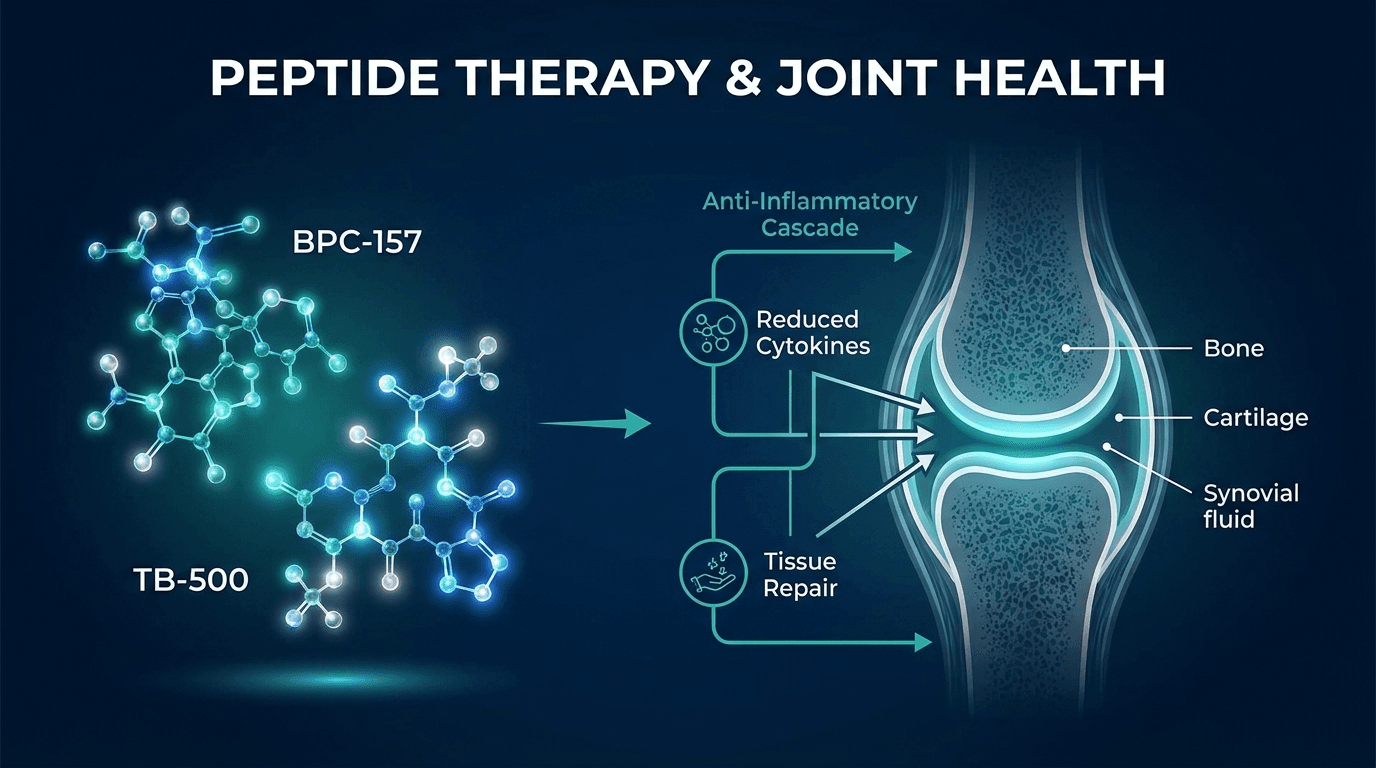
BPC-157: The Benchmark Research Peptide for Musculoskeletal Repair
Body Protective Compound-157 (BPC-157) is a synthetic 15-amino-acid peptide derived from a protective protein found in human gastric juice. It was first characterized by Croatian researcher Predrag Sikirić in the 1990s and has since become the most extensively studied research peptide in musculoskeletal medicine, with more than 500 publications in the preclinical literature. [2]
What BPC-157 actually does at the molecular level:
- VEGF upregulation: BPC-157 strongly promotes vascular endothelial growth factor expression, driving the formation of new blood vessels in damaged tissue. Arthritic and injured joints are often chronically underperfused — poor blood supply impairs healing. BPC-157's angiogenic effect directly addresses this bottleneck. [1]
- GH receptor sensitization: It upregulates growth hormone receptor expression on target cells, amplifying the body's own repair signaling without elevating systemic GH levels — a targeted way to enhance the local repair environment.
- eNOS and the nitric oxide system: BPC-157 activates endothelial nitric oxide synthase (eNOS), increasing local NO production. Nitric oxide is anti-inflammatory, vasodilatory, and directly protective of chondrocytes under inflammatory stress. [2]
- Type I collagen synthesis: In tendon and ligament models, BPC-157 accelerates the production of type I collagen — the primary structural protein of connective tissue — and promotes fibroblast migration into wound zones. [7]
The animal study landscape is substantial. A landmark 2025 systematic review in Sports Health (Vasireddi et al.) examined 544 publications on BPC-157 in orthopaedic contexts, identifying 36 studies meeting criteria — of which 35 were preclinical and 1 was clinical. Findings included: improved tendon-to-bone healing in rotator cuff models, accelerated ACL and MCL ligament repair, cartilage preservation in osteoarthritis models, and significantly faster muscle reattachment recovery after surgical detachment in rat models. [1,7]
The honest assessment on human data: As of June 2026, three published human studies on BPC-157 exist — all small pilot studies from a single research group in Florida, none with placebo controls. A 2025 narrative review ("Regeneration or Risk?") explicitly noted that the preclinical evidence is compelling but "translational claims must be tempered by the absence of rigorous human trial data." [11] The scientific story here is not dismissible — the mechanism is sound, the animal data is reproducible across independent labs, and the limited human safety signal has been favorable. What the field needs is randomized controlled trials in humans with joint indications. They haven't happened yet.
TB-500 (Thymosin Beta-4 Fragment): Systemic Reach, Whole-Body Anti-Inflammatory
TB-500 is a 17-amino-acid synthetic fragment of thymosin beta-4 (Tβ4) — a naturally occurring 43-amino-acid peptide found in virtually all nucleated human cells, with particularly high concentrations in injured tissue during active repair. TB-500 is not identical to full thymosin beta-4, and researchers should note that most published mechanistic studies examine Tβ4 rather than the shorter TB-500 fragment specifically — the distinction matters when interpreting the literature. [5,8]
The key mechanism: actin sequestration and cell motility
Tβ4/TB-500 binds G-actin (monomeric actin), regulating the dynamic assembly of the actin cytoskeleton. This seemingly basic function has profound downstream consequences: cell migration, wound contraction, satellite cell activation for muscle repair, and the modulation of signaling cascades governing inflammation and tissue remodeling all depend on actin dynamics. Cells in damaged tissue that cannot migrate into the wound zone — a common failure mode in chronic, low-grade joint inflammation — are often limited by actin dysregulation that TB-500 can normalize. [8]
Three mechanisms particularly relevant to joint health:
- MMP downregulation: In animal models, TB-500 treatment reduces the expression of MMP-2 and MMP-9 — matrix metalloproteinases that degrade the collagen scaffolding of joint cartilage. Reducing these enzymes slows structural damage at the cartilage matrix level. [5]
- ILK-mediated NF-κB suppression: Integrin-linked kinase (ILK) activation by TB-500 suppresses NF-κB activity and promotes cell survival under inflammatory stress — directly inhibiting the central driver of arthritic tissue destruction described earlier. [5]
- Systemic distribution: Unlike BPC-157, which acts more locally near the injection site, TB-500 distributes systemically. This makes it potentially valuable for diffuse joint disease — polyarthritis, systemic inflammatory conditions, or bilateral joint involvement — where a single injection can reach multiple sites simultaneously.
A 2025 scoping review (Lau et al., Applied Sciences, DOI: 10.3390/app16126202) mapped 62 studies on Tβ4/TB-500 in tissue healing contexts. Most musculoskeletal evidence was concentrated in cardiac, ocular, and wound-healing settings rather than joints specifically — but the anti-inflammatory mechanisms are directly relevant to arthritis pathology across tissue types. Human trial evidence: limited to one included study, not in joint indications. [5]
Research Peptides for Joint Health: Evidence Landscape (2026)
Preclinical Evidence Depth vs. Human Clinical Trial Completeness (Editorial Score 1–10)
Scores reflect the relative quantity and quality of published evidence as of June 2026. This is an editorial assessment based on systematic review data, not a formal meta-analysis. All four peptides show a large gap between strong preclinical rationale and limited human validation — the defining challenge of the research peptide field. Sources: Vasireddi et al. 2025 [1]; Lau et al. 2025 [5]; Brzoska et al. 2008 [3]; Pickart & Margolina 2018 [9].
KPV: The Tripeptide That Matched Prednisolone in Arthritis Animal Models
KPV is a tripeptide — three amino acids: Lysine-Proline-Valine — representing the C-terminal active fragment of alpha-melanocyte-stimulating hormone (α-MSH). It is one of the smallest biologically active peptides under investigation for inflammatory conditions, and its mechanism is distinctly different from BPC-157 and TB-500. Where those peptides primarily work through growth factors and structural repair machinery, KPV attacks inflammation directly at the transcriptional control level. [3]
The NF-κB dual block — what makes KPV mechanistically unique:
- Cytoplasmic inhibition: KPV reduces IκB kinase (IKK) activity, preventing the phosphorylation and degradation of IκB — the "off switch" that normally keeps NF-κB sequestered in the cytoplasm. With IκB intact, NF-κB cannot enter the nucleus to activate inflammatory gene transcription.
- Nuclear inhibition: Even when NF-κB enters the nucleus, KPV competes directly with NF-κB for binding to its transcriptional co-activators (CBP/p300), blocking gene activation even after nuclear translocation occurs. This dual-compartment mechanism explains the consistency of KPV's anti-inflammatory effects across different cell types and disease models. [3]
The arthritis animal data: The landmark Brzoska et al. 2008 review in Endocrine Reviews — a comprehensive analysis of α-MSH peptide fragments including KPV — documented that treatment significantly attenuated both clinical and histological signs of adjuvant-induced arthritis in rodents with effects comparable to prednisolone but without the metabolic side effects (weight gain, bone density loss, glucose dysregulation) that characterize long-term corticosteroid therapy. [3]
A three-amino-acid peptide achieving corticosteroid-level joint protection without corticosteroid-level systemic toxicity is precisely the therapeutic selectivity that makes KPV research compelling. The critical limitation: KPV has not completed human arthritis trials. Its clinical development has focused on oral delivery for IBD. For joint indications, the evidence remains entirely preclinical — but the mechanistic case is unusually strong for a molecule of its size.
GHK-Cu: 4,000 Genes, Collagen Scaffolding, and a Unique MMP-Inhibiting Profile
GHK-Cu (glycine-histidine-lysine bound to a copper ion) is a copper-binding tripeptide with a well-established place in tissue repair research, most familiar from its applications in wound healing and skin rejuvenation. Its relevance to joint health derives from two complementary effects: it both promotes the synthesis of structural collagen and actively inhibits the MMP enzymes that destroy cartilage matrix in arthritic disease. [4,9]
The structural repair case: GHK-Cu stimulates the production of collagen types I and III, elastin, and proteoglycans — the structural molecules that comprise articular cartilage and the tendons and ligaments that stabilize joints. Simultaneously, it inhibits MMP-1, MMP-2, and MMP-3, the enzymes primarily responsible for degrading this matrix during arthritis progression. This dual effect — build matrix, slow degradation — creates a mechanistically favorable balance for cartilage preservation under inflammatory conditions. [4]
The genomic dimension: A 2018 analysis by Pickart and Margolina examined microarray data on GHK-Cu's effects across human gene expression profiles, finding that it modulates the expression of approximately 4,000 human genes — affecting pathways related to inflammation, antioxidant defense, tissue remodeling, DNA repair, and neurological function. [9] Many of these are directly relevant to joint pathology: genes encoding pro-inflammatory cytokines are downregulated; genes for antioxidant enzymes that protect chondrocytes from oxidative stress are upregulated. This breadth makes GHK-Cu one of the most systemically active peptides in the research landscape despite being a three-amino-acid molecule.
For joint applications specifically, GHK-Cu is typically considered a complementary addition to BPC-157 or TB-500 rather than a standalone intervention — particularly relevant during recovery and maintenance phases where collagen matrix rebuilding, MMP suppression, and oxidative stress management are the primary goals.
| Peptide | Size | Primary Joint Mechanism | Key Animal Evidence | Administration | Human RCT Status |
|---|---|---|---|---|---|
| BPC-157 | 15 amino acids | VEGF angiogenesis, eNOS/NO activation, GH receptor upregulation, collagen synthesis | Cartilage preservation, tendon/ligament healing, bone reattachment (35 preclinical studies) | SC or IM injection; oral for gut only | 3 small pilots — no RCTs |
| TB-500 | 17 AA (Tβ4 fragment) | Actin sequestration, MMP-2/9 suppression, ILK/NF-κB inhibition, systemic angiogenesis | MMP reduction, anti-fibrotic effects, systemic anti-inflammatory (mapped in 62 studies) | SC injection (systemic distribution) | 1 study included — no joint RCTs |
| KPV | 3 amino acids | Dual NF-κB inhibition: IKK suppression + nuclear CBP/p300 competition | Adjuvant arthritis attenuation comparable to prednisolone without metabolic side effects | Oral, SC injection, or topical | IBD trials ongoing — no joint RCTs |
| GHK-Cu | 3 AA + copper ion | Collagen I/III synthesis, MMP-1/2/3 inhibition, ~4,000 gene modulation, antioxidant defense | Matrix repair, MMP suppression, chondrocyte protection in cell and animal models | SC injection, topical, or nasal | Wound healing only — no joint RCTs |

A Research-Based Stacking Protocol for Joint Inflammation and Repair
If you are designing a preclinical research protocol targeting joint inflammation and connective tissue repair, the most evidence-supported combination is BPC-157 as the primary angiogenic/repair agent, paired with TB-500 as the systemic anti-inflammatory and actin-remodeling complement. This combination addresses local tissue healing (BPC-157's VEGF-driven vascularization and collagen production) alongside systemic inflammation (TB-500's wide distribution, MMP suppression, and ILK/NF-κB pathway effects). [1,5]
KPV can be added as an oral or injected anti-inflammatory for NF-κB-mediated inflammatory flares — particularly relevant in rheumatoid-pattern inflammation or acute post-injury phases. GHK-Cu serves best as an adjunct collagen remodeling agent during the consolidation and recovery phases, where matrix rebuilding is the primary goal.
BPC-157 + TB-500 Joint Recovery Research Protocol
| Phase | Duration | BPC-157 | TB-500 |
|---|---|---|---|
| Loading Phase (Active Repair) | Weeks 1–4 | 250–500 mcg/day (SC near injury site or IM) | 2.0–2.5 mg twice weekly (SC) |
| Maintenance Phase (Consolidation) | Weeks 5–8 | 250 mcg/day or 5× weekly | 2.0 mg once weekly (SC) |
| Observation Phase (Washout) | Weeks 9–12 | Taper to 3× weekly or discontinue | Discontinue or maintain 2.0 mg bi-weekly |
- •All dosing figures are derived from preclinical animal studies (Sikirić et al. 2011, Vasireddi et al. 2025, Lau et al. 2025). No validated human dosing protocol for joint indications exists as of June 2026.
- •These peptides are for research purposes only and must not be used in humans without appropriate medical supervision, IRB protocols, or clinical trial registration.
- •Combination stacking is not validated in published human joint trials — the above structure is derived from mechanistic and animal-model rationale only.
Sourcing Quality Research Peptides: The Non-Negotiables
For any research application involving these compounds, purity and quality documentation are non-negotiable. Research-grade peptides contaminated with endotoxins, mis-sequenced, or mislabeled can produce data artifacts, invalidate experiments, or cause harm in animal models. Third-party HPLC purity certification (≥98%) and mass spectrometry identity confirmation are minimum standards.
The vendors below have established reputations in the research peptide community for consistent quality on BPC-157, TB-500, KPV, and GHK-Cu specifically:
Peptech (Peptidetech)
Top RatedBPC-157, TB-500, GHK-Cu, CJC-1295, Ipamorelin
Check site for current pricing
US-manufactured research peptides with third-party Certificates of Analysis on every batch. HPLC-verified purity ≥99% on BPC-157 and TB-500. Cold-chain shipping as standard. Peptech (formerly peptidetech.co) operates with a security-focused Icelandic domain registration and is well-regarded in the research community for consistent quality across their musculoskeletal peptide catalog.
Modified Aminos
BPC-157, TB-500, KPV, GHK-Cu, LL-37, Thymosin Alpha-1
Check site for current pricing
Specializes in acetylated and chemically modified peptides — one of the few vendors that consistently stocks KPV and other less-common anti-inflammatory tripeptides. QR-code lot verification system enables provenance tracking per batch. Competitive pricing on the complete joint health peptide stack (BPC-157, TB-500, KPV, GHK-Cu).
Amino USA
BPC-157, TB-500, KPV, GHK-Cu, BPC-157/TB-500 combination vials
Check site for current pricing
US-lyophilized peptides with ISO-certified manufacturing documentation and COA with every order. Carries combination vials (BPC-157 + TB-500) for research convenience alongside individual compounds. Particularly well-regarded for thymosin-family and structural repair peptides. Reliable fulfillment track record across the research supply market.
VANDL Labs
TB-500, BPC-157, GHK-Cu, SS-31, IGF-1 LR3, Epithalon
Check site for current pricing
Premium research supplier with publicly available batch COAs for all current inventory. Dual verification via HPLC plus mass spectrometry identity confirmation. Specializes in advanced longevity and mitochondrial compounds alongside musculoskeletal research peptides. Strong documentation practices across their catalog make VANDL Labs a preferred choice for researchers requiring rigorous quality audit trails.
What is the difference between osteoarthritis and rheumatoid arthritis — and does it change which peptides are most relevant?
Osteoarthritis (OA) is a degenerative disease driven by mechanical wear, oxidative stress, and age-related chondrocyte dysfunction — cartilage gradually breaks down. Rheumatoid arthritis (RA) is an autoimmune disease: the immune system attacks the synovial lining, causing systemic inflammation that secondarily destroys cartilage and bone. For OA research, BPC-157 (pro-angiogenic, collagen-promoting, repair-focused) and GHK-Cu (MMP inhibition, matrix synthesis) are mechanistically most relevant. For RA, the priority shifts to potent NF-κB and cytokine suppression — making KPV (dual NF-κB block) and TB-500 (ILK pathway, systemic anti-inflammatory) more prominent. Most research stacks combine both approaches given the shared inflammatory cascade underlying both conditions.
Can BPC-157 actually regenerate cartilage, or does it primarily reduce pain?
Based on the animal literature, BPC-157 appears to do both — through different mechanisms. Analgesic effects come from NO system activation (reducing inflammatory sensitization of pain receptors) and reduction of joint inflammation. The structural evidence is more specific: animal studies show preservation of articular cartilage extracellular matrix, reduced MMP activity, and improved histological cartilage scoring in OA models. The 2025 systematic review in Sports Health (Vasireddi et al.) noted these structural effects across multiple independent animal models. Whether these translate to humans remains unproven — there are no published human cartilage imaging studies for BPC-157. Claiming BPC-157 regenerates human cartilage currently outpaces the available evidence.
Is KPV worth adding to a BPC-157 and TB-500 stack for joint research?
For research targeting NF-κB-driven inflammation — which includes both OA and RA patterns — adding KPV creates a mechanistically distinct third layer. BPC-157 promotes repair signaling and vascularization; TB-500 provides systemic anti-inflammatory and actin-remodeling effects; KPV specifically blocks the NF-κB transcription factor driving cytokine expression. These three mechanisms are non-overlapping — one doesn't substitute for another. KPV's oral bioavailability is also an advantage: unlike BPC-157 and TB-500 (primarily injectable for systemic effects), KPV can be administered orally, simplifying the protocol. The main limitation remains the absence of human joint trial data for any combination.
How does GHK-Cu compare to standard collagen supplements for joint health?
These are fundamentally different in mechanism and evidence quality. Commercial collagen supplements (hydrolyzed type I or II collagen) provide amino acid substrates that the body may or may not use for new collagen synthesis — the clinical evidence for this in joints is modest and controversial. GHK-Cu doesn't supply substrates; it signals the body's own cells to upregulate collagen gene expression while simultaneously inhibiting MMP enzymes that degrade existing matrix. Its modulation of approximately 4,000 genes — including antioxidant pathways, inflammation regulators, and structural matrix genes — makes it mechanistically more targeted than dietary supplements. The published clinical evidence for GHK-Cu in joint indications is limited (most human studies are in skin and wound healing), but the mechanistic case for joint applications is considerably stronger than for collagen supplementation.
What is the current regulatory status of these peptides for joint applications in 2026?
BPC-157, TB-500, KPV, and GHK-Cu are not FDA-approved drugs for any joint indication in the United States. BPC-157 and TB-500 were specifically nominated for and subsequently removed from the FDA's Section 503B bulk-compounding eligibility list, meaning licensed compounding pharmacies cannot legally prepare them for patient administration. They are legally available as research chemicals from licensed research suppliers for laboratory and preclinical animal research. Any clinical application in humans occurs outside this regulatory framework and should involve appropriate IRB oversight, medical supervision, and ideally clinical trial registration. KPV has a somewhat different status given its ongoing IBD clinical development, but for joint indications it remains purely experimental as of mid-2026.
Are there any registered human clinical trials for these peptides in arthritis?
As of June 2026, no completed large randomized controlled trials have been published specifically testing BPC-157, TB-500, KPV, or GHK-Cu in human osteoarthritis or rheumatoid arthritis patients. A small number of open-label pilot studies have examined intra-articular BPC-157 injections for knee pain — results were positive but the absence of placebo controls significantly limits their interpretability. Searching ClinicalTrials.gov for 'BPC-157' shows a handful of registered small-scale safety studies, primarily Phase 1/2 in design. The field is in early clinical development: mechanistically mature, preclinically well-characterized, but awaiting the randomized controlled trial evidence that would validate or refute the animal results in humans.
Key Takeaways: What the 2026 Evidence Actually Shows
The research peptide landscape for joint pain and arthritis is scientifically compelling and intellectually honest at the same time — which is a useful combination. Here is the state of play as of June 2026:
- BPC-157 has the most extensive preclinical musculoskeletal evidence base of any research peptide: 500+ publications, reproducible results across independent labs, and a 2025 systematic review in Sports Health that gives the literature its most rigorous analysis to date. The mechanisms — VEGF, eNOS, GH receptor, collagen synthesis — are sound. Human evidence: thin but growing. [1,11]
- TB-500 provides a systemic complement to BPC-157's more local action. Actin dynamics, MMP suppression, and ILK-mediated NF-κB inhibition address aspects of joint pathology that BPC-157 doesn't primarily target. The 2025 scoping review (doi: 10.3390/app16126202) is the definitive current resource for this compound. Human joint evidence: essentially absent, but mechanistic rationale for anti-inflammatory applications is well-documented. [5,8]
- KPV is arguably the most targeted NF-κB suppressor in the research peptide toolkit, with the animal arthritis data showing effects comparable to prednisolone — without corticosteroid side effects. Its development path has prioritized GI disease over joints, but the mechanism is directly applicable. The missing piece: human joint trials. [3]
- GHK-Cu brings a unique genomic breadth to the stack — 4,000 modulated genes, dual collagen/MMP action, antioxidant pathway activation. It represents a sophisticated approach to matrix preservation and repair that no other small peptide matches for sheer regulatory scope. [9]
- The field needs randomized controlled trials in humans. This is the honest takeaway across all four compounds. The preclinical science is real and the mechanistic rationale is compelling. The translational gap is equally real. The scientific case for funding human joint trials exists; the results remain unknown.
For researchers, clinicians, and educated observers following the literature: the peptide story for joint health is not hype — the biology is there and the animal data is reproducible. But holding that alongside the genuine limitations of preclinical-to-human translation is what rigorous engagement with this science requires. The next chapter depends on well-designed human trials. Watch for them.
Sources & References
- 1.Vasireddi N, Hahamyan H, Salata MJ, Karns M, Calcei JG, Voos JE, Apostolakos JM. "Emerging Use of BPC-157 in Orthopaedic Sports Medicine: A Systematic Review" — Sports Health, 2025. DOI: 10.1177/15563316251355551.View source
- 2.Sikirić PC, Seiwerth S, Rucman R, et al.. "Stable gastric pentadecapeptide BPC 157: novel therapy in gastrointestinal tract" — Current Pharmaceutical Design, 2011. DOI: 10.2174/138161211798768008.View source
- 3.Brzoska T, Luger TA, Maaser C, Abels C, Böhm M. "Alpha-melanocyte-stimulating hormone and related tripeptides: biochemistry, anti-inflammatory and protective effects in vitro and in vivo, and future perspectives for the treatment of immune-mediated inflammatory diseases" — Endocrine Reviews, 2008. DOI: 10.1210/er.2007-0027.View source
- 4.Pickart L, Vasquez-Soltero JM, Margolina A. "GHK peptide as a natural modulator of multiple cellular pathways in skin regeneration" — BioMed Research International, 2015. DOI: 10.1155/2015/648108.View source
- 5.Lau WY, Lai FC, Lau SH, et al.. "Thymosin Beta-4 and TB-500 in Tissue Healing, Regeneration, and Musculoskeletal Repair: A Scoping Review" — Applied Sciences, 2025. DOI: 10.3390/app16126202.View source
- 6.Grässel S, Aszodi A. "Advances and Challenges in the Pursuit of Disease-Modifying Osteoarthritis Drugs: A Review of 2010–2024 Clinical Trials" — Pharmaceuticals, 2025.View source
- 7.Sikiric P, Seiwerth S, Rucman R, et al.. "Stable Gastric Pentadecapeptide BPC 157 as Therapy After Surgical Detachment of the Quadriceps Muscle from Its Attachments for Muscle-to-Bone Reattachment in Rats" — Biomedicines, 2025.View source
- 8.Goldstein AL, Hannappel E, Sosne G, Kleinman HK. "Thymosin β4: a multi-functional regenerative peptide. Basic properties and clinical applications" — Expert Opinion on Biological Therapy, 2012. DOI: 10.1517/14712598.2012.663787.View source
- 9.Pickart L, Margolina A. "Regenerative and Protective Actions of the GHK-Cu Peptide in the Light of the New Gene Data" — International Journal of Molecular Sciences, 2018. DOI: 10.3390/ijms19071987.View source
- 10.ClinicalTrials.gov. "Search: BPC-157 osteoarthritis and musculoskeletal registered trials" — ClinicalTrials.gov, 2026.View source
- 11.Gwyer D, Bhatt DL, Bhatt N, et al.. "Regeneration or Risk? A Narrative Review of BPC-157 for Musculoskeletal Healing" — PMC / JSES International, 2025.View source
- 12.World Health Organization. "Musculoskeletal health: key facts and global burden of osteoarthritis and rheumatoid arthritis" — WHO Fact Sheet, 2024.View source