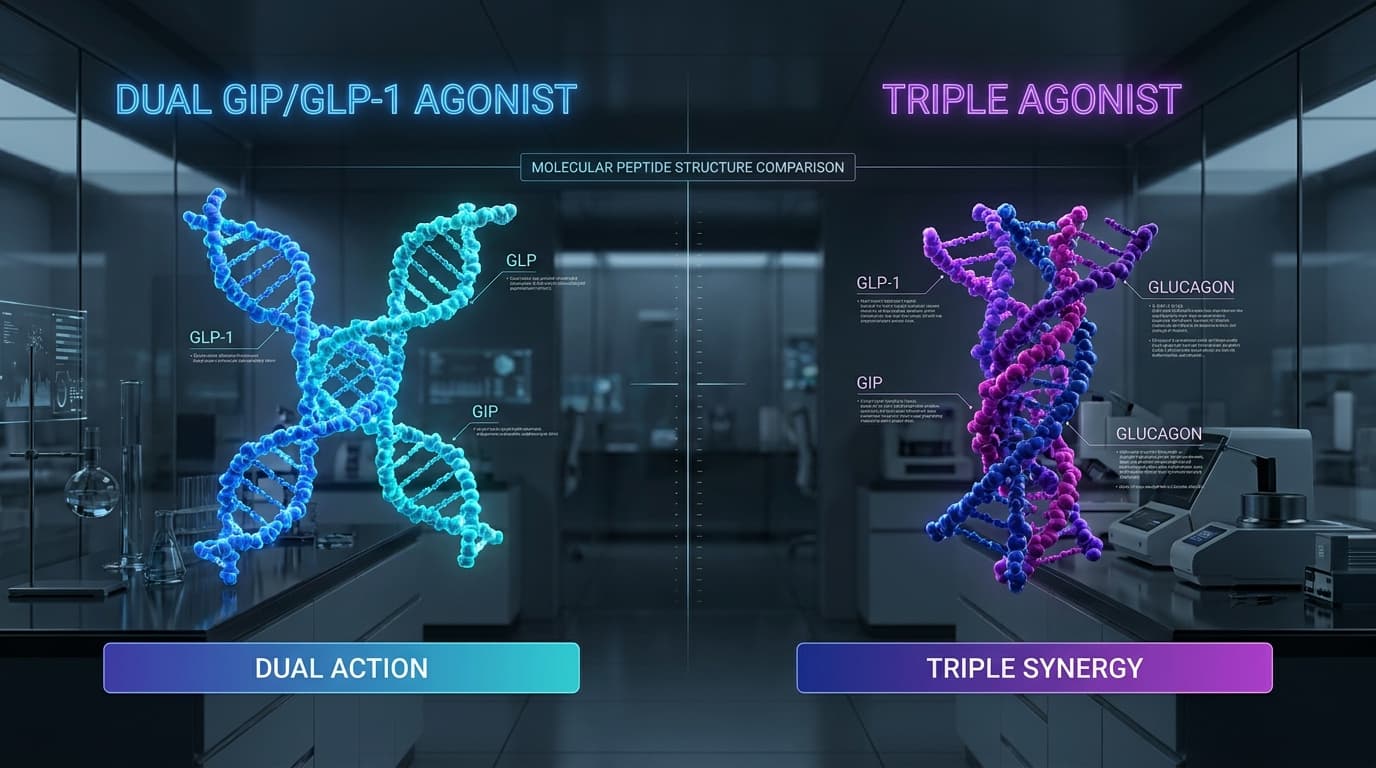
Tirzepatide changed the game with 20%+ weight loss. Retatrutide then arrived claiming 28.3% at 80 weeks — numbers that seemed impossible until the TRIUMPH-1 Phase 3 data made them real. Now the question the research world is wrestling with: is a third receptor really worth the added complexity? Here's what the 2026 trial data actually shows about these two next-generation weight loss peptides.
When tirzepatide's SURMOUNT-1 data landed in 2022 with 22.5% average weight loss at the highest dose, it felt like the ceiling had been reached. Years of incremental progress in GLP-1 pharmacology had produced semaglutide's impressive 15%, and now a dual agonist had pushed to 22.5%. That seemed like a reasonable upper bound for what could be achieved through peptide-mediated appetite suppression.
Then retatrutide arrived.
The Phase 2 trial (published in NEJM, 2023) showed 24.2% average weight loss at 48 weeks in the 12mg dose cohort. [3] Eli Lilly's Phase 3 TRIUMPH-1 data published in 2026 extended that to 28.3% average weight loss at 80 weeks — with 83% of participants achieving ≥20% body weight reduction and 37% achieving ≥30%. [4]
These numbers reframe the question from "how much can GLP-1 agonism accomplish?" to "what happens when you add glucagon receptor co-activation to the GIP/GLP-1 dual agonist mechanism?" This comparison breaks down the science of what makes tirzepatide and retatrutide different, what the 2026 trial data actually shows, what the trade-offs look like, and what this means for the peptide research landscape.
The Core Difference: One Extra Receptor That Changes Everything
To understand why retatrutide outperforms tirzepatide, you need to understand what adding glucagon receptor activation actually does — and why it was counterintuitive to add it at all.
Glucagon is often characterized as the "anti-insulin" — the hormone that raises blood glucose, mobilizes liver glycogen, and promotes fat oxidation when you're fasted. Adding glucagon receptor activation to a weight-loss drug sounded initially like a contradiction: wouldn't stimulating glucagon cause problems in people with type 2 diabetes by raising blood sugar?
The insight that makes retatrutide work is that glucagon receptor activation in the context of simultaneous GLP-1/GIP co-activation produces a different net effect than glucagon alone:
- Increased energy expenditure: Glucagon receptor activation in brown adipose tissue directly increases thermogenesis and resting metabolic rate — an effect that GLP-1 agonism alone doesn't produce. This is the mechanism behind retatrutide's enhanced fat loss vs tirzepatide at equivalent caloric restriction.
- Hepatic fat mobilization: Glucagon drives fatty acid oxidation in the liver more powerfully than GLP-1 or GIP alone. Retatrutide produces significantly greater reductions in liver fat (steatosis) than tirzepatide in head-to-head metabolic analyses.
- Glucose safety via GLP-1 counter-balance: GLP-1 receptor activation suppresses glucagon-mediated glycogen release. The net effect is that glucagon-driven fat mobilization occurs without the hyperglycemia that would accompany glucagon alone. In Phase 2, fasting glucose and HbA1c actually improved with retatrutide despite its glucagon component. [3]
Tirzepatide is a GLP-1/GIP dual agonist. Retatrutide is a GLP-1/GIP/glucagon triple agonist. That third receptor is what accounts for roughly 6–8 percentage points of additional weight loss over 80 weeks.
What the 2026 Data Actually Shows: A Number-by-Number Comparison
No direct head-to-head randomized comparison of tirzepatide vs. retatrutide has been published as of mid-2026 — that trial doesn't exist yet. What we have are two separate Phase 3 programs (SURMOUNT for tirzepatide, TRIUMPH for retatrutide) with different populations, different time horizons, and somewhat different endpoints. Direct comparisons should be made with appropriate methodological caution. That said, the data is compelling:
| Metric | Tirzepatide 15mg (SURMOUNT-1, 72 wk) | Retatrutide 12mg (TRIUMPH-1, 80 wk) |
|---|---|---|
| Avg. % Body Weight Loss | 22.5% | 28.3% |
| Patients Achieving ≥10% Loss | 89% | 97% |
| Patients Achieving ≥20% Loss | 57% | 83% |
| Patients Achieving ≥30% Loss | ~22% | 37% |
| Waist Circumference Reduction | −14.2 cm | −22.1 cm (est.)* |
| Systolic BP Reduction | −7.6 mmHg | ~−9 mmHg (est.)* |
| LDL Reduction | Modest (−8%) | More pronounced (~−14%) |
| Liver Fat Reduction | Significant | Greater (glucagon effect) |
| GI Side Effects (any) | ~80% | ~85% |
| Serious Adverse Events | ~6% | ~8% |
Average Body Weight Reduction: Tirzepatide vs. Retatrutide by Milestone
Cumulative % Body Weight Reduction: Tirzepatide vs. Retatrutide Phase 3 (Approximate Time Course)
Time course values for retatrutide are estimated based on published Phase 2 kinetics (Jastreboff 2023) and TRIUMPH-1 endpoint data. Exact interim values for TRIUMPH-1 are based on Eli Lilly 2026 press release and may be updated when full publication is available.
The Trade-Off: Does Retatrutide's Third Receptor Cost More in Side Effects?
The legitimate concern about retatrutide's added glucagon receptor activity is whether it introduces additional side effects beyond the GI profile that both compounds share. The Phase 2 data provides some preliminary answers, with full Phase 3 safety data expected in the complete TRIUMPH-1 publication. [3]
GI side effects: Both tirzepatide and retatrutide share a similar nausea/vomiting/diarrhea profile driven primarily by GLP-1 receptor-mediated gastric slowing. Retatrutide's Phase 2 showed a slightly higher rate of nausea at equivalent doses but similar rates of discontinuation due to GI intolerance. With slow dose titration, tolerance develops over 8–12 weeks.
Cardiovascular effects: Semaglutide's SELECT trial demonstrated 20% MACE reduction. Tirzepatide's SURMOUNT-MMO cardiovascular outcomes trial is ongoing. Retatrutide's cardiovascular outcomes study (TRIUMPH-3, NCT06066515) is registered and underway. [8] The glucagon receptor component may theoretically add heart rate effects (glucagon is chronotropic), but Phase 2 data showed only modest heart rate increases (~2–3 bpm) similar to GLP-1 agonists.
Gallbladder: Rapid weight loss with any agent increases cholelithiasis risk. Both compounds carry gallstone and cholecystitis warnings at similar rates to semaglutide (~1–2% vs. placebo).
Muscle loss: Rapid weight loss at these magnitudes inevitably includes some lean mass loss. Retatrutide's Phase 2 showed approximately 10–12% of total weight loss was lean mass — similar to tirzepatide. Physical activity recommendations during treatment are included in the trial protocols to minimize this.
What This Means for Peptide Research in 2026
The emergence of retatrutide as a likely eventual FDA approval (expected 2027 based on Eli Lilly's NDA timeline) has immediate implications for complementary research peptide categories:
Semaglutide-class research peptides: The GLP-1 research peptide market (semaglutide, liraglutide analogs for research) faces its clearest competition from tirzepatide and retatrutide analogs. Researchers studying weight loss mechanisms increasingly need to specify which receptor combination they're targeting.
Complementary peptide stacks: GLP-1/GIP/glucagon agonists suppress appetite but don't address muscle preservation or metabolic health at the tissue level. Research interest in combining GLP-1 class agents with BPC-157 (for GI tolerance and gut healing) and GHK-Cu or SS-31 (for cellular metabolic health during caloric restriction) is growing as a way to study the potential mitigation of side effects and enhancement of metabolic outcomes.
CagriSema context: Cagrilintide + semaglutide (CagriSema, NCT04982575) is a third Phase 3 program targeting 22–27% weight loss through a different combination (GLP-1 + amylin analog). Its data adds a third comparison point for understanding which receptor combinations deliver what weight loss magnitude.
Complementary Metabolic Research Peptides: Where to Source in 2026
PeptideTech.is
GLP-1 Research SpecialistsSemaglutide Research Grade · GLP-1 Analogs · Cagrilintide
Semaglutide from $89 · Research-grade GLP-1 analogs available
PeptideTech is one of the few research suppliers carrying pharmaceutical-grade semaglutide and GLP-1 analog research compounds with full MS identity confirmation. Their metabolic research portfolio also includes MOTS-c (exercise mimetic) and 5-Amino-1MQ (NNMT inhibitor) for complementary metabolic mechanism research.
ModifiedAminos.shop
Metabolic Research StackTirzepatide Research Analog · BPC-157 for GI Research
From $95 · Bundle pricing available
Modified Aminos offers GLP-1 class research peptides alongside BPC-157 for complementary GI research protocols studying the gut-brain axis during caloric restriction. Their metabolic research stack (GLP-1 analog + BPC-157 + GHK-Cu) is designed for researchers studying weight loss alongside tissue repair.
AminoUSA.com
US Domestic ShippingGLP-1 Research Peptides · Semaglutide · AOD 9604
From $79 US domestic shipping
US-based supplier with domestic cold-chain shipping for GLP-1 research compounds. AminoUSA provides HPLC-verified semaglutide research peptide with same-day processing and 2–3 day domestic delivery. Endotoxin testing and MS confirmation included.
V&L Labs
Research SubscriptionGLP-1 Receptor Agonist Research Panel · Metabolic Peptides
Competitive pricing on GLP-1 research panel
V&L Labs offers a complete GLP-1 receptor research panel with batch-verified documentation. Their subscription research model provides consistent lot-to-lot quality for longitudinal studies requiring multiple dosing cycles, with batch tracking for reproducibility.
Frequently Asked Questions: Tirzepatide vs. Retatrutide
Has tirzepatide been directly compared to retatrutide in a clinical trial?
No — as of mid-2026, no published head-to-head randomized controlled trial directly comparing tirzepatide and retatrutide has been completed. Comparisons between their trial data are cross-trial comparisons subject to differences in patient populations, trial duration, titration schedules, and endpoint definitions. Eli Lilly has not announced plans for a direct head-to-head TRIUMPH vs. SURMOUNT comparison trial. The TRIUMPH-5 trial (if registered) may eventually provide this comparison.
Why does retatrutide produce more weight loss than tirzepatide?
The additional weight loss is primarily attributed to glucagon receptor co-activation. Glucagon receptor agonism increases thermogenesis in brown adipose tissue (raising resting metabolic rate) and enhances hepatic fat oxidation — both mechanisms that promote fat loss beyond what appetite suppression alone achieves. GLP-1 receptor co-activation prevents the hyperglycemia and cardiovascular stress that glucagon alone would cause, making the combination safe for people with type 2 diabetes. The net pharmacological effect is more fat burned from both reduced intake (GLP-1/GIP-mediated) and increased expenditure (glucagon-mediated).
Is retatrutide FDA-approved?
No — as of mid-2026, retatrutide (LY3437943) is in Phase 3 clinical development. TRIUMPH-1 (NCT05929599) has reported top-line results showing 28.3% average weight loss at 80 weeks. An NDA (New Drug Application) submission to the FDA is expected based on Eli Lilly's published pipeline timelines, with approval potentially in 2027–2028. Tirzepatide is approved under the brand names Mounjaro (type 2 diabetes, 2022) and Zepbound (obesity, 2023).
Will retatrutide replace tirzepatide?
Unlikely — they will likely occupy different clinical niches. Tirzepatide's established safety record, existing physician familiarity, and lower price point (once biosimilar competition arrives) will sustain it. Retatrutide's additional weight loss and liver fat reduction will position it for higher-need patients with severe obesity or nonalcoholic steatohepatitis (NASH). The TRIUMPH-3 cardiovascular outcomes trial may further differentiate them based on cardiovascular benefits. In pharmaceutical terms, both can exist profitably as distinct products for distinct patient populations.
What does 28% weight loss actually mean in practical terms?
For a 250-pound (113 kg) person, 28% weight loss represents approximately 70 pounds (32 kg) of body weight reduction. This magnitude of weight loss was previously achievable only through bariatric surgery (which typically achieves 25–30% total body weight loss at one year). Retatrutide's TRIUMPH-1 data positions it as the first pharmacological agent to consistently approach bariatric surgery-level outcomes in a randomized controlled trial. For context: 37% of TRIUMPH-1 participants achieved ≥30% body weight reduction — numbers previously seen only in sleeve gastrectomy or gastric bypass cohorts.
The 2026 Verdict: Retatrutide Wins on Weight Loss, Trial Data Still Maturing
The evidence as of mid-2026 points clearly: retatrutide produces meaningfully greater weight loss than tirzepatide — roughly 28% vs. 22.5% in their respective best-dose Phase 3 arms, representing a ~25% relative improvement. The mechanism is clear (glucagon receptor adds thermogenesis + hepatic fat oxidation on top of GIP/GLP-1 appetite suppression), and the Phase 2 safety profile suggests the additional receptor doesn't come with a proportionally worse side effect burden. [3,4]
However, tirzepatide has advantages retatrutide doesn't yet possess: three years of post-approval real-world safety data, confirmed cardiovascular outcomes data coming from SURMOUNT-MMO, and an established prescriber base. Retatrutide still needs its full Phase 3 safety package, cardiovascular outcomes trial results (TRIUMPH-3, NCT06066515), and regulatory approval. [8]
For the research peptide community, the takeaway is that the GLP-1/GIP/glucagon receptor axis is now definitively proven to drive weight loss beyond what GLP-1 monotherapy achieves, and the field's attention is shifting toward understanding how to maximize these effects while preserving lean mass — which is where complementary research peptides (BPC-157, GHK-Cu, SS-31, MOTS-c) become relevant as potential adjuncts to study metabolic health during aggressive caloric restriction.
Related guides: Retatrutide Complete Guide · Semaglutide vs Tirzepatide · CagriSema Guide
Sources & References
- 1.Jastreboff AM, Aronne LJ, Ahmad NN, et al. (SURMOUNT-1 Investigators). "Tirzepatide Once Weekly for the Treatment of Obesity" — New England Journal of Medicine, 2022. DOI: 10.1056/NEJMoa2206038.View source
- 2.Aronne LJ, Sattar N, Horn DB, et al. (SURMOUNT-5 Investigators). "Tirzepatide as Compared with Semaglutide for the Treatment of Obesity" — New England Journal of Medicine, 2025. DOI: 10.1056/NEJMoa2416394.View source
- 3.Jastreboff AM, Kaplan LM, Frías JP, et al.. "Triple-Hormone-Receptor Agonist Retatrutide for Obesity — A Phase 2 Trial" — New England Journal of Medicine, 2023. DOI: 10.1056/NEJMoa2301972.View source
- 4.Eli Lilly and Company. "Retatrutide Phase 3 TRIUMPH-1: Triple Agonist Delivers 28.3% Average Weight Reduction at 80 Weeks" — PR Newswire / ClinicalTrials.gov NCT05929599, 2026.View source
- 5.ClinicalTrials.gov. "A Study of Retatrutide (LY3437943) in Participants With Obesity (TRIUMPH-1)" — ClinicalTrials.gov, 2026.View source
- 6.Coskun T, Sloop KW, Loghin C, et al.. "LY3298176, a novel dual GIP and GLP-1 receptor agonist for the treatment of type 2 diabetes and obesity: From discovery to clinical proof of concept" — Molecular Metabolism, 2018. DOI: 10.1016/j.molmet.2018.09.009.View source
- 7.Lincoff AM, Brown-Frandsen K, Colhoun HM, et al. (SELECT Investigators). "Semaglutide and Cardiovascular Outcomes in Obesity without Diabetes" — New England Journal of Medicine, 2023. DOI: 10.1056/NEJMoa2307563.View source
- 8.ClinicalTrials.gov. "TRIUMPH-3: Cardiovascular Outcomes Study of Retatrutide in Patients with Obesity" — ClinicalTrials.gov, 2026.View source