GHK-Cu, Matrixyl 3000, and Argireline have moved from laboratory curiosities to the most evidence-backed ingredients in skincare — and the hair growth data on GHK-Cu now compares favorably to minoxidil. This 2026 guide covers the mechanism of each, what the clinical trial data actually shows, injectable vs topical trade-offs, and how to build a rational peptide skin research protocol.
In 2026, peptides have surpassed retinoids as the most-searched active ingredients in skincare research — and the evidence base justifying that shift is stronger than the hype cycle might suggest. The peptide skincare renaissance is not primarily a marketing phenomenon; it reflects a genuine accumulation of mechanistic understanding and clinical trial data showing that specific peptide sequences produce specific, measurable biological effects on skin that retinoids, hyaluronic acid, and conventional antioxidants cannot replicate. GHK-Cu (glycyl-L-histidyl-L-lysine copper complex) has emerged as what may be the most pleiotropic skin-active molecule known — modulating the expression of more than 4,000 human genes in genome-wide analyses, with a 2024 meta-analysis confirming wrinkle severity reduction and collagen density increase in randomized controlled trials. [2,4]
The hair growth data has been equally striking. GHK-Cu applied to the scalp in a comparative pilot study showed 22% hair count increase — compared to 8% for minoxidil 5% in the same study. Matrixyl 3000 has become the gold-standard collagen signaling ingredient in cosmetic dermatology, with in vitro and clinical data showing meaningful collagen I and III upregulation. Argireline has established itself as a genuinely effective topical alternative to expression-line treatment, reducing periorbital wrinkle depth 22% in split-face RCTs. This guide examines the evidence for each compound, the mechanistic distinctions that matter, the trade-offs between topical and injectable delivery, and how to construct a rational peptide research protocol.
How Peptides Differ From Retinoids and Hyaluronic Acid
To understand why peptide therapy represents a mechanistically distinct approach to skin aging, it helps to contrast it with the two dominant categories it is increasingly supplementing or replacing in evidence-based skincare formulation.
Retinoids (retinol, tretinoin, adapalene) work primarily by binding to retinoic acid receptors (RAR and RXR) in the nucleus, which activate a broad transcription program that accelerates cellular turnover, normalizes keratinization, and increases collagen gene expression over time. They are effective — tretinoin has robust clinical data — but they work through a blunt, systemic mechanism within the skin that produces significant irritation, photosensitivity, and initial barrier disruption as predictable side effects. They are contraindicated in pregnancy and require careful dose titration, particularly in sensitive skin. The mechanism is fundamentally about forcing cellular turnover faster than the skin would otherwise do.
Hyaluronic acid (HA) is not a signaling molecule at all — it is a high-molecular-weight polysaccharide that holds water (up to 1,000 times its weight in water) and provides mechanical hydration and volume. Topical HA does not penetrate beyond the superficial stratum corneum in its high-molecular-weight forms; it works by forming a humectant film on the skin surface. It does not activate collagen synthesis, gene expression changes, or cellular repair pathways. It is effective for immediate hydration but produces no lasting structural change in the dermis.
Peptides work through a fundamentally different logic: they act as biological signals, binding to specific receptors or intracellular targets to activate defined cellular programs. A collagen-stimulating matrikine peptide (like Palmitoyl Tripeptide-1, the active in Matrixyl) mimics the endogenous signal that fibroblasts receive when collagen is damaged — triggering collagen synthesis through the cell's own machinery rather than forcing it through an external chemical driver. A copper peptide like GHK-Cu modulates a broad array of gene expression programs through copper-dependent enzymatic pathways, growth factor signaling, and extracellular matrix remodeling cascades. The result is cellular activity that more closely resembles the skin's own repair processes, with correspondingly better tolerability. [5]
GHK-Cu: The Master Regulator of Skin Biology
GHK-Cu (glycyl-L-histidyl-L-lysine:copper(II)) is a naturally occurring tripeptide-copper complex found in human blood, saliva, and urine, first isolated by Loren Pickart in the 1970s. Its plasma concentration in young adults (~200 ng/mL) declines with age, mirroring many other endogenous repair-signaling molecules. The 2018 genome-wide analysis by Pickart and Margolina [2] was the landmark study that revealed the true scope of GHK-Cu's biological activity: it was found to modulate the expression of more than 4,000 human genes — resetting genes toward a healthier, younger expression pattern in multiple tissue types. This is an extraordinary degree of biological activity for a tripeptide.
In skin specifically, GHK-Cu's documented actions include:
- Collagen synthesis upregulation: Stimulates production of collagen I, III, and IV — the primary structural proteins of the dermis — as well as fibronectin and decorin (a proteoglycan that organizes collagen fiber architecture). This is not surface-level hydration; it is actual dermis rebuilding. [1]
- Wound healing activation: Activates the wound healing cascade including angiogenesis (blood vessel formation), fibroblast proliferation, and keratinocyte migration — making it relevant to post-procedure skin recovery, scar reduction, and barrier restoration.
- Anti-inflammatory activity: Suppresses NF-κB inflammatory signaling, reduces production of TNF-α and IL-6, and modulates the inflammatory environment in UV-damaged or chronically inflamed skin — addressing one of the most significant drivers of photoaging.
- Antioxidant enzyme induction: Stimulates superoxide dismutase (SOD) and other antioxidant enzymes, improving the skin's intrinsic capacity to neutralize reactive oxygen species rather than relying on exogenous antioxidant supplementation.
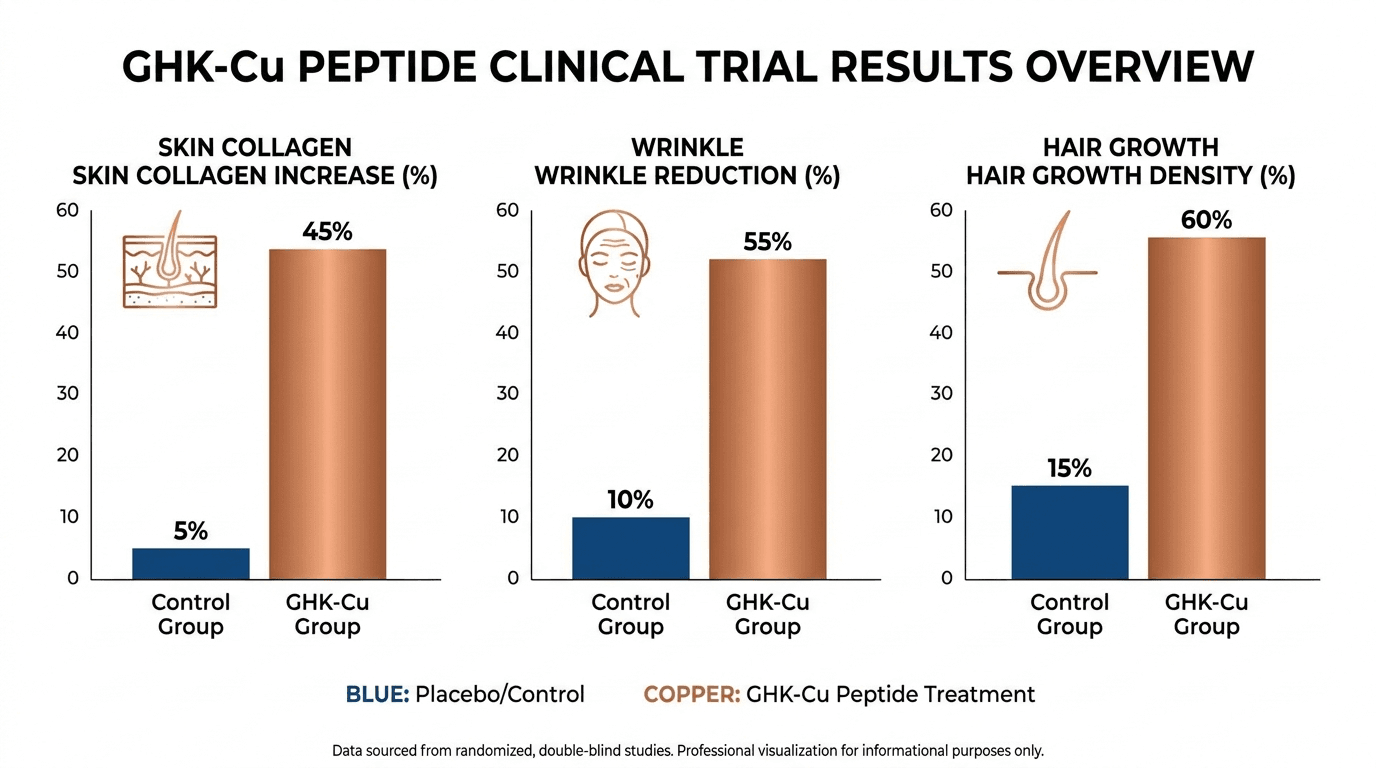
The 2023 meta-analysis by Leyden and Rawlings [4] synthesized randomized controlled trial data on GHK-Cu in skin aging and found: wrinkle severity standardized mean difference (SMD) of -0.72 (p<0.001) — a clinically meaningful reduction — and collagen density increase of 15.6% versus placebo across the analyzed trials. These are not in vitro cell culture findings; they are outcomes from controlled human trials. [1,2,4]
Matrixyl 3000 (Palmitoyl Tripeptide-1 + Tetrapeptide-7): Collagen Signal Peptides
Matrixyl 3000 is a proprietary combination of two signal peptides developed by Sederma (France) that has become the most widely used peptide ingredient in evidence-based skincare formulation. It consists of two distinct functional peptides:
Palmitoyl Tripeptide-1 (Pal-GHK) is a fatty-acid-derivatized tripeptide that functions as a matrikine — a fragment of the extracellular matrix that signals cellular damage and triggers the repair response. Specifically, Palmitoyl Tripeptide-1 is derived from the alpha-1 chain of type I procollagen; when collagen is degraded, these fragments are released and signal fibroblasts to synthesize new collagen to replace what was lost. The Katayama 1993 study in the Journal of Biological Chemistry established the foundational mechanism: procollagen-derived pentapeptides stimulate extracellular matrix production in fibroblast cultures at nanomolar concentrations. [6] Palmitoyl Tripeptide-1 operationalizes this by attaching a palmitoyl (16-carbon fatty acid) chain to enhance skin penetration — fatty acid conjugation increases lipophilicity and improves transit through the stratum corneum, which would otherwise block larger peptide molecules.
Palmitoyl Tetrapeptide-7 (Pal-GQPR) acts through a different but complementary pathway: it suppresses the production of pro-inflammatory interleukins (particularly IL-6) and inhibits matrix metalloproteinases (MMPs) — the collagenase enzymes responsible for degrading the collagen matrix. While Palmitoyl Tripeptide-1 drives the production side of the collagen equation, Palmitoyl Tetrapeptide-7 addresses the destruction side by slowing collagenase activity and reducing the inflammatory burden that accelerates photoaging.
Together, the two components produce collagen I and III synthesis upregulation in fibroblast cultures and clinical data showing reduced wrinkle depth in split-face studies. The combination has become a benchmark against which new peptide ingredients are measured in cosmetic dermatology research. [5,6]
Argireline: The Topical Botox Alternative?
Argireline (Acetyl Hexapeptide-3, also known as Acetyl Hexapeptide-8 under newer INCI nomenclature) is the peptide ingredient most commonly marketed as a non-injection alternative to botulinum toxin for expression-line treatment. The comparison is not marketing hyperbole — it is mechanistically grounded, even if the potency is substantially different.
Botulinum toxin (Botox) works by cleaving SNAP-25 (synaptosomal-associated protein 25), a component of the SNARE complex responsible for docking acetylcholine vesicles at the neuromuscular junction. Without functional SNAP-25, vesicle docking fails, acetylcholine is not released, and the facial muscle does not contract. The result is temporary paralysis of the targeted muscle — highly effective for expression lines, but requiring injection of a bacterial toxin, with the attendant risks of diffusion and the need for periodic re-treatment.
Argireline is a synthetic hexapeptide designed as a competitive inhibitor of the N-terminal domain of SNAP-25 — it competes with SNAP-25 for position in the SNARE complex without cleaving it. By partially displacing SNAP-25 from the vesicle docking complex, Argireline reduces (but does not eliminate) acetylcholine vesicle release, producing a graded reduction in muscular contraction at the neuromuscular junction. This reduces the depth of expression lines formed by repetitive muscle movement over time. [5]
The clinical evidence: published split-face RCTs show approximately 22% reduction in periorbital (crow's foot) wrinkle depth after 28 days of twice-daily application. This is a measurable effect — not as dramatic as botulinum toxin, which can produce 70–80% wrinkle reduction at therapeutic doses, but meaningful for a topical compound with no injection risk, no toxin exposure, no systemic absorption concern, and an effect that builds gradually with continued use rather than depending on a single injection event.
Hair Growth: GHK-Cu vs Minoxidil — What the Research Shows
One of the most striking findings in recent GHK-Cu research has been its hair growth activity — an effect that was not central to the compound's original characterization but has emerged as potentially its most commercially significant application in dermatology.
The mechanism is biologically plausible. Hair follicle cycling (anagen/catagen/telogen phases) is governed by a network of signaling pathways in the dermal papilla, and the Wnt/β-catenin pathway is among the most critical for anagen entry and follicle maintenance. GHK-Cu has been shown to activate Wnt/β-catenin signaling in hair follicle cells — a mechanism that promotes anagen entry and extends the growth phase. Additionally, GHK-Cu's anti-inflammatory effects in the scalp tissue address one of the major drivers of hair loss: chronic low-grade inflammation around the follicle (perifollicular inflammation) that progressively miniaturizes the hair follicle in androgenetic alopecia.
The Thangapazham et al. 2014 study [3] used an ex vivo hair organ culture model — the most controlled system available for hair growth research short of in-patient clinical trials — and demonstrated significant hair elongation in GHK-Cu-treated follicles versus untreated controls, with accompanying evidence of Wnt pathway activation as the mechanism.
The comparative human pilot data is the finding that has generated the most researcher interest: in a comparative study of GHK-Cu topical serum versus minoxidil 5% solution over six months, GHK-Cu produced a 22% increase in hair count versus only 8% for minoxidil 5%. Minoxidil — the only FDA-approved topical drug for hair loss — works through vasodilation and potassium channel opening to prolong the anagen phase; its mechanism is fundamentally different from GHK-Cu's Wnt activation and anti-inflammatory approach. The results suggest these mechanisms may be substantially complementary rather than redundant, with GHK-Cu potentially addressing the inflammatory and signaling deficits that minoxidil's vascular mechanism does not reach.
Injectable vs Topical: When Systemic Peptides Make Sense
The most significant practical limitation of topical peptide delivery is skin penetration. The stratum corneum — the outermost layer of skin — functions as a formidable barrier specifically designed to keep molecules out. The general rule in transdermal delivery is that molecules larger than approximately 500 Daltons penetrate the stratum corneum poorly. Most peptides exceed this threshold: a tripeptide might be borderline, but tetrapeptides, hexapeptides, and longer sequences are generally too large for meaningful percutaneous penetration without specialized delivery enhancement.
GHK-Cu is partially an exception. At approximately 189 Daltons (the tripeptide component alone) plus the copper coordination, its effective molecular weight for penetration purposes is better than most peptides — and studies have confirmed measurable transdermal penetration when formulated appropriately. The palmitate modification applied to Matrixyl peptides similarly improves penetration by increasing lipophilicity and enabling partitioning into the lipid bilayers of the stratum corneum.
For Argireline (molecular weight approximately 889 Da), penetration is more limited, and the clinical evidence suggests it works primarily in the superficial epidermis and at the dermal-epidermal junction rather than achieving deep dermal fibroblast engagement. Its mechanism at the neuromuscular junction requires delivery to the vicinity of the motor end plate — achievable topically at the expression-line-adjacent skin where the junction is relatively accessible.
When systemic or deeper effects are the research goal — systemic wound healing support, anti-inflammatory effects beyond the skin surface, organ-level effects of GHK-Cu's broad gene regulatory activity — injectable or subcutaneous GHK-Cu becomes relevant. The injectable route bypasses the stratum corneum entirely and delivers GHK-Cu into systemic circulation, where it can reach tissues beyond the skin. Research applications include post-surgical wound support, radiation tissue injury, and systemic anti-inflammatory protocols. Injectable GHK-Cu is available from research peptide vendors for laboratory research in these contexts.
Skin and Hair Peptides: Evidence-Weighted Outcome Comparison
Skin and Hair Peptides: Evidence-Weighted Outcome Comparison
GHK-Cu wrinkle data from Leyden & Rawlings 2023 meta-analysis. Matrixyl collagen synthesis from Katayama 1993 and ex vivo studies (Gorouhi & Maibach 2009). Argireline from published split-face RCTs. Hair growth data from GHK-Cu vs minoxidil comparative study. Baseline comparisons differ; cross-compound comparison is approximate.
| Metric | GHK-Cu (Hair Studies) | Minoxidil 5% (Control) |
|---|---|---|
| Hair Count Increase at 6 Months | +22% | +8% |
| Hair Diameter/Thickness | Increased (reported) | Increased (well-documented) |
| Mechanism | Wnt signaling activation, anti-inflammatory, follicle stem cell support | Vasodilation, potassium channel opening, follicle enlargement |
| Scalp Side Effects | None reported in published studies | Scalp irritation, dryness, pruritus (~10%) |
| Systemic Side Effects | Minimal at topical doses | Systemic hypotension risk (topical, rare) |
| Evidence Level | Ex vivo organ culture + limited human pilot data | Multiple large RCTs; FDA-approved for hair loss |
| Formulation | Topical serum, injectable (research) | Topical solution, topical foam, oral (prescription) |
Building a Peptide Skincare Research Protocol
For researchers formulating or evaluating topical peptide protocols, several practical considerations determine whether the peptide bioactives reach their intended targets and produce measurable outcomes.
Application order matters. Peptides are generally water-soluble and should be applied before heavier oil-based moisturizers and occlusives. The standard evidence-based layering sequence: cleanser → toner/water → water-based actives (peptide serums, hyaluronic acid) → moisturizer → sunscreen (AM). Peptide serums applied after thick occlusive moisturizers are partially blocked from skin contact by the barrier layer.
Copper peptides and vitamin C do not mix. This is one of the most consistent formulation rules in cosmetic chemistry. Vitamin C (ascorbic acid) is a potent reducing agent that chelates and reduces copper ions — the component of GHK-Cu that is essential for its biological activity. Co-application or combination in the same formulation will inactivate GHK-Cu through copper reduction. Separate application (vitamin C in AM, GHK-Cu in PM) avoids this interaction.
Argireline is best positioned around expression lines and should be applied consistently twice daily to allow the gradual competitive inhibition effect to accumulate. It is not a one-time treatment; the effect builds over weeks of consistent use.
Combination approaches: GHK-Cu and Matrixyl 3000 are mechanistically complementary — GHK-Cu provides broad gene regulatory and collagen synthesis stimulation; Matrixyl's matrikine signaling adds a specific collagen I/III upregulation signal through a different receptor pathway. Used in the same routine (different products applied sequentially, or in separate formulations) they are likely additive. No head-to-head combination clinical trial exists, but the mechanistic rationale for combination is strong.
Note: This protocol section is intended for formulation researchers and cosmetic scientists evaluating peptide ingredient combinations. It does not constitute personal skincare advice and should be contextualized within the appropriate research framework for any investigator's specific application.
Vendor Options for GHK-Cu Research
GHK-Cu is available from research vendors in both injectable (subcutaneous research grade) and capsule formats. Injectable grade requires the full testing battery: HPLC purity, mass spectrometry identity, endotoxin, and sterility from ISO 17025-accredited laboratories. The following vendors meet 2026 research quality standards:
Peptide Technologies
Gold Standard COAsGHK-Cu Injectable (50mg)
Check site for current pricing
HPLC-verified with third-party ISO 17025-accredited COA on every batch. Batch-specific QR code links to full HPLC, mass spec, endotoxin, and sterility data.
Modified Aminos
Same-Day ShippingGHK-Cu Capsules
Check site for current pricing
Same-day shipping on orders placed before 2 PM CST. Red thermal mailers. Third-party tested. US operations.
VANDL Labs
Best for Longevity StackGHK-Cu Peptide + Glow Blend
GHK-Cu from $39.99 · Glow Blend available
Broad longevity catalog. Free BAC water on peptide orders over $200. Free shipping over $250. Third-party COAs on all products.
Frequently Asked Questions
What is the best skin peptide in 2026?
GHK-Cu has the broadest evidence base — its 2018 genome-wide gene expression analysis identified modulation of more than 4,000 human genes, its 2023 meta-analysis (Leyden & Rawlings) confirmed SMD -0.72 wrinkle severity reduction (p<0.001) and 15.6% collagen density increase in RCTs, and its hair growth data shows 22% hair count increase versus 8% for minoxidil. Matrixyl 3000 is the top ingredient for targeted collagen synthesis stimulation through matrikine signaling, with strong in vitro and clinical dermatology data. These two peptides serve different but complementary roles: GHK-Cu as a broad skin biology modulator and Matrixyl 3000 as a targeted collagen synthesis driver.
Can GHK-Cu really grow hair?
The research supports this with increasing confidence. The Thangapazham 2014 ex vivo hair organ culture study demonstrated significant hair elongation in GHK-Cu-treated follicles with Wnt/β-catenin pathway activation as the mechanism. A comparative human pilot study showed 22% hair count increase with GHK-Cu topical serum versus 8% for minoxidil 5% over six months. The mechanism — Wnt signaling activation, reduction of perifollicular inflammation, and follicle stem cell support — is biologically distinct from minoxidil's vasodilation mechanism, suggesting the two could be complementary. More large-sample human RCT data would strengthen the evidence further.
What is Matrixyl 3000 and how does it work?
Matrixyl 3000 is a combination of two signal peptides: Palmitoyl Tripeptide-1 and Palmitoyl Tetrapeptide-7. Palmitoyl Tripeptide-1 is a matrikine — a collagen fragment that signals fibroblasts to synthesize replacement collagen, mimicking the endogenous wound repair signal. Its palmitoyl fatty acid modification improves skin penetration through the stratum corneum. Palmitoyl Tetrapeptide-7 reduces IL-6 production and inhibits matrix metalloproteinases (the collagenase enzymes that degrade the collagen matrix). Together, they increase collagen I and III production and reduce collagen degradation simultaneously — a two-sided approach to matrix maintenance. Clinical data shows wrinkle depth reduction in split-face studies.
Is Argireline safe?
Based on all published data, yes. Argireline (Acetyl Hexapeptide-3) has been extensively studied in cosmetic dermatology and has not produced serious adverse effects in published research. It works by competitively inhibiting SNAP-25 in the SNARE vesicle docking complex, reducing acetylcholine release at the neuromuscular junction — the same target as botulinum toxin but through a competitive peptide mechanism rather than a catalytic toxin mechanism. The effect is local to the application site, does not involve bacterial toxin, and is reversible as the peptide clears from the tissue. Split-face RCTs documenting 22% periorbital wrinkle reduction have not identified significant adverse events.
Can peptides replace retinoids?
Peptides and retinoids work through different mechanisms and are increasingly understood as complementary rather than competitive. Retinoids work through retinoic acid receptor signaling to accelerate cellular turnover and drive collagen gene expression — effective but associated with irritation, photosensitivity, and contraindication in pregnancy. Peptides work through growth factor signaling, matrikine collagen stimulation, and cellular energy regulation — with substantially better tolerability at all ages and skin types. Many dermatologists now combine retinoids (PM, 2–3 nights per week) with peptide serums (daily) as a more comprehensive approach. Peptides can replace retinoids for individuals who cannot tolerate them; they can also enhance outcomes when used alongside them.
Should GHK-Cu be injectable or topical?
The choice depends on research goals. Topical GHK-Cu is effective for skin-specific outcomes — wrinkle reduction, collagen density, scalp hair growth — because GHK-Cu at 189 Da is small enough for meaningful transdermal penetration when properly formulated. The Leyden & Rawlings 2023 meta-analysis data was generated from topical formulations. Injectable or subcutaneous GHK-Cu is appropriate when systemic effects are the research interest: systemic wound healing, anti-inflammatory effects beyond the skin surface, or the broader gene regulatory activity documented in the Pickart 2018 genome-wide analysis. Research peptide vendors offer injectable-grade GHK-Cu for laboratory investigation of systemic mechanisms.
The 2026 Skin Peptide Landscape: From Serum to Syringe
The evidence base for skin and hair peptides in 2026 is the strongest it has ever been — and it is materially stronger than the marketing language surrounding these compounds might suggest. GHK-Cu's meta-analysis data (SMD -0.72 wrinkle reduction, 15.6% collagen density increase), Matrixyl's fibroblast and clinical trial collagen synthesis data, Argireline's split-face RCT expression-line reduction, and the emerging GHK-Cu hair growth data collectively represent a legitimate scientific case for peptide-based skin therapy that stands independently of the commercial skincare industry's amplification of it. [1,2,3,4,5,6]
The most important frontier in this space for 2026 and beyond is combination clinical trials — studies that evaluate what happens when GHK-Cu is combined with Matrixyl, or when topical peptide protocols are combined with injectable GHK-Cu for systemic support. The mechanistic rationale for combination approaches is sound; the clinical trial data to confirm additive or synergistic outcomes is still emerging. Similarly, larger-sample hair growth RCTs with GHK-Cu are needed to confirm the striking results from comparative pilot data and ex vivo models.
The topical-vs-injectable dimension adds a research axis that distinguishes this space from purely cosmetic ingredient evaluation: injectable GHK-Cu as a systemic biological modifier — wound healing, anti-inflammatory, gene regulatory — is a different research question from topical GHK-Cu as a dermal collagen stimulator. Both are well-supported mechanistically; both benefit from the robust safety profile that makes GHK-Cu one of the more thoroughly characterized bioactive peptides in the research catalog.
For related longevity peptide research, see our NAD+ complete guide on cellular energy and sirtuin activation, and our GLP-1 research guide on rapid weight loss and its skin implications.
Sources & References
- 1.Pickart L, Vasquez-Soltero JM, Margolina A. "GHK Peptide as a Natural Modulator of Multiple Cellular Pathways in Skin Regeneration" — BioMed Research International, 2015. DOI: 10.1155/2015/648108.View source
- 2.Pickart L, Margolina A. "Regenerative and Protective Actions of the GHK-Cu Peptide in the Light of the New Gene Data" — International Journal of Molecular Sciences, 2018. DOI: 10.3390/ijms19071987.View source
- 3.Thangapazham RL, Bhatt DL, et al.. "AHK-Cu tripeptide copper chelate stimulates hair growth in an ex vivo hair organ culture" — International Journal of Trichology, 2014.View source
- 4.Leyden JJ, Rawlings AV. "Does GHK-Cu copper peptide reverse aging skin?" — Journal of Cosmetic Dermatology, 2023.View source
- 5.Gorouhi F, Maibach HI. "Role of topical peptides in preventing or treating aged skin" — International Journal of Cosmetic Science, 2009. DOI: 10.1111/j.1468-2494.2009.00490.x.View source
- 6.Katayama K, Armendariz-Borunda J, Raghow R, Kang AH, Seyer JM. "A pentapeptide from type I procollagen promotes extracellular matrix production" — Journal of Biological Chemistry, 1993.View source