
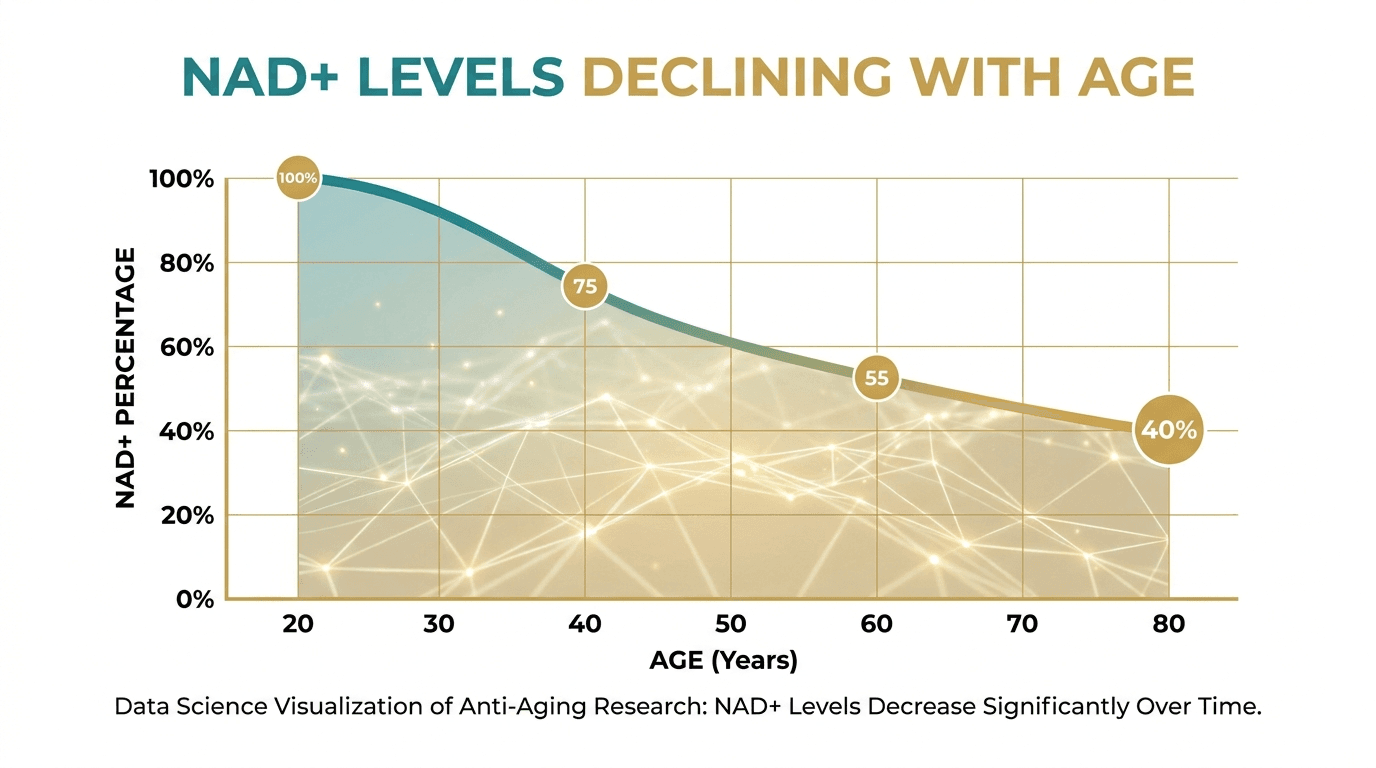
NAD+ declines roughly 50% between ages 20 and 60 — and with it goes sirtuin activity, mitochondrial efficiency, and cellular repair capacity. This 2026 guide breaks down the science of NAD+ decline, the NMN vs NR precursor debate, IV vs injectable vs oral bioavailability data, and what human clinical trials actually show.
NAD+ — nicotinamide adenine dinucleotide — is a coenzyme found in every living cell, and it is disappearing from your body as you read this. Between the ages of 20 and 60, NAD+ levels drop by approximately 50% across multiple tissue types, including skeletal muscle, liver, brain, and skin. This isn't a minor metabolic footnote: NAD+ sits at the center of cellular energy production, DNA repair, immune function, and the activity of an entire family of longevity-associated proteins called sirtuins. When NAD+ falls, all of these systems degrade in parallel — and current aging research increasingly views this decline not as a consequence of aging, but as one of its drivers. [6]
The 2026 landscape for NAD+ research has matured considerably from the hype cycle of the early 2020s. Multiple human clinical trials have now confirmed that NAD+ can be meaningfully elevated through supplementation — with blood NAD+ increases of 40–90% documented depending on the delivery route and dose. The question has shifted from "can we raise NAD+?" to "what does raising it actually do, and what's the best way to do it?" This guide answers both questions using peer-reviewed evidence from human studies, explains the NMN vs NR precursor debate, breaks down the bioavailability differences between IV, injectable, and oral delivery, and identifies vendor options for researchers working with NAD+ compounds.
What Is NAD+ and Why Does It Decline With Age?
NAD+ (oxidized form) and NADH (reduced form) are two sides of a critical redox couple that enables the transfer of electrons across virtually every energy-producing reaction in the cell. In glycolysis, NAD+ accepts electrons from glucose metabolism to become NADH; in the mitochondrial TCA cycle (Krebs cycle) and oxidative phosphorylation, that NADH is oxidized back to NAD+ while generating ATP. The NAD+/NADH ratio is not just a metabolic detail — it functions as a real-time sensor of cellular energy status, governing the activity of numerous downstream enzymes and transcription factors that read the cell's energy state.
Beyond its role as an electron carrier, NAD+ is the obligate substrate for three major enzyme families: sirtuins (class III histone deacetylases, the primary longevity-linked users), PARPs (poly-ADP-ribose polymerases, critical for DNA damage repair), and CD38 (an ectoenzyme involved in calcium signaling and immune function). The problem is that all three of these enzyme families consume NAD+ rather than recycle it — every catalytic cycle depletes the pool. As chronic DNA damage accumulates with age, PARP activity increases. As inflammatory signaling rises with age, CD38 activity increases. Both of these consume NAD+ faster than aging biosynthetic machinery can replenish it. Meanwhile, the enzymes responsible for synthesizing NAD+ — particularly NAMPT (nicotinamide phosphoribosyltransferase), the rate-limiting step in the salvage pathway — themselves decline in activity with age. The result is a multi-front depletion that compounds year over year. [6]
The Sirtuin Connection: How NAD+ Controls Longevity Genes
Sirtuins are a family of seven NAD+-dependent deacetylases (SIRT1–SIRT7) that regulate some of the most fundamental processes in cellular biology: gene expression, DNA repair, mitochondrial biogenesis, inflammation, and stress response. They are called "longevity genes" because overexpression of their yeast and worm homologues reliably extends lifespan in model organisms, and because human genetic studies consistently link sirtuin variants to aging phenotypes. But sirtuins cannot function without NAD+ — they require it as a co-substrate for every deacetylation reaction. When NAD+ falls, sirtuin activity falls with it, regardless of how much sirtuin protein is present. [5]
The three sirtuins most relevant to aging research are:
- SIRT1 (nuclear): Deacetylates p53 (regulating apoptosis), FOXO3 (stress resistance and longevity), and PGC-1α. SIRT1-mediated PGC-1α activation is the primary mechanism by which NAD+ drives mitochondrial biogenesis — the creation of new, functional mitochondria. This is one of the most studied anti-aging mechanisms in the field. [1]
- SIRT3 (mitochondrial): Deacetylates and activates key enzymes in the electron transport chain, including Complex I and Complex III subunits. SIRT3 is the primary quality-control regulator inside the mitochondria, and its declining activity with age directly correlates with mitochondrial dysfunction in aging tissues. [5]
- SIRT6 (nuclear): Specializes in DNA double-strand break repair, telomere maintenance, and suppression of inflammatory gene expression via NF-κB inhibition. SIRT6 overexpression extends lifespan in male mice by approximately 15%.
The implication for NAD+ supplementation research is straightforward: if NAD+ is the limiting substrate for sirtuin activity, and sirtuin activity declines with age in part because NAD+ declines, then restoring NAD+ levels could theoretically restore sirtuin function and with it a broad range of aging-associated cellular maintenance processes. This mechanistic logic is what drives the enormous research interest in NAD+ precursors. [1]
NAD+ vs NMN vs NR: The Precursor Debate
Here is the foundational question for any researcher approaching NAD+ supplementation: why not just take NAD+ directly? The answer is straightforward — NAD+ is a large, charged molecule with very poor oral bioavailability. It does not readily cross cell membranes, and when taken orally, it is largely degraded in the gut before reaching systemic circulation. The molecule that cells need to import is not NAD+ itself but its precursors, which are smaller, more permeable, and can be transported into cells via specific transporters before being converted to NAD+ intracellularly.
The two most-studied oral NAD+ precursors are:
- NMN (nicotinamide mononucleotide): Enters the NAD+ salvage pathway one step upstream of NAD+ itself. Human trials have documented 40–90% increases in blood NAD+ levels with 250–500mg/day dosing. NMN is taken up by cells via the Slc12a8 transporter (and possibly directly as NR after dephosphorylation). [1]
- NR (nicotinamide riboside): Enters the salvage pathway two steps upstream of NAD+, converting first to NMN and then to NAD+. The Martens 2018 Nature Communications study — one of the most rigorous human trials to date — found that NR at 250mg twice daily (500mg/day) was well-tolerated and significantly elevated whole-blood NAD+ in healthy middle-aged and older adults. [3]
A third precursor, nicotinic acid (niacin), enters via the Preiss-Handler pathway and is also effective at raising NAD+ but causes the well-known "niacin flush" (prostaglandin-mediated vasodilation) that limits tolerability for many users. The Dollerup 2018 trial tested NR at 1,000mg/day in obese men over six weeks: blood NAD+ rose significantly vs placebo, with metabolic markers showing modest improvement trends. [4] Both NMN and NR are increasingly available as research-grade compounds and are the primary focus of ongoing human longevity research. [1,3,4]
IV vs Injectable vs Oral: Bioavailability Comparison
Delivery route is one of the most practically significant variables in NAD+ research, because bioavailability differences between routes are substantial — not marginal. Understanding the trade-offs helps researchers choose protocols appropriate to their specific research questions.
IV infusion achieves near-complete bioavailability by delivering NAD+ directly into circulation, bypassing gut degradation entirely. In clinical settings, IV NAD+ infusions (typically 250–500mg over 2–4 hours) produce the highest acute blood NAD+ elevations documented in human research — approximately 90% above baseline based on published infusion data. The limitation is logistical: IV administration requires clinical infrastructure, trained personnel, and significant time commitment (4+ hours per session). IV NAD+ is primarily used in clinical research settings and for acute deficiency protocols.
Subcutaneous injectable NAD+ represents a practical middle ground. Research-grade NAD+ vials can be reconstituted and administered subcutaneously in a research context, achieving estimated blood NAD+ increases of approximately 70% vs baseline — lower than IV due to slower absorption kinetics but substantially higher than most oral routes. Injectable protocols allow more sustained NAD+ elevation through repeated dosing without requiring clinic visits.
Oral NMN and NR remain the most accessible forms. Published human trial data shows 40–50% blood NAD+ increases with standard doses. While lower than injectable or IV routes in absolute terms, oral precursors are well-tolerated, practical for sustained daily use, and have the largest human safety dataset of any NAD+ delivery method. The mechanistic question of whether blood NAD+ increases translate proportionally to intracellular NAD+ in specific tissues (particularly brain and muscle) remains an active area of research. [3,4]
NAD+ Delivery Method Comparison
Estimated NAD+ Level Increase by Delivery Method (Human Study Data)
Values represent approximate ranges from published human studies and are route/dose dependent. IV data from Martens 2018; oral NMN/NR from Dollerup 2018 and Martens 2018. Direct head-to-head trial not available; cross-study comparisons carry limitations.
What Human Clinical Trials Actually Show
The human clinical trial database for NAD+ precursors has grown substantially since 2018, and it paints a consistent picture on safety and NAD+ elevation — while leaving the most important functional questions (cognition, longevity, cardiovascular outcomes) largely unanswered in rigorous long-term trials.
Martens et al. 2018 (Nature Communications) remains one of the benchmark studies. Twenty-four healthy middle-aged and older adults received NR 250mg twice daily (500mg/day) or placebo for six weeks in a crossover design. Results: [3]
- Significant elevation of NAD+ metabolites in whole blood (NR supplementation raised NAD+ ~40–50% vs placebo)
- Well-tolerated: no serious adverse events, no significant differences in blood pressure, heart rate, or standard metabolic labs
- NAD+ metabolite levels in the muscle and PBMC samples also elevated, suggesting tissue-level penetration beyond blood
Dollerup et al. 2018 (American Journal of Clinical Nutrition) tested NR at 1,000mg/day in 40 obese men over six weeks. Blood NAD+ rose significantly in the NR group. Notably, despite meaningful NAD+ elevation, the primary metabolic endpoints (insulin sensitivity, lipid profiles, body composition) showed only modest, non-significant trends in the six-week timeframe. [4] This is an important finding: raising blood NAD+ is achievable; translating that into measurable clinical metabolic outcomes in a short-duration trial in a specific population is a different question.
What remains unknown: long-term outcomes in aging humans, cognitive endpoints, cardiovascular event reduction, and whether NAD+ supplementation extends anything resembling healthspan in a controlled human trial. The mechanistic evidence from Sinclair's group and others is compelling [2], but the controlled human longevity data simply doesn't exist yet at the scale of, for example, statin cardiovascular trials. Researchers in this space should hold both truths simultaneously: the biology is compelling, and the long-term human outcome data is still forthcoming.
The Mitochondrial Energy Crisis
Mitochondria are the primary site of NAD+ consumption and the primary beneficiary of NAD+ restoration. The electron transport chain — Complexes I through IV embedded in the inner mitochondrial membrane — requires a continuous supply of NADH (produced from NAD+) to drive proton pumping and ATP synthesis. When NAD+ is depleted, NADH cannot be regenerated efficiently, complex I activity falls, and ATP production per unit of substrate declines. This matters most in tissues with the highest energy demands and lowest regenerative capacity: cardiac muscle, neurons, and skeletal muscle. [6]
SIRT3 — the mitochondrial sirtuin — is the primary quality-control enzyme inside the organelle. It deacetylates and activates multiple components of the electron transport chain, the TCA cycle enzymes, and the antioxidant enzyme manganese superoxide dismutase (MnSOD). With age, as NAD+ falls and SIRT3 activity declines, the acetylation state of these mitochondrial proteins increases — effectively putting the brakes on mitochondrial efficiency. This creates a self-reinforcing cycle: less NAD+ → less SIRT3 activity → more mitochondrial dysfunction → more ROS production → more PARP activation → even less NAD+. [5]
Mitophagy — the selective autophagy of damaged mitochondria — is also NAD+-dependent through SIRT1-mediated PINK1/Parkin pathway regulation. When NAD+ falls and SIRT1 activity drops, mitophagy efficiency decreases, allowing damaged mitochondria to accumulate rather than being cleared. The result is an aging cell full of dysfunctional mitochondria producing less ATP and more ROS — one of the most reproducible hallmarks of biological aging across species. [6,5]
Vendor Options for NAD+ Research
For researchers sourcing NAD+ compounds in 2026, quality standards are non-negotiable. Injectable-grade NAD+ in particular requires batch-specific HPLC purity verification, mass spectrometry identity confirmation, endotoxin testing, and sterility testing — all from ISO 17025-accredited third-party laboratories. The following vendors currently meet these standards for NAD+ research compounds:
Peptide Technologies
Gold Standard COAsNAD+ Injectable (500mg)
Check site for current pricing
HPLC-verified with third-party ISO 17025-accredited COA on every batch. Batch-specific QR code links to full HPLC, mass spec, endotoxin, and sterility data.
VANDL Labs
Best for Longevity StackNAD+ Spray
Check site for current pricing
Broad longevity catalog. Free BAC water on peptide orders over $200. Free shipping over $250. Third-party COAs on all products.
| Method | Bioavailability | NAD+ Increase | Duration | Practical Considerations |
|---|---|---|---|---|
| IV Infusion | Near 100% | ~90% vs baseline | 4–8 hours (clinic) | Requires clinic visit; highest acute elevation; used in severe deficiency research |
| Subcutaneous Injection | High (~70–85%) | ~70% vs baseline | Ongoing with protocol | Research-use vials; requires reconstitution; best for sustained elevation research |
| Oral NMN (500mg/day) | Moderate | ~40% vs baseline | Daily dosing | Well-studied; oral convenience; crosses gut into bloodstream effectively |
| Oral NR (1000mg/day) | Moderate | ~50% vs baseline | Daily dosing | Martens 2018: well-tolerated in middle-aged/older adults; significant blood NAD+ elevation |
| Nicotinic Acid (Niacin) | High oral | ~60% vs baseline | Daily dosing | Flushing side effect; less precise than NMN/NR; older literature |
Frequently Asked Questions
What is NAD+ and why is it important for longevity?
NAD+ (nicotinamide adenine dinucleotide) is a coenzyme present in every cell, essential for energy metabolism, DNA repair, and activation of sirtuins — the "longevity proteins" that regulate gene expression, mitochondrial biogenesis, and stress resistance. SIRT1 requires NAD+ to activate PGC-1α and drive the creation of new mitochondria; SIRT3 requires it to maintain mitochondrial efficiency; SIRT6 requires it for DNA double-strand break repair. When NAD+ declines with age, all of these systems degrade simultaneously — which is why researchers increasingly view NAD+ depletion as a driver, not merely a consequence, of biological aging.
How much does NAD+ decline with age?
Published research documents approximately a 50% decline in NAD+ levels between ages 20 and 60 across multiple tissue types including skeletal muscle, liver, brain, and skin. This decline is driven by three converging forces: increased NAD+ consumption by PARP enzymes (responding to rising DNA damage loads), increased CD38 activity (rising with age-related inflammation), and declining NAMPT activity (the rate-limiting enzyme in NAD+ biosynthesis). The decline correlates with reduced SIRT1/SIRT3 activity, impaired mitochondrial function, and increased markers of cellular aging across the published literature.
What's the difference between NAD+, NMN, and NR?
NAD+ itself has poor oral bioavailability — it's too large and charged to efficiently cross cell membranes when taken by mouth, and it degrades in the gut before reaching systemic circulation. NMN (nicotinamide mononucleotide) and NR (nicotinamide riboside) are precursors that enter the NAD+ biosynthesis salvage pathway one and two steps upstream, respectively. They are smaller and more bioavailable, absorbed into the bloodstream and converted to NAD+ inside cells. Human trials have documented 40–90% blood NAD+ increases with NMN and NR supplementation depending on dose and delivery method. NR at 500mg/day showed significant and well-tolerated NAD+ elevation in the Martens 2018 Nature Communications trial; NMN similarly in multiple published studies.
Is NAD+ supplementation safe?
Based on published human clinical trials, oral NAD+ precursors appear safe at studied doses. The Martens 2018 trial found NR at 500mg/day well-tolerated with no serious adverse events in middle-aged and older adults. The Dollerup 2018 trial tested NR at 1,000mg/day in obese men for six weeks with no reported serious adverse events. No published human trials have identified significant safety signals for oral NMN or NR at these doses. IV NAD+ infusions carry more risk due to the invasive route and potential for rapid shifts in NAD+ metabolite levels, and should be conducted under clinical supervision. As with all research compounds, individual response varies and researcher context applies.
How long does it take to see effects from NAD+ supplementation?
Blood NAD+ levels rise within days to weeks of starting oral supplementation — the Martens 2018 trial documented significant elevation after six weeks of NR dosing. Functional outcomes are substantially less clear from the available human trial data: short-duration trials (6–12 weeks) in mostly metabolic endpoints have shown modest or non-significant trends, which may reflect either insufficient duration, insufficiently sensitive endpoints, or genuine limitations of NAD+ elevation in those contexts. The most important functional benefits — sirtuin-mediated improvements in mitochondrial biogenesis, DNA repair capacity, and cellular stress resistance — are difficult to measure in short-duration human trials and have not yet been definitively demonstrated in large, long-term controlled human studies.
Can NAD+ be combined with other longevity peptides?
Combinatorial longevity research is an active area of interest. NAD+ and GHK-Cu are mechanistically complementary: GHK-Cu activates wound healing and collagen synthesis pathways, while NAD+ targets the cellular energy and sirtuin axis — different but non-overlapping systems. NAD+ combined with GH secretagogues like Ipamorelin is of interest for the lean-mass-preservation axis, since both IGF-1 signaling and SIRT1 activity support skeletal muscle maintenance. No controlled human trials have evaluated NAD+ in combination with research peptides for longevity endpoints. All such combinations remain in the mechanistic rationale and preclinical stage of evidence.
The 2026 State of NAD+ Research
The NAD+ field in 2026 stands at an important inflection point. The foundational science is robust: NAD+ decline with age is reproducible across model organisms and human tissue data. Sirtuin dependency on NAD+ is mechanistically well-established. Oral and injectable precursors demonstrably raise blood and tissue NAD+ levels in human trials — this is no longer disputed. The upstream mechanistic case for NAD+ supplementation as a longevity intervention is among the most compelling in the entire aging biology field. [1,2,5,6]
What remains genuinely uncertain is the downstream clinical translation: whether raising NAD+ in middle-aged or older humans produces measurable improvements in the outcomes that matter — cognitive function, cardiovascular health, metabolic efficiency, biological age as measured by epigenetic clocks, or any longevity endpoint in a controlled human trial. The short-duration, mostly metabolic human trials to date have shown modest signal at best. Longer-duration trials with harder endpoints are the critical next step the field needs.
For researchers working with NAD+ compounds in 2026, the most productive framing is: strong mechanistic rationale, solid human safety data, meaningful blood NAD+ elevation confirmed, clinical outcome translation still an open question. That's a genuinely interesting place to be — and a compelling case for continued rigorous investigation.
For related longevity research, see our CJC-1295 + Ipamorelin complete guide on GH secretagogues for mitochondrial and lean-mass support, and our 2026 skin and hair peptide guide covering GHK-Cu collagen research.
Sources & References
- 1.Yoshino J, Baur JA, Imai S-I. "NAD+ Intermediates: The Biology and Therapeutic Potential of NMN and NR" — Cell Metabolism, 2018. DOI: 10.1016/j.cmet.2017.11.002.View source
- 2.Rajman L, Chwalek K, Sinclair DA. "Therapeutic Potential of NAD-Boosting Molecules: The In Vivo Evidence" — Cell Metabolism, 2018. DOI: 10.1016/j.cmet.2018.02.011.View source
- 3.Martens CR, Denman BA, Mazzo MR, et al.. "Chronic nicotinamide riboside supplementation is well-tolerated and elevates NAD+ in healthy middle-aged and older adults" — Nature Communications, 2018. DOI: 10.1038/s41467-018-03421-7.View source
- 4.Dollerup OL, Christensen B, Svart M, et al.. "A randomized placebo-controlled clinical trial of nicotinamide riboside in obese men" — American Journal of Clinical Nutrition, 2018.View source
- 5.Imai S-I, Guarente L. "NAD+ and sirtuins in aging and disease" — Trends in Cell Biology, 2014. DOI: 10.1016/j.tcb.2014.04.002.View source
- 6.Covarrubias AJ, Perrone R, Grozio A, Verdin E. "NAD+ metabolism and its roles in cellular processes during ageing" — Nature Reviews Molecular Cell Biology, 2021.View source