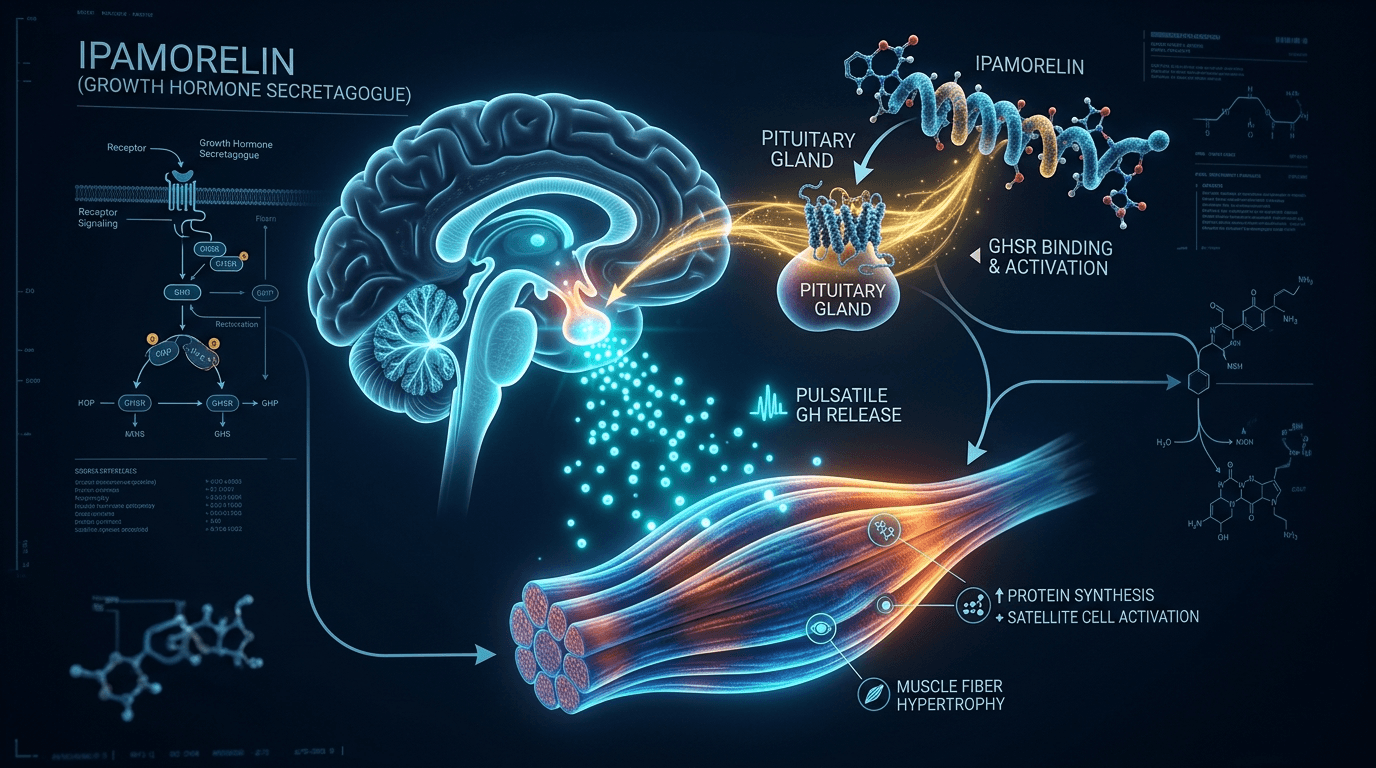
Ipamorelin is the most selective growth hormone secretagogue ever developed — it stimulates pulsatile GH release without raising cortisol, prolactin, or ACTH. This 2026 complete guide covers mechanism, optimal dosing protocols, CJC-1295 stacking strategies, clinical evidence, and verified sources.
Ipamorelin occupies a unique position in the growth hormone secretagogue landscape. Unlike its predecessors GHRP-2 and GHRP-6 — which cause significant elevations in cortisol and prolactin alongside GH release — ipamorelin produces clean, selective GH pulses through ghrelin receptor activation with minimal off-target hormonal activity.
This selectivity is clinically meaningful. Elevated cortisol is catabolic to muscle tissue and suppresses immune function — the exact opposite of what most people are trying to achieve with a GH peptide protocol. Elevated prolactin causes libido reduction and potential estrogenic effects in men. GHRP-6 notoriously triggers acute hunger that makes caloric control difficult. Ipamorelin avoids all three of these downsides.
The result: ipamorelin has become — paired with CJC-1295 — the most widely researched and used GH secretagogue combination globally in 2026. This guide covers everything: pharmacology, clinical data, optimal dosing, stacking, results timeline, and where to source quality-verified material.
How Ipamorelin Works: Selective Ghrelin Receptor Agonism
Ipamorelin is a synthetic pentapeptide (Aib-His-D-2-Nal-D-Phe-Lys-NH₂) developed by Novo Nordisk in the late 1990s. It acts as a selective agonist at the growth hormone secretagogue receptor (GHSR-1a) — commonly called the ghrelin receptor — primarily in pituitary somatotrophs and hypothalamic neurons.
Activating GHSR-1a stimulates the release of stored GH from pituitary somatotrophs. What sets ipamorelin apart from earlier GHRPs is its pharmacological cleanliness:
- No ACTH/cortisol elevation: Unlike GHRP-2 and GHRP-6, ipamorelin does not stimulate the pituitary-adrenal axis. This was definitively established by Raun et al. (1998) using both in vitro pituitary cell assays and in vivo rodent models with equimolar doses [1].
- No prolactin elevation: Prolactin increase from GHRP-2 causes libido reduction and gynecomastia concerns. Ipamorelin avoids this entirely.
- Minimal appetite stimulation: GHRP-6 causes significant acute hunger through ghrelin-mediated hypothalamic NPY stimulation. Ipamorelin's hunger effect is minor by comparison.
- Preserved somatostatin feedback: Ipamorelin works within the natural GH feedback loop. When somatostatin (GH's endogenous inhibitor) is high, ipamorelin's GH-releasing effect is blunted — the body can still regulate GH levels. This prevents the runaway IGF-1 elevation seen with exogenous HGH.
The Pulsatile GH Pattern
After subcutaneous injection, ipamorelin reaches peak plasma concentration at 15-30 minutes, triggering a GH pulse that peaks 30-60 minutes post-injection and returns to baseline within 2-4 hours. This pulsatile pattern closely mirrors natural GH secretion — which is essential for optimal anabolic signaling, fat metabolism, and IGF-1 production without receptor downregulation [4].
GHRP Hormonal Selectivity: GH Potency vs Off-Target Effects
Relative Hormonal Effect Profile of GHRPs (higher = more effect)
Based on Raun et al. 1998 (Eur J Endocrinol) and comparative GHRP studies. Ipamorelin achieves near-equivalent GH release with dramatically lower cortisol and prolactin stimulation vs other GHRPs.
Clinical Evidence Base
Ipamorelin has a solid clinical research foundation spanning foundational pharmacology through human clinical trials.
The Foundational Selectivity Study (Raun et al., 1998)
The defining ipamorelin paper from Novo Nordisk established its selectivity advantage over GHRP-2 and GHRP-6. At equimolar doses in rat pituitary cell cultures and in vivo rodent models, ipamorelin produced robust GH stimulation with no detectable ACTH or cortisol elevation — versus significant increases with both comparators. This pharmacological profile set ipamorelin apart from every previous GHRP and remains the foundation for its clinical use today [1].
Clinical Trials for Post-Operative Ileus
Ipamorelin's largest human clinical program was conducted by Helsinn Healthcare for post-operative ileus (POI) — a condition where GI motility is severely impaired following abdominal surgery. Ghrelin receptors in the GI tract regulate motility, and GHSR-1a agonists accelerate GI recovery.
Phase II/III trials (NCT00988520, NCT01328184) demonstrated that ipamorelin significantly reduced time to first bowel movement and hospital length of stay after colonic surgery. While POI differs from anti-aging or body composition applications, these trials validated ipamorelin's human pharmacokinetics, tolerability profile, and dosing parameters in a controlled clinical setting.
GH Pulse and IGF-1 Pharmacodynamics
Multiple human pharmacokinetic studies confirm that 200-300 mcg subcutaneous ipamorelin produces GH peaks of 2-10 ng/mL (versus normal baseline pulses of 0.5-3 ng/mL in adults), with IGF-1 elevation of 15-30% over repeated dosing cycles. Crucially, the pulsatile GH pattern is preserved, and IGF-1 levels remain within or modestly above physiological ranges — avoiding the supraphysiological IGF-1 overshoot that accompanies exogenous GH injection [2,5].
| Goal | Dose | Frequency | Optimal Timing | Cycle Length |
|---|---|---|---|---|
| Anti-aging / longevity | 200 mcg | 1x daily | Before bed (fasted) | 6-12 months continuous |
| Body recomposition | 200-300 mcg | 2x daily | Morning + before bed | 12-16 weeks |
| Enhanced recovery / sport | 200 mcg | 2x daily | Post-training + before bed | 8-16 weeks |
| Maximum GH output (stacked) | 200-300 mcg ipamorelin | 1-2x daily | With Mod GRF 1-29 | 12-24 weeks |
Elevated blood glucose and insulin profoundly blunt GH secretion — injecting in a fed state reduces GH pulse magnitude by 30-70%. The most GH-productive ipamorelin injections occur fasted: first thing in the morning (before breakfast), 2+ hours after the last meal during the day, or immediately before bed (2-3 hours post-dinner). Avoid high-carbohydrate or high-fat meals within 90 minutes of injection. A protein-only small meal 60-90 minutes before injection is acceptable; carbohydrates are the primary concern since they drive the insulin response that suppresses GH.
Stacking Ipamorelin: Why the GHRH Combination Matters
Ipamorelin's clinical value compounds dramatically when combined with a GHRH analog. The mechanism is complementary: ipamorelin stimulates GH release from pituitary somatotrophs by activating ghrelin receptors (GHSR-1a), while GHRH analogs like Mod GRF 1-29 amplify the pituitary's GH synthesis capacity via the GHRH receptor. These pathways act through different second messenger systems and produce synergistic, rather than simply additive, GH pulses — research in human subjects demonstrates 4-10x greater GH peaks from the combination versus either peptide alone [5,6].
The Classic Stack: Ipamorelin + Mod GRF 1-29
Mod GRF 1-29 (often incorrectly called CJC-1295 no-DAC) has a 30-minute half-life similar to ipamorelin. Co-injecting both peptides produces a synchronized, powerful GH pulse that closely mimics natural physiology. Standard doses: 100-200 mcg Mod GRF 1-29 + 200 mcg ipamorelin per injection, 1-3x daily.
Ipamorelin + CJC-1295 DAC
CJC-1295 with Drug Affinity Complex extends the GHRH analog half-life to 7-8 days via albumin binding, enabling once-weekly dosing. Combined with daily ipamorelin, this creates a "GH baseline elevation" from CJC-1295 DAC with ipamorelin-triggered acute pulses layered on top. Weekly CJC-1295 DAC dose: 1-2 mg. This format trades physiological pulsatility for injection convenience — some practitioners prefer it for anti-aging protocols; others prefer pure pulsatile patterns for body composition goals.
| Timeframe | Commonly Reported Changes | Underlying Mechanism |
|---|---|---|
| Weeks 1-2 | Deeper sleep, vivid dreams, morning grogginess | GH pulse during slow-wave sleep amplified |
| Weeks 2-4 | Mild water retention, increased daytime energy | GH-mediated fluid shifts, improved mitochondrial function |
| Weeks 4-8 | Faster post-workout recovery, strength gains | Collagen synthesis upregulation, protein synthesis via IGF-1 |
| Weeks 8-12 | Visible fat reduction, muscle volume improvement | Sustained lipolysis from elevated IGF-1, anabolic signaling |
| Weeks 12-24 | Skin quality, joint comfort, body recomposition | Collagen renewal, ongoing anabolic and lipolytic dual effect |
Side Effects and Safety
Ipamorelin's selectivity translates to an exceptionally clean side effect profile versus older GHRPs:
- Water retention: Mild, most noticeable weeks 2-6. GH increases extracellular water — subcutaneous, not dangerous, and self-resolving as the body adapts to elevated IGF-1.
- Tingling or numbness in extremities: Carpal tunnel-like symptoms from GH-induced fluid shifts around peripheral nerves. More common above 300 mcg per injection. Dose reduction resolves it.
- Headaches: Occasionally in weeks 1-2 as the body adjusts. Usually resolves spontaneously within 7-14 days.
- Injection site reactions: Minor redness or irritation typical of subcutaneous peptide injections. Rotate sites (abdomen, thigh, lateral arm) to minimize this.
What ipamorelin does NOT typically cause (unlike GHRP-2/6): significant cortisol elevation, prolactin increase, acute hunger, or rapid desensitization. Its selectivity profile makes it appropriate for long-duration protocols that would be impractical with less selective GHRPs [1,3].
Verified Ipamorelin Sources
PeptideTech
Editor's PickIpamorelin 5mg
$34.99
HPLC-verified, lyophilized 5mg vials, most economical per-dose cost
Modified Aminos
Best ValueIpamorelin + Mod GRF 1-29 Stack Kit
$69.99
Bundle includes ipamorelin + Mod GRF 1-29, both HPLC tested, best stack value
AminoUSA
Ipamorelin 2mg
$24.99
Domestic US shipping, 2mg and 5mg options, batch COA available online
VANDL Labs
PremiumIpamorelin 5mg Premium
$39.99
Pharmaceutical-grade lyophilization, independent third-party COA, excellent vial stability
Ipamorelin FAQ
How long does it take for ipamorelin to show results?
Sleep quality and energy improvements are typically noticed within 1-2 weeks. Body composition changes (fat reduction, muscle quality improvement) are gradual and typically visible at 8-12 weeks with consistent daily dosing. Collagen-related benefits (skin elasticity, joint comfort) emerge at 12+ weeks and continue improving through 6-12 months of continuous use.
Is ipamorelin better than HGH injections?
Ipamorelin works within physiological feedback mechanisms — it stimulates your own pituitary to produce GH in natural pulses, preserving the body's regulatory capacity. Exogenous HGH bypasses these mechanisms, suppresses natural production, and produces higher absolute GH/IGF-1 levels with correspondingly greater side effect potential. For most anti-aging and body composition goals, ipamorelin + GHRH analog produces meaningful benefits with substantially less risk than supraphysiological exogenous HGH.
Should I stack ipamorelin with CJC-1295?
Yes — the combination produces 4-10x higher GH pulses than either peptide alone. Mod GRF 1-29 (CJC-1295 without DAC) co-injected with ipamorelin is the most physiologically sound approach for pulsatile GH release. The stack is used in the foundational protocol in our <a href="/blog/cjc-1295-ipamorelin-stack-guide">CJC-1295 + Ipamorelin Stack Guide</a>.
How many injections per day are optimal?
Once before bed is sufficient for anti-aging and sleep optimization goals. Twice daily (morning + before bed) enhances body composition results significantly. Three times daily (morning, pre-workout, before bed) is used in aggressive body recomposition protocols. Most practitioners find twice daily the best balance of results to injection burden.
Does ipamorelin cause water retention?
Mild water retention is common in the first 4-6 weeks, consistent with any GH secretagogue protocol. It is typically subcutaneous and not clinically concerning. It usually reduces as the body adapts to modestly elevated IGF-1. Reducing sodium intake and maintaining adequate hydration helps manage this.
Can women use ipamorelin safely?
Yes. Ipamorelin's hormonal selectivity — no androgen stimulation, no prolactin effect, no meaningful cortisol elevation — makes it appropriate for female protocols. Women naturally have higher baseline GH pulse amplitudes than men, so lower doses (100-200 mcg per injection) typically suffice. Starting at 100 mcg and increasing based on response and tolerance is recommended.
The Bottom Line on Ipamorelin
Ipamorelin's combination of clinical validation, hormonal selectivity, and practical usability makes it the benchmark GHRP in 2026. Whether used alone for sleep and anti-aging optimization or stacked with a GHRH analog for comprehensive body recomposition, it delivers meaningful GH-mediated benefits without the cortisol, prolactin, and hunger downsides that limited older GHRPs.
The key to successful ipamorelin protocols is consistent daily dosing in a fasted state, appropriate injection timing relative to sleep and training, patience for the body composition changes that require weeks to months to manifest, and pairing with a GHRH analog to maximize the synergistic GH pulse amplitude.
For the complete ipamorelin pharmacology profile and comparison to other GHRPs, see the PeptideWiki Ipamorelin Database Page. For the full stack guide, see our CJC-1295 + Ipamorelin Complete Stack Guide.
Sources & References
- 1.Raun K, Hansen BS, Johansen NL, et al.. "Ipamorelin, the first selective growth hormone secretagogue" — European Journal of Endocrinology, 1998. DOI: 10.1530/eje.0.1390552.View source
- 2.Svensson J, Lönn L, Jansson JO, et al.. "Two-month treatment of obese subjects with the oral growth hormone (GH) secretagogue MK-677 increases GH secretion, fat-free mass, and energy expenditure" — Journal of Clinical Endocrinology & Metabolism, 1998. DOI: 10.1210/jcem.83.2.4553.View source
- 3.Nass R, Pezzoli SS, Oliveri MC, et al.. "Effects of an oral ghrelin mimetic on body composition and clinical outcomes in healthy older adults" — Annals of Internal Medicine, 2008. DOI: 10.7326/0003-4819-149-9-200811040-00003.View source
- 4.Veldhuis JD, Bowers CY. "Human GH pulsatility: an ensemble property regulated by age and gender" — Journal of Endocrinological Investigation, 2003.View source
- 5.Khorram O, Yeung M, Vu L, Yen SS. "Effects of [Nle27] growth hormone-releasing hormone (1-29)-NH2 administration on the pulsatile release of GH and IGF-I in healthy adults" — Journal of Clinical Endocrinology & Metabolism, 1997. DOI: 10.1210/jcem.82.9.4212.View source
- 6.Smith RG, Van der Ploeg LH, Howard AD, et al.. "Peptidomimetic regulation of growth hormone secretion" — Endocrine Reviews, 1997. DOI: 10.1210/edrv.18.5.0316.View source