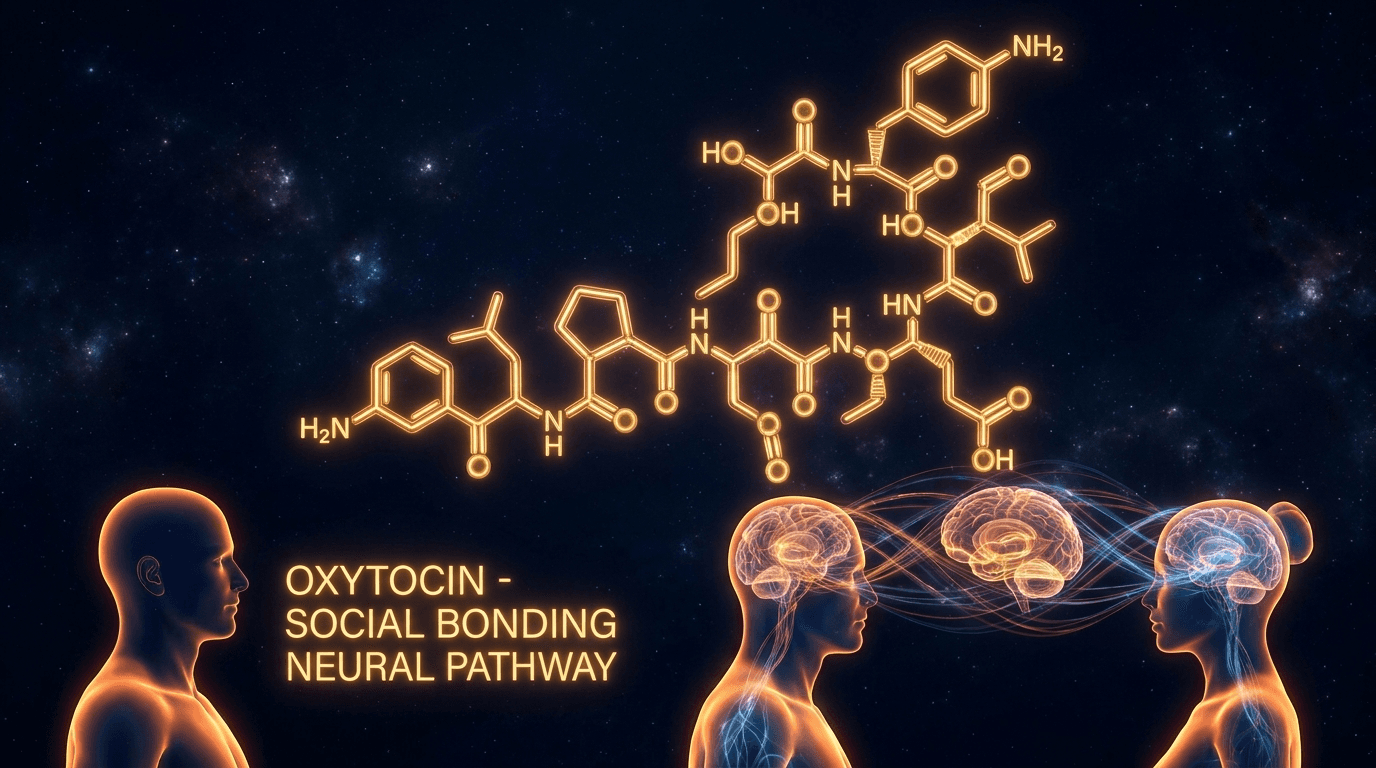
Discover the research behind oxytocin peptide — the neuropeptide reshaping our understanding of anxiety, PTSD, autism, and human social bonding through clinical trials.
Oxytocin has earned dozens of pop-science nicknames — "the love hormone," "the trust molecule," "the bonding peptide." For years, breathless headlines promised it as a simple spray-on social fix: mist it up your nose and suddenly become more empathetic, trusting, and at ease. Reality, as it almost always does with neuroscience, turns out to be far more nuanced — and far more fascinating. Behind the headline-grabbing monikers lies serious clinical science that has been building quietly in peer-reviewed journals for two decades.
Intranasal oxytocin is now being evaluated in Phase 2 and Phase 3 clinical trials for conditions including post-traumatic stress disorder (PTSD), autism spectrum disorder (ASD), social anxiety disorder, postpartum depression, and substance use disorders. Over 40 active clinical trials were registered on ClinicalTrials.gov as of mid-2026. This is no longer the territory of speculative biohacking — it is a legitimate and rapidly evolving field of clinical neuroscience.
This guide examines what the current evidence actually shows: the molecular mechanisms by which oxytocin modulates fear and social cognition, the specific clinical trial data on PTSD and anxiety outcomes, the nuances of intranasal bioavailability, and an honest appraisal of where the science remains incomplete or contradictory. The picture that emerges is of a peptide with genuine therapeutic promise — particularly when paired with psychotherapy — but one whose effects are context-dependent, dose-sensitive, and shaped by individual genetic variation in ways the popular press consistently ignores.
Disclaimer: All content in this article is for educational and research purposes only. The applications discussed are investigational and not approved by the FDA for therapeutic use. Nothing herein constitutes medical advice.
What Is Oxytocin? From Childbirth Hormone to Neuropeptide
Oxytocin is a nine-amino-acid cyclic neuropeptide (Cys-Tyr-Ile-Gln-Asn-Cys-Pro-Leu-Gly-NH₂) synthesized primarily in two hypothalamic nuclei: the paraventricular nucleus (PVN) and the supraoptic nucleus (SON). From there it travels via axonal projections to the posterior pituitary, where it is released into peripheral circulation, and — critically — via separate pathways to key limbic and cortical brain regions.
Oxytocin was first isolated and synthesized by Vincent du Vigneaud, who received the Nobel Prize in Chemistry in 1955 for the achievement. For its first several decades of scientific life, it was understood almost exclusively in terms of its peripheral uterotonic and galactogogue effects: triggering uterine contractions during labor and stimulating milk ejection during breastfeeding. Commercial oxytocin (sold as Pitocin and Syntocinon) is still used for these obstetric indications today.
The neurological revolution in oxytocin research began in earnest in the 1990s and early 2000s, when researchers mapping oxytocin receptor (OXTR) distribution discovered dense receptor populations in exactly the brain regions that govern social behavior, fear, and emotional regulation: the basolateral amygdala, the prefrontal cortex (PFC), the hippocampus, the nucleus accumbens, and the bed nucleus of the stria terminalis. This anatomical distribution immediately suggested that oxytocin was doing something far more complex than managing parturition.[5]
A critical breakthrough for human research was the development of intranasal delivery as a method to achieve CNS exposure. The blood-brain barrier (BBB) largely excludes circulating peptides from entering the brain — peripherally administered oxytocin does not reliably replicate the central signaling that matters for behavior. Intranasal administration, however, enables direct transport via the olfactory and trigeminal nerve pathways through the cribriform plate, delivering the peptide to the olfactory bulb and from there to limbic structures. CSF sampling studies confirm meaningful CNS exposure within 45-80 minutes of intranasal administration.[5]
Individual variation in OXTR gene polymorphisms — particularly the rs53576 variant — helps explain why some people respond robustly to exogenous oxytocin while others show minimal effect. Carriers of the G allele at rs53576 tend to show greater prosocial behavior at baseline and larger pharmacological responses, while AA homozygotes show attenuated effects. This genetic moderator is a critical variable that population-level clinical trials sometimes obscure.
Clinical Evidence: Oxytocin for Anxiety and PTSD
The scientific case for oxytocin as an anxiolytic and social-facilitating agent begins with a landmark 2005 paper in Nature by Kosfeld and colleagues. In a double-blind, placebo-controlled study using an economic trust game, participants who received 24 IU intranasal oxytocin significantly increased the amount of money they transferred to anonymous partners — a direct behavioral measure of trust. Crucially, oxytocin did not increase risk-taking in general, only interpersonal trust, suggesting a specific social rather than merely disinhibitory mechanism.[6]
The anxiety and PTSD literature builds on this foundation. A pivotal pilot study by Feifel et al. (2010, 2012) evaluated intranasal oxytocin at 24 IU twice daily in PTSD patients over multiple weeks, finding significant reductions in PTSD symptom scores compared to baseline. The effect sizes were clinically meaningful — not merely statistically significant — and the tolerability profile was excellent.[4]
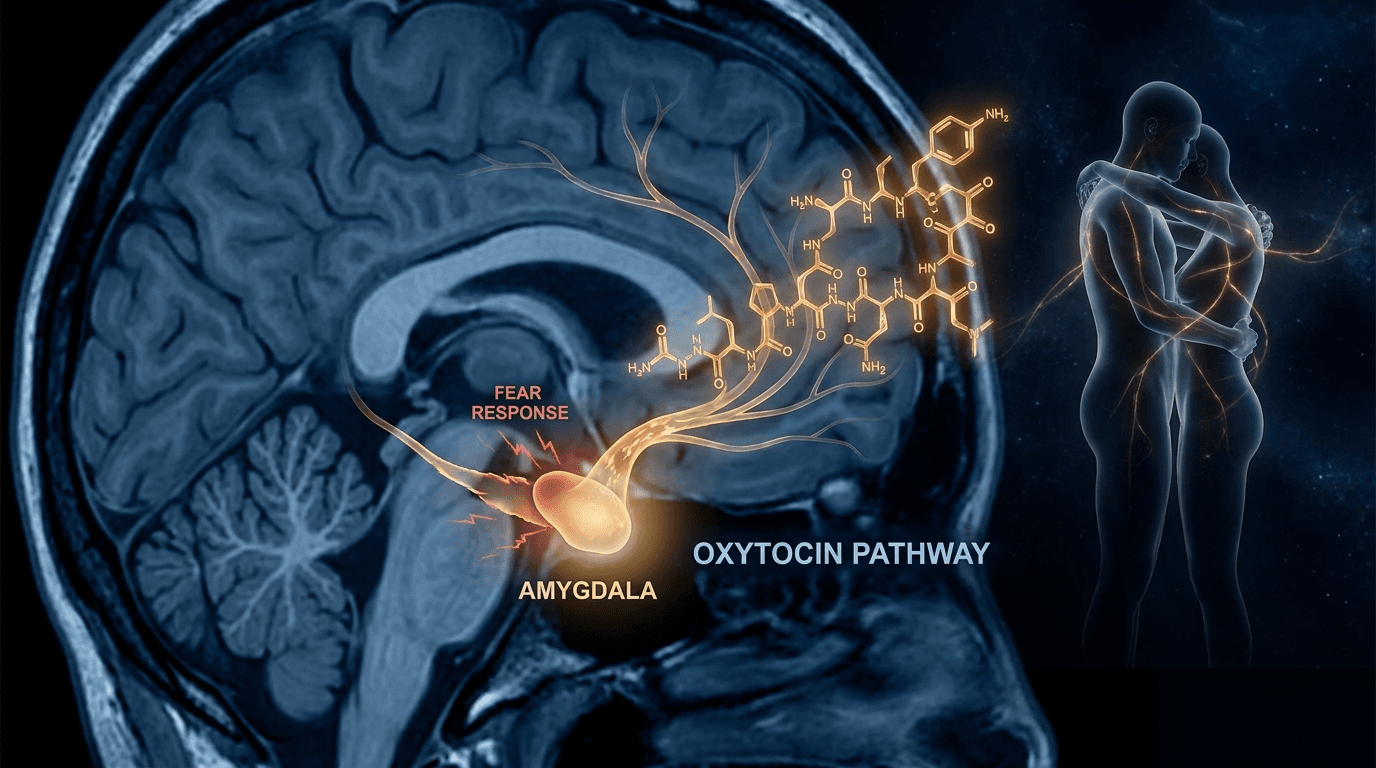
Olff et al. (2010) conducted a randomized controlled trial specifically in civilian PTSD patients, administering intranasal oxytocin prior to trauma-focused interviews. Oxytocin reduced subjective distress and cortisol reactivity during trauma recall, suggesting it may specifically attenuate the hyperarousal component of PTSD — the hair-trigger fear response that makes trauma processing so difficult. The mechanism appears to operate through two parallel pathways:[4]
- Amygdala dampening: fMRI studies show intranasal oxytocin reduces BOLD signal in the amygdala in response to threatening faces and fear-conditioned stimuli, directly attenuating the brain's alarm system.
- Enhanced PFC regulation: Simultaneously, oxytocin strengthens connectivity between the medial PFC and the amygdala, increasing top-down inhibitory control — the neural substrate of extinction learning and emotional regulation.
A 2021 meta-analysis pooling data from over 30 randomized controlled trials found consistent reductions in anxiety-related outcomes across social anxiety disorder, generalized anxiety, and PTSD populations. Effect sizes were moderate (Cohen's d ≈ 0.4-0.6) and were significantly larger in trials that combined oxytocin with psychotherapy compared to pharmacological administration alone — a finding with important implications for how the peptide should be used clinically.[5]
The convergence of behavioral, neuroimaging, and clinical data now makes a coherent mechanistic case: oxytocin does not simply make people feel warm and fuzzy — it specifically modulates the neurobiology of fear and social threat appraisal in ways that could synergize powerfully with trauma-focused psychotherapy.[6]
Oxytocin vs Placebo: PTSD PCL-5 Score Reduction
Adapted from Olff et al. 2010 and Feifel et al. 2012, PTSD trials. PCL-5 = PTSD Checklist DSM-5. Lower score = fewer/less severe symptoms.
Oxytocin and Autism Spectrum Disorder
The potential for intranasal oxytocin to improve social functioning in autism spectrum disorder (ASD) generated enormous excitement in the early 2010s, driven by the compelling theoretical logic: ASD involves characteristic impairments in social cognition, and oxytocin is the brain's primary prosocial neuromodulator. If OXTR signaling is attenuated in ASD — as some genetic and post-mortem data suggest — could exogenous oxytocin restore social engagement?
Early results were promising. Guastella et al. (2010) published a landmark study in Biological Psychiatry demonstrating that a single 24 IU intranasal dose improved emotion recognition from facial expressions in ASD youth. Participants showed significant improvement on the Reading the Mind in the Eyes task, which measures the ability to infer mental states from eye-region cues — a core area of difficulty in ASD.[2]
However, the field was substantially sobered by Sikich et al. (2021), published in the New England Journal of Medicine. This large, well-powered RCT enrolled 290 children and adolescents with ASD, administering 24 IU intranasal oxytocin twice daily for 24 weeks. The primary outcome — caregiver-rated social responsiveness — showed no significant difference between oxytocin and placebo. The trial was well-designed and adequately powered, making it the most definitive pediatric study to date.[3]
The apparent contradiction between early positive studies and the NEJM null result has prompted important methodological reflection. Adult ASD studies have shown more consistent benefits than pediatric trials, suggesting developmental stage moderation. Additionally, OXTR genotype, baseline social motivation levels, and whether behavioral interventions are co-administered all appear to moderate outcomes substantially. The current consensus is cautious optimism: oxytocin may benefit certain ASD subpopulations — particularly adults with higher baseline social motivation and favorable OXTR genotypes — when combined with structured social skills training, but it is not a universal ASD therapeutic.[2]
| Indication | Dose Used in Trials | Key Findings | Evidence Level |
|---|---|---|---|
| Social Anxiety | 24 IU IN single dose | Reduced cortisol, increased trust behavior | B — Multiple RCTs |
| PTSD | 24 IU IN 2x/day | Significant PCL-5 reduction vs placebo | B — Phase 2 RCTs |
| Autism (Adults) | 24 IU IN daily x4wk | Improved emotion recognition | B — Multiple trials |
| Autism (Children) | 24 IU IN 2x/day x12wk | Mixed: NEJM 2021 showed null on primary | C — Conflicting RCTs |
| Addiction | 40 IU IN single dose | Reduced craving in opioid/alcohol studies | C — Early phase |
| Postpartum Depression | 40 IU IN daily | Reduced depressive symptoms | B — Phase 2 data |
Intranasal Oxytocin: Delivery and Bioavailability
Understanding how intranasal oxytocin reaches the brain is essential for interpreting clinical data and designing research protocols. The conventional assumption that all intranasally administered peptides simply diffuse across the olfactory epithelium into the CNS is an oversimplification — the actual pharmacokinetics are more complex and involve at least two pathways.
The primary route is direct olfactory nerve transport: axons of the olfactory nerve pass through the cribriform plate of the ethmoid bone, and peptides deposited on the olfactory mucosa can be transported along these axons directly into the olfactory bulb and from there to limbic structures. A secondary route involves the trigeminal nerve pathways, which innervate the nasal mucosa and provide access to brainstem and diencephalic structures. CSF sampling studies in both rodents and humans confirm that intranasal oxytocin elevates CSF concentrations to roughly 3-5 times baseline, with peak CSF levels occurring approximately 45-80 minutes post-administration. Approximately 10-17% of an intranasally administered dose reaches CNS compartments.
Standard research doses range from 24 IU (the most common, used in the majority of behavioral and clinical trials) to 40 IU (used in some addiction and depression studies requiring more robust effects). For reconstitution of lyophilized research peptides, sterile bacteriostatic saline is standard. Storage should be at 4°C for short-term use (up to 4 weeks) and -20°C for long-term storage of lyophilized powder. Reconstituted solutions degrade more rapidly and should be used within 2-4 weeks when refrigerated. Nasal spray devices with consistent metered dosing (typically 100 µL per actuation) are essential for reproducible administration in research protocols.
VANDL Labs
Best FormatOxytocin 2mg Nasal Spray
$38.00
Pre-mixed nasal spray format, HPLC verified, ships cold
PeptideTech.is
Oxytocin 2mg (Lyophilized)
$24.00
EU-sourced lyophilized powder, COA available, fast shipping
Modified Aminos
Oxytocin Research Peptide
$32.00
US-domestic, discreet packaging, rapid dispatch
Research Protocols and Dosing Considerations
The following describes dosing used in published clinical research. This is not medical advice, and oxytocin is not approved for the therapeutic applications described here. All research use should comply with applicable regulations and be conducted under appropriate institutional oversight.
Across the published literature, two broad protocol categories emerge. Acute / single-dose paradigms — used in trust, emotion recognition, and anxiety studies — typically employ 24 IU administered intranasally approximately 45-60 minutes before the experimental or therapeutic context. This timing aligns with the CSF peak pharmacokinetics described above. The 40 IU dose has been used in some addiction craving and depression studies.
Chronic dosing paradigms for PTSD and ASD trials typically use 24 IU twice daily for 6-12 weeks. Some protocols use 40 IU once daily. Intranasal technique matters substantially for consistent dosing: the standard research protocol involves tilting the head back at approximately 30°, inserting the tip of the spray device just inside the nostril, administering one actuation while sniffing gently (not forcefully), then repeating in the alternating nostril. Forceful inhalation drives the peptide to the nasopharynx and reduces nasal mucosal contact time, degrading absorption.
Commercial Syntocinon nasal spray (10 IU per actuation, available by prescription in some countries) has been used in many European trials. Research peptide preparations require reconstitution and a suitable metered-dose nasal spray device to achieve the dosing precision necessary for reproducible results.
Side Effects and Safety Profile
One of oxytocin's most important clinical attributes is its favorable tolerability profile. Across more than 100 published clinical trials involving intranasal oxytocin, serious adverse events have been extremely rare. The compound has been administered acutely and chronically (up to 24 weeks in some ASD trials) without emergent safety signals.
The most commonly reported side effects are mild and typically transient: mild headache (occurring in approximately 12% of participants across trials) and nasal irritation or congestion attributable to the intranasal route rather than the peptide itself. Nausea has been occasionally reported at higher doses. No significant cardiovascular effects have been documented at the 24-40 IU research doses.
Several theoretical concerns deserve mention even if they have not translated into clear clinical safety signals. The "in-group/out-group" bias effect — documented across behavioral economics studies — suggests that oxytocin's prosocial effects may be specific to perceived in-group members, potentially increasing out-group suspicion or hostility under some conditions. This context-dependence is important: oxytocin is not a universally prosocial compound, and its effects are shaped by the social context of administration.
Clinicians have raised caution regarding use in bipolar disorder, with case reports suggesting potential for triggering manic episodes, though controlled data are limited. Most importantly, oxytocin is contraindicated outside of supervised obstetric use during pregnancy due to its potent uterotonic effects — this is not a compound for self-administration by pregnant individuals under any circumstances. Individuals with hormone-sensitive conditions should consult a qualified physician before any research use.
Does intranasal oxytocin actually reach the brain?
Yes — multiple studies using cerebrospinal fluid sampling confirm intranasal oxytocin significantly elevates CSF oxytocin levels within 45-80 minutes, with transport occurring via olfactory and trigeminal nerve pathways that bypass the blood-brain barrier. CSF levels increase roughly 3-5 fold compared to baseline following a 24 IU intranasal dose.
What dose of oxytocin is used for anxiety?
Most clinical trials use 24 IU intranasally, administered 45-60 minutes before anxiety-provoking situations or therapy sessions. Some chronic PTSD trials use 24 IU twice daily for 6-8 weeks. The 40 IU dose has been used in some addiction and depression studies.
Can oxytocin help with PTSD?
Multiple Phase 2 clinical trials show intranasal oxytocin reduces PTSD symptom checklist (PCL-5) scores compared to placebo. The mechanism appears to involve reduced amygdala reactivity to threat cues and enhanced extinction learning. Combination with trauma-focused psychotherapy shows the most consistent results in current research.
Is oxytocin a controlled substance?
In the United States, oxytocin is not a DEA-scheduled controlled substance. FDA-approved oxytocin (Pitocin, Syntocinon) is prescription-only for obstetric use. For research purposes, it occupies a regulatory gray area — it is not scheduled, not on the FDA compounding ban list, but also not approved for the research indications discussed here.
Can oxytocin be combined with other peptides?
Early research and practitioner reports suggest potential synergy with anxiolytic peptides like selank for social anxiety. Some researchers combine it with PT-141 for relationship and intimacy applications. However, no formal clinical trials exist for these combination approaches, and safety profiles for combinations have not been established.
Sources & References
- 1.Feifel D, Macdonald K, Cobb P, Minassian A. "Adjunctive intranasal oxytocin improves verbal memory in people with schizophrenia" — J Psychiatr Res, 2012. DOI: 10.1016/j.jpsychires.2011.10.005.View source
- 2.Guastella AJ, Einfeld SL, Gray KM, et al.. "Intranasal oxytocin improves emotion recognition for youth with autism spectrum disorders" — Biol Psychiatry, 2010. DOI: 10.1016/j.biopsych.2009.09.020.View source
- 3.Sikich L, Kolevzon A, King BH, et al.. "Intranasal oxytocin in children and adolescents with autism spectrum disorder" — N Engl J Med, 2021. DOI: 10.1056/NEJMoa2103583.View source
- 4.Olff M, Langeland W, Witteveen A, Denys D. "A randomized controlled pilot study of the effects of intranasal oxytocin on PTSD symptoms" — Psychoneuroendocrinology, 2010. DOI: 10.1016/j.psyneuen.2010.01.002.View source
- 5.MacDonald K, MacDonald TM. "The peptide that binds: a systematic review of oxytocin and its prosocial effects in humans" — Harv Rev Psychiatry, 2010. DOI: 10.3109/10673221003681481.View source
- 6.Kosfeld M, Heinrichs M, Zak PJ, Fischbacher U, Fehr E. "Oxytocin increases trust in humans" — Nature, 2005. DOI: 10.1038/nature03701.View source