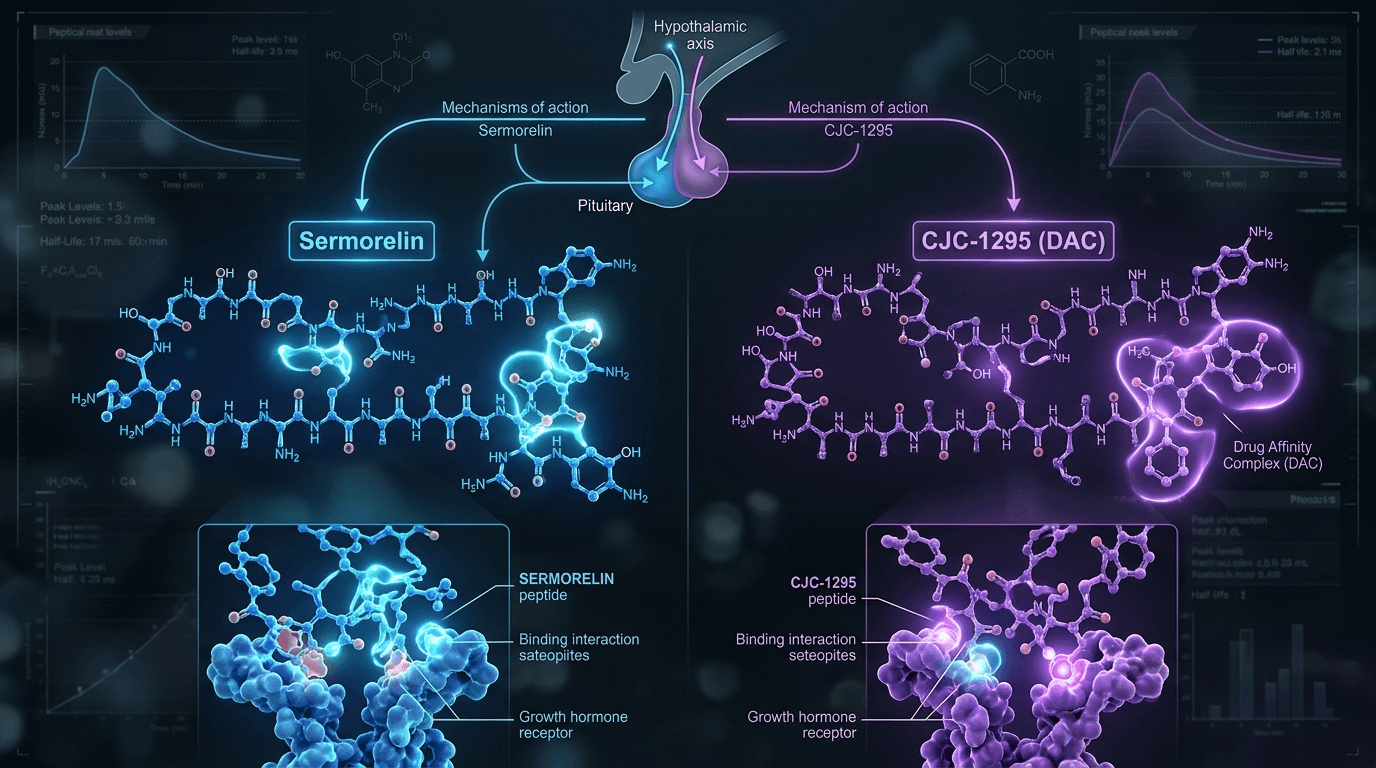
Sermorelin and CJC-1295 are both GHRH analogs that stimulate GH release — but they differ dramatically in half-life, mechanism, clinical data depth, and cost. This complete 2026 comparison breaks down the science, pulsatile vs continuous GH release, optimal protocols, and when to choose each.
If you have spent any time researching growth hormone peptides, you have encountered the sermorelin vs CJC-1295 question. Both are GHRH analogs — modified versions of the body's own growth hormone-releasing hormone — and both stimulate GH release from the pituitary. But they are pharmacologically distinct compounds with different properties that suit different goals and protocols.
Sermorelin is the grandfather of GHRH therapy: a 29-amino-acid fragment of natural GHRH(1-44) with an FDA approval history, two decades of clinical use data in adults, and a track record in anti-aging medicine that dates back to the 1990s. CJC-1295 is a modified version of that same GHRH fragment — but the name covers two distinct molecules with dramatically different pharmacokinetics. CJC-1295 without DAC (also called Mod GRF 1-29) behaves similarly to sermorelin. CJC-1295 with DAC extends the half-life to 7-8 days through albumin binding, fundamentally changing the GH release pattern.
This guide resolves the confusion with a systematic comparison: pharmacology, half-life, clinical evidence, dosing, cost, and the clinically important question of pulsatile versus continuous GH release.
Sermorelin: The Original GHRH Fragment
Sermorelin (GHRH 1-29 NH₂) corresponds to the first 29 amino acids of endogenous GHRH(1-44) — the minimum sequence required for full GHRH receptor binding and activation. It was originally developed for diagnostic testing of GH secretory capacity and subsequently used therapeutically for GH deficiency under the brand name Geref.
Key pharmacological characteristics:
- Mechanism: Binds GHRH receptors on pituitary somatotrophs, stimulating both GH synthesis and pulsatile secretion
- Half-life: 10-20 minutes in plasma (rapid cleavage by serum dipeptidyl aminopeptidase IV)
- GH release pattern: Purely pulsatile — follows natural physiological timing determined by endogenous somatostatin feedback
- Regulatory history: FDA approved for pediatric GHD (Geref, Serono); withdrawn from US market in 2008 for commercial/manufacturing reasons, not safety concerns
- Clinical safety data: Extensive — 30+ years of human use data including pediatric and adult populations [1,2]
Sermorelin's short half-life is simultaneously a limitation (requires daily injection) and a pharmacological feature: the pulse pattern precisely mirrors natural GH physiology, somatostatin feedback is fully preserved, and there is no risk of sustained GH elevation that could cause receptor desensitization. The body can "regulate around" sermorelin in ways it cannot with long-acting GHRH analogs.
CJC-1295: Three Names, Two Very Different Drugs
The CJC-1295 naming situation is one of the most persistent sources of confusion in peptide research. Understanding the distinction is essential for dosing correctly:
Mod GRF 1-29 (frequently called "CJC-1295 without DAC" or "CJC-1295 no-DAC")
Modified GRF 1-29 shares sermorelin's 29-amino-acid core but contains four strategic amino acid substitutions that protect against serum enzyme degradation (Ala² → D-Ala, Gln⁸ → Aib, Ser⁹ → Ala, Leu²⁷ → Nle). These substitutions extend plasma half-life to approximately 30 minutes — roughly double sermorelin. It produces pulsatile GH release identical in character to sermorelin when co-injected with a GHRP, with modestly better per-dose efficiency due to extended receptor occupancy.
Note: technically, this molecule is Mod GRF 1-29, not CJC-1295 — but market convention has unfortunately merged the names. When ordering "CJC-1295 no-DAC," you should be receiving Mod GRF 1-29.
CJC-1295 DAC (with Drug Affinity Complex)
CJC-1295 DAC adds a reactive lysine residue (at position 15) with a maleimide-PEG linker that covalently bonds to plasma albumin after injection. Albumin binding protects the peptide from enzymatic degradation and dramatically extends effective half-life to 7-8 days. Once-weekly dosing is therefore feasible — a major convenience advantage [3].
The trade-off: albumin binding creates sustained GHRH receptor stimulation, generating a "GH bleed" pattern of continuous GH elevation rather than discrete pulses. This is fundamentally different physiology. Some clinical evidence suggests pulsatile GH may produce different tissue-level anabolic effects than the same total GH delivered continuously — a debate that remains unresolved in human research [4].
| Property | Sermorelin | Mod GRF 1-29 | CJC-1295 DAC |
|---|---|---|---|
| Mechanism | GHRH receptor agonist | GHRH receptor agonist | GHRH receptor agonist + albumin binding |
| Half-life | 10-20 min | ~30 min | 7-8 days |
| GH release pattern | Pulsatile | Pulsatile | Continuous ("GH bleed") |
| Dosing frequency | 1-2x daily | 1-2x daily | Once weekly |
| Requires GHRP co-admin? | Yes (strongly recommended) | Yes (strongly recommended) | Optional, but beneficial |
| Somatostatin feedback preserved? | Yes (fully) | Yes (fully) | Partially (blunted) |
| FDA approval history | Yes (Geref 1997-2008) | No | No |
| Clinical data depth | Extensive (30+ years) | Limited | Moderate (human PKD studies) |
| Injection convenience | Daily | Daily | Weekly |
| Typical cost per cycle | Low | Low-Moderate | Moderate |
Clinical Evidence: How the Data Compares
Sermorelin has the deepest human evidence base of any GHRH analog. Walker's 2006 review in Clinical Interventions in Aging synthesized the available evidence and positioned sermorelin as a physiologically sound approach to adult GH management — preserving pulsatile GH patterns while restoring the blunted GH axis that accompanies normal aging [2]. Thorner's landmark 1997 paper established the GHRH therapy framework that sermorelin's clinical positioning still rests on [1]. Multiple trials in age-advanced adults documented beneficial effects on body composition, bone mineral density, and sleep architecture.
Mod GRF 1-29 lacks specific human clinical trials despite widespread use. Its pharmacological equivalence to a stabilized, truncated GHRH analog is well-established in vitro and in animal models, but controlled human trials are absent.
CJC-1295 DAC has the most specific human pharmacokinetic data of the modified versions. Ionescu and Frohman (2006) conducted a dose-escalation study in healthy adults demonstrating that weekly CJC-1295 DAC injections produced sustained GH and IGF-1 elevation for 7-10 days per injection, with IGF-1 accumulation over repeated weeks [3]. A companion protein profiling study confirmed broad IGF-1-mediated changes in serum protein expression [4]. Crucially, pulsatile GH secretion was partially preserved even during continuous CJC-1295 DAC stimulation — an important finding that suggests the "GH bleed" is superimposed on, not a replacement for, pulsatile GH patterns.
GH Pulse Profile Comparison: Sermorelin vs CJC-1295 Variants
Estimated Peak GH (ng/mL) per Injection — Co-administered with Ipamorelin
Estimated from published PKD studies and comparative GHRH data. CJC-1295 DAC produces lower peak pulses but sustained trough elevation between injections. Values are illustrative.
When to Choose Each: The Decision Framework
The choice between sermorelin and CJC-1295 variants is not about which is "better" in an absolute sense — it depends on your specific goals, preferences, and risk tolerance:
Choose Sermorelin When:
- Clinical data depth and safety record is the top priority
- You want the most physiologically natural GH pulse pattern
- Cost is a significant consideration
- You are new to GH peptides and want the most extensively characterized compound
- You want to preserve complete somatostatin feedback regulation
Choose Mod GRF 1-29 When:
- You want modestly better per-dose efficiency than sermorelin
- Daily injection is acceptable and you prefer pulsatile GH release
- You're combining with daily ipamorelin for synchronized, potent GH pulses
Choose CJC-1295 DAC When:
- Injection convenience is the top priority (once weekly)
- You want sustained IGF-1 elevation for collagen synthesis and anti-aging applications
- You're comfortable with the continuous GH pattern and its tradeoffs
- You prefer a "set and forget" weekly injection combined with daily ipamorelin
| Protocol Name | Components & Dose | Frequency | Best For |
|---|---|---|---|
| Classic Anti-Aging | Sermorelin 100mcg + Ipamorelin 200mcg | 1x daily, before bed | Sleep, longevity, skin, joint health |
| Body Recomposition Standard | Mod GRF 1-29 100mcg + Ipamorelin 200mcg | 2x daily (AM + PM) | Fat loss, lean muscle, recovery |
| Convenience Protocol | CJC-1295 DAC 2mg weekly + Ipamorelin 200mcg daily | Weekly DAC + daily GHRP | Anti-aging, minimal injections |
| Advanced Recomposition | Mod GRF 1-29 200mcg + Ipamorelin 300mcg | 3x daily (AM, post-workout, PM) | Competitive body recomposition |
Sermorelin's FDA approval history (Geref, 1997) for pediatric GH deficiency means it has the most extensively characterized adverse event database of any GHRH analog — informing both its safety profile and dosing parameters in adults. The market withdrawal in 2008 was a commercial manufacturing decision by Serono, not a safety action. Sermorelin remains used clinically by US compounding pharmacies (with prescription) and in clinical practice internationally. For practitioners who place safety documentation above all other considerations, sermorelin's history provides a meaningful advantage over any of the CJC-1295 variants.
Verified Sources for GHRH Analogs
PeptideTech
Editor's PickSermorelin 5mg
$39.99
HPLC verified, lyophilized 5mg vials, ships with full COA and mass spec
Modified Aminos
Best ValueCJC-1295 DAC 2mg
$44.99
Weekly convenience format, tested for DAC attachment efficiency, batch COA published
AminoUSA
Mod GRF 1-29 (CJC-1295 no-DAC) 5mg
$34.99
Clearly labeled without DAC, domestic US shipping, batch COA available online
VANDL Labs
PremiumSermorelin 5mg Premium
$42.00
Premium lyophilized formulation, independent third-party COA, excellent reconstitution profile
Sermorelin vs CJC-1295 FAQ
Is CJC-1295 stronger than sermorelin?
CJC-1295 DAC produces more sustained GH and IGF-1 elevation due to its 7-8 day half-life — a different pattern, not strictly "stronger." Mod GRF 1-29 (no-DAC) produces a more potent single-injection GH pulse than sermorelin due to better enzymatic stability, but the biological character of the GH release is similar. For most goals, "more potent" equates to the combination of either GHRH analog + ipamorelin, not one GHRH compound alone.
Does CJC-1295 cause GH bleed?
The DAC version only. CJC-1295 DAC's albumin-binding half-life means GH levels remain continuously elevated between weekly injections — a "GH bleed" background. Ionescu & Frohman (2006) confirmed this but also showed pulsatile GH secretion was not fully abolished. Mod GRF 1-29 (without DAC) behaves like sermorelin and does NOT produce GH bleed.
Can I use sermorelin without a GHRP like ipamorelin?
Technically yes, but results are significantly reduced. GHRH analogs (including sermorelin) stimulate GH synthesis and release from pituitary somatotrophs; GHRPs like ipamorelin additionally suppress somatostatin (GH's endogenous inhibitor). The combination amplifies GH pulses 4-10x compared to either peptide alone. Using sermorelin without ipamorelin leaves most of the protocol's potential unrealized.
Which is better for anti-aging: sermorelin or CJC-1295?
For classic anti-aging goals (sleep quality, skin, collagen, GH axis restoration), both sermorelin and Mod GRF 1-29 co-administered with ipamorelin at bedtime are physiologically sound and effective. Sermorelin's safety record is unmatched. Many practitioners prefer the convenience of CJC-1295 DAC (weekly) + ipamorelin (daily) for long-term anti-aging protocols. The GHRH + GHRP combination principle matters more than which GHRH analog is chosen.
Is sermorelin still available without a prescription?
Sermorelin was an FDA-approved pharmaceutical and is therefore tightly regulated. US compounding pharmacies may prescribe it with a physician's order. As a research peptide, it is available from peptide suppliers. The 2008 withdrawal from the Geref brand was not a legal ban — sermorelin remains legally synthesizable and available as a research chemical, though its regulatory history complicates its status versus purely synthetic research compounds.
The Verdict: Sermorelin vs CJC-1295
There is no universally superior GHRH analog — the best choice depends on your specific priorities:
- Deepest safety and clinical data: Sermorelin
- Best pulsatile GH efficiency per injection: Mod GRF 1-29
- Maximum convenience with sustained IGF-1: CJC-1295 DAC
- Best all-round protocol for most goals: Mod GRF 1-29 + Ipamorelin 1-2x daily
Regardless of which GHRH analog you choose, the data is clear that co-administration with a selective GHRP like ipamorelin dramatically amplifies the GH response. This combination principle is more important than the specific GHRH analog chosen.
For detailed individual peptide profiles, see Sermorelin and CJC-1295 on PeptideWiki. For the complete stack guide, see our CJC-1295 + Ipamorelin Stack Guide.
Sources & References
- 1.Thorner MO, Vance ML, Laws ER Jr, et al.. "The anterior pituitary. Growth hormone-releasing hormone and growth hormone-releasing peptide as therapeutic agents" — Annals of Internal Medicine, 1997. DOI: 10.7326/0003-4819-127-1-199707010-00007.View source
- 2.Walker RF. "Sermorelin: a better approach to management of adult-onset growth hormone insufficiency?" — Clinical Interventions in Aging, 2006.View source
- 3.Ionescu M, Frohman LA. "Pulsatile secretion of growth hormone (GH) persists during continuous stimulation by CJC-1295, a long-acting GH-releasing hormone analog" — Journal of Clinical Endocrinology & Metabolism, 2006. DOI: 10.1210/jc.2006-1702.View source
- 4.Sackmann-Sala L, Ding J, Frohman LA, Kopchick JJ. "Activation of the GH/IGF-1 axis by CJC-1295, a long-acting GHRH analog, results in serum protein profile changes in normal adult subjects" — Growth Hormone & IGF Research, 2009. DOI: 10.1016/j.ghir.2008.08.004.View source
- 5.Khorram O, Laughlin GA, Yen SS. "Endocrine and metabolic effects of long-term administration of [Nle27] growth hormone-releasing hormone-(1-29)-NH2 in age-advanced men and women" — Journal of Clinical Endocrinology & Metabolism, 1997. DOI: 10.1210/jcem.82.5.3942.View source