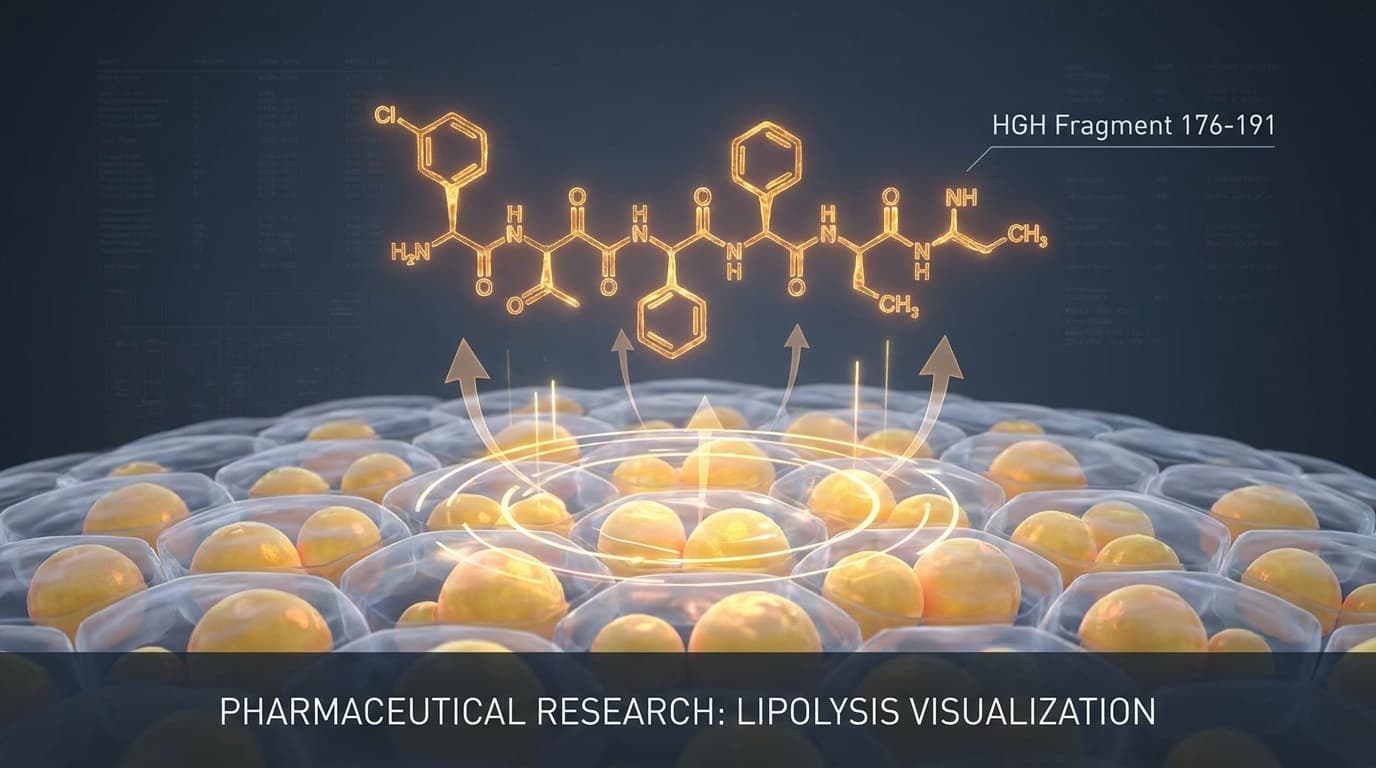
A research-focused deep dive into HGH Fragment 176-191 (AOD9604) — the C-terminal growth hormone fragment that selectively activates adipose lipolysis and fat oxidation without the insulin resistance, IGF-1 elevation, or diabetogenic effects of full-length GH.
Human growth hormone (HGH) does two things that pull in opposite directions: it drives lipolysis (fat breakdown) and it causes insulin resistance. For decades, researchers and clinicians working in obesity and metabolic disease wished for a way to get the first effect without the second. HGH Fragment 176-191 — also known as AOD9604 in its pharmaceutical development form — represents the most successful attempt to solve that problem through molecular engineering of the GH sequence.
The fragment is, as its name suggests, the C-terminal 16-amino-acid segment of growth hormone, corresponding to positions 176 through 191 of the 191-amino-acid GH sequence. It was discovered and developed by Monash University researchers, who observed that this fragment retained GH's lipolytic activity while completely lacking its diabetogenic and IGF-1-stimulating properties — a dissociation of function that opened new avenues in metabolic research. [2]
This guide covers the structural basis for that functional dissociation, the pharmacological evidence for the lipolytic mechanism, the Phase II clinical trials conducted on AOD9604, and what the current science says about where this compound fits in the 2026 metabolic peptide landscape.
Molecular Dissection: How a 16-Amino-Acid Fragment Does What Full GH Cannot
Growth hormone is a 191-amino-acid, single-chain protein with a complex three-dimensional structure dominated by four alpha-helices. Its receptor (GHR) binding involves two distinct sites on the molecule: Site 1 and Site 2, which bind different regions of GHR in sequence to form a receptor dimer that initiates signaling through JAK2/STAT5. The metabolic effects of GH — anabolism via IGF-1 induction, insulin resistance, and lipolysis — map to different structural domains.
The key structural insight of Fragment 176-191 research is that the C-terminal region of GH (residues 176–191) appears to independently activate lipolytic pathways in adipocytes, potentially via a mechanism distinct from canonical GHR binding. Fragment 176-191 binds the full-length GHR with extremely low affinity — insufficient to stimulate hepatic IGF-1 production or trigger JAK2/STAT5 signaling at relevant concentrations. Yet it demonstrably stimulates lipolysis in adipose tissue, suggesting the fragment engages a different receptor interaction or pathway at the adipocyte level. [2]
What Fragment 176-191 Does Not Do
Understanding the compound's profile means understanding what it doesn't do:
- Does not stimulate hepatic JAK2/STAT5 signaling (the pathway driving IGF-1 production)
- Does not elevate serum IGF-1 levels (confirmed in multiple human studies)
- Does not cause insulin resistance (confirmed through glucose/insulin measurements in Phase II trials)
- Does not stimulate anabolic tissue growth beyond what its indirect fat-to-lean composition shift produces
This negative profile — what the compound doesn't do — is arguably as important as what it does do, because it defines a genuine pharmacological separation of the lipolytic and diabetogenic effects of growth hormone. [5]
Lipolysis Mechanism: What Fragment 176-191 Does to Adipocytes
In adipose tissue, HGH Fragment 176-191 has been shown in preclinical models to:
Stimulate Hormone-Sensitive Lipase (HSL)
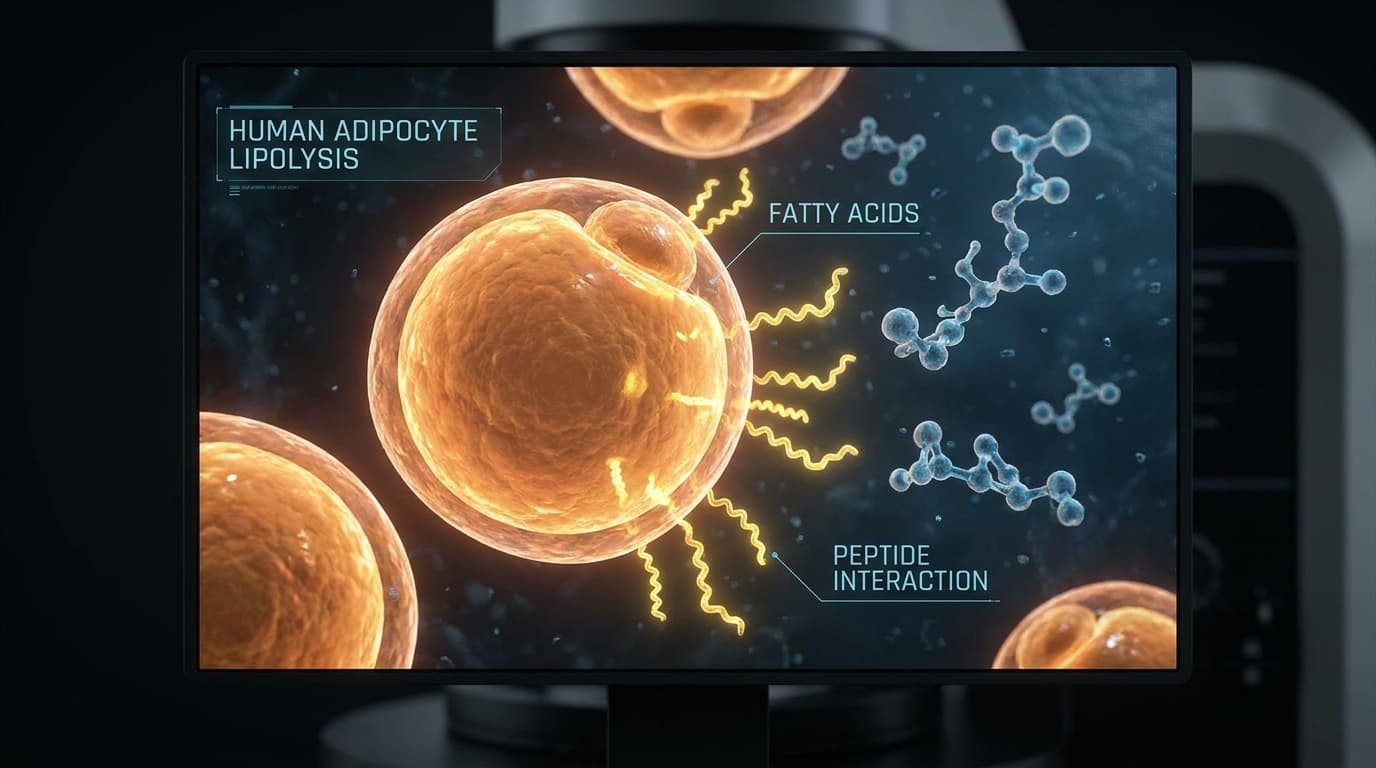
The primary lipolytic enzyme in adipocytes is hormone-sensitive lipase (HSL), which hydrolyzes stored triglycerides into free fatty acids and glycerol. Fragment 176-191 administration in animal models increases HSL activity in adipose tissue — the same downstream effector that catecholamines activate via the β-adrenergic/cAMP/PKA pathway. This HSL activation drives mobilization of stored fat for peripheral oxidation. [1]
Inhibit Lipogenesis
Alongside lipolytic stimulation, the fragment has been reported to reduce lipogenesis — fat cell storage activity — potentially via effects on lipoprotein lipase (LPL) activity. This dual action (more breakdown, less synthesis) creates a favorable substrate flux in adipose tissue that full-length GH does not achieve without the accompanying insulin resistance.
Increase Whole-Body Fat Oxidation
The Heffernan et al. (2001) study in obese mice demonstrated that chronic treatment with Fragment 176-191 significantly increased whole-body fat oxidation (measured by respiratory quotient) and reduced visceral fat mass — without hyperglycemia or IGF-1 elevation seen with full-length GH at equivalent lipolytic doses. This was the definitive proof-of-concept for the functional separation claim. [1]
AOD9604: The Clinical Development Program
Fragment 176-191 was taken into pharmaceutical development under the name AOD9604 (Anti-Obesity Drug 9604) by Australian company Metabolic Pharmaceuticals. The clinical program was extensive, completing multiple Phase I safety studies and a large Phase IIb trial. [4]
Phase IIb Trial: Design and Results
The AOD9604 Phase IIb trial enrolled over 300 obese adults at multiple sites, comparing AOD9604 at daily doses of 1 mg and 2 mg to placebo over 12 weeks. Key findings from the clinical program:
- Safety: Well-tolerated at all doses — no significant adverse events compared to placebo across multiple trials
- No diabetogenic effect: Glucose, insulin, and HbA1c were unchanged from baseline and vs. placebo — the critical safety confirmation
- No IGF-1 elevation: Serum IGF-1 levels were unchanged, confirming the fragment's predicted lack of GHR/JAK2/STAT5 signaling in humans
- Efficacy: Weight loss numerically favored AOD9604, but the difference from placebo did not reach statistical significance in the primary endpoint
Why AOD9604 Didn't Get Approved
The clinical program did not support regulatory approval for obesity treatment. The modest weight loss advantage over placebo (approximately 1–2 kg across studies) was insufficient to justify approval, particularly against the competitive backdrop of GLP-1 agonists that were beginning to demonstrate dramatically larger effect sizes. The compound was safe but the efficacy story wasn't compelling enough for the regulatory bar in a competitive therapeutic landscape. [4]
However, the clinical data remains scientifically valuable precisely because it confirmed in humans what animal studies predicted: Fragment 176-191/AOD9604 does not affect glucose, insulin, or IGF-1. For a fragment of growth hormone, that safety profile is genuinely remarkable.
Full GH vs. Fragment 176-191: Metabolic Effect Profile Comparison
Relative Metabolic Effects: Full-Length GH vs. HGH Fragment 176-191
Schematic based on Ng et al. (2000) and Heffernan et al. (2001). Fragment 176-191 retains substantial lipolytic activity while nearly eliminating the diabetogenic and IGF-1-stimulating effects of full-length GH.
Fragment 176-191 vs. GH Secretagogues: Different Research Tools
HGH Fragment 176-191 occupies a fundamentally different research niche than GH secretagogues like CJC-1295, Ipamorelin, or Hexarelin. The distinction matters for protocol design:
- GH secretagogues (CJC-1295, Ipamorelin, Hexarelin) stimulate the pituitary to release endogenous GH — elevating GH pulses, which then stimulate IGF-1 production. They affect the full GH/IGF-1 axis with all its downstream effects including anabolism, body composition changes, and at supraphysiologic levels, potential insulin resistance.
- HGH Fragment 176-191 bypasses the pituitary axis entirely, delivering a selective lipolytic signal to adipose tissue without stimulating IGF-1 or causing insulin resistance. It's not a growth hormone releaser — it's a selective fragment with a specific, domain-mapped adipose tissue action. [2][5]
For research focused specifically on adipose tissue biology, visceral fat metabolism, or the dissociation of GH's anabolic and metabolic effects, Fragment 176-191 provides a pharmacological tool that GH secretagogues cannot replicate. Researchers wanting to isolate lipolytic signaling from the anabolic effects of the GH axis have essentially one tool that achieves this from the GH peptide family: Fragment 176-191.
Where to Source HGH Fragment 176-191 for Research
HGH Fragment 176-191 is commercially available through multiple established research peptide suppliers. Given the compound's relatively short amino acid sequence (16 residues), HPLC purity confirmation and mass spectrometry identity verification are both achievable and should be required from any supplier. COAs should document purity ≥98% and confirm the molecular weight corresponding to the fragment sequence.
PeptideTech
Gold Standard COAsHGH Fragment 176-191 Research Vial
Check site for current pricing
Dual ISO 17025-accredited lab testing on every batch. QR-code COA links to full HPLC, mass spec, endotoxin, and sterility data. Icelandic GMP manufacturing environment.
Modified Aminos
Fast US ShippingHGH Fragment 176-191
Check site for current pricing
US operations with same-day shipping. Red thermal mailers for temperature-sensitive peptide protection. Full batch COA available, competitive pricing for research orders.
AminoUSA
US ManufacturedHGH Fragment 176-191 Research Peptide
Check site for current pricing
ISO-certified US manufacturer. Domestic supply chain with rapid shipping and published COAs. Research reference documentation included on product pages.
VANDL Labs
InternationalHGH Fragment 176-191 Vial
Check site for current pricing
Premium lyophilized formulation with independent lab verification. International shipping with COA documentation on every order.
HGH Fragment 176-191: Research FAQs
Is HGH Fragment 176-191 the same as AOD9604?
Yes — functionally and structurally identical. AOD9604 was the pharmaceutical trade name given to Fragment 176-191 (amino acids 176-191 of human growth hormone) during clinical development by Metabolic Pharmaceuticals. Both refer to the same 16-amino-acid peptide sequence.
Does HGH Fragment 176-191 raise IGF-1 levels?
No — this is the defining pharmacological property of the fragment. Unlike full-length GH, Fragment 176-191 lacks sufficient GHR binding affinity to stimulate hepatic JAK2/STAT5 signaling and IGF-1 production. Multiple human clinical studies confirmed IGF-1 levels remain unchanged with AOD9604 treatment, which was a primary safety endpoint in the clinical program.
Does HGH Fragment 176-191 cause insulin resistance?
Clinical data consistently shows no significant effect on glucose, insulin, or insulin sensitivity at studied doses. This is the key safety advantage over full-length GH and the pharmacological basis for the compound's original development as an anti-obesity agent.
Why did AOD9604 not receive FDA approval?
The Phase IIb clinical trials demonstrated statistical safety but insufficient weight loss efficacy to clear the approval bar — approximately 1-2 kg advantage over placebo across studies. The compound was safe but the effect size wasn't compelling enough for the competitive obesity treatment market, particularly with GLP-1 agonists demonstrating 10-20% weight loss advantages in trials during the same period.
How does Fragment 176-191 differ from GH secretagogues like CJC-1295?
GH secretagogues stimulate the pituitary to release endogenous GH, affecting the full GH/IGF-1 axis including anabolism, IGF-1 elevation, and potential insulin resistance at high doses. Fragment 176-191 bypasses the pituitary axis entirely, delivering selective lipolytic activity at adipose tissue without IGF-1 stimulation or insulin effects.
Research Summary: Fragment 176-191 in the Metabolic Peptide Landscape
HGH Fragment 176-191 represents a genuinely interesting case study in domain-selective pharmacology: a fragment of a larger hormone that dissociates two of its key biological activities — lipolysis and diabetogenesis — through structural truncation. The mechanism is real, the preclinical evidence is solid, and the clinical safety data is unusually robust for a research peptide, backed by multiple Phase I/II studies and an FDA GRAS determination. [4]
What the compound doesn't have is a proven clinical efficacy story in humans beyond the modest weight loss trends seen in AOD9604 trials. The GLP-1 agonist revolution has largely moved the obesity treatment landscape toward agents with much larger effect sizes, leaving Fragment 176-191 in a research niche rather than a mainstream therapeutic role. For the research community, however, that niche is scientifically valuable: no other peptide achieves selective adipose lipolysis with zero IGF-1 or insulin signaling effects.
For researchers studying adipose tissue biology, fat oxidation mechanisms, the pharmacology of GH structural domains, or the metabolic consequences of selective lipolytic activation without systemic anabolic effects, HGH Fragment 176-191 remains a scientifically compelling and practically accessible tool.
For the broader growth hormone secretagogue axis, see PeptideWiki's CJC-1295 + Ipamorelin Research Guide. For GLP-1 metabolic peptides with the largest human efficacy evidence base, see the GLP-1 Peptide Research Guide 2026. For GHRP mechanisms including the most potent secretagogue, see the Hexarelin Research Guide.
Sources & References
- 1.Heffernan MA, Thorburn AW, Fam B, et al.. "Increase of fat oxidation and weight loss in obese mice caused by chronic treatment with human growth hormone fragment 176-191" — International Journal of Obesity, 2001.View source
- 2.Ng FM, Sun J, Sharma L, Libinaka R, Jiang WJ, Gianello R.. "Metabolic studies of a synthetic lipolytic domain (AOD9604) of human growth hormone" — Hormone Research, 2000.View source
- 3.Svensson J, Fowelin J, Landin K, Bengtsson BA, Johansson JO.. "Effects of seven years of GH-replacement therapy on insulin sensitivity in GH-deficient adults" — Journal of Clinical Endocrinology & Metabolism, 2002.View source
- 4.Metabolic Pharmaceuticals Ltd.. "AOD9604 Phase IIb Placebo-Controlled Clinical Trial — Obese Adults" — ClinicalTrials.gov / Metabolic Pharmaceuticals, 2007.View source
- 5.Yuen KC, Dunger DB.. "Therapeutic aspects of growth hormone and insulin-like growth factor-I treatment on visceral fat and insulin sensitivity in adults" — Diabetes, Obesity and Metabolism, 2007.View source
- 6.Clemmons DR.. "Metabolic actions of IGF-1 in normal physiology and diabetes" — Endocrinology and Metabolism Clinics of North America, 2012.View source