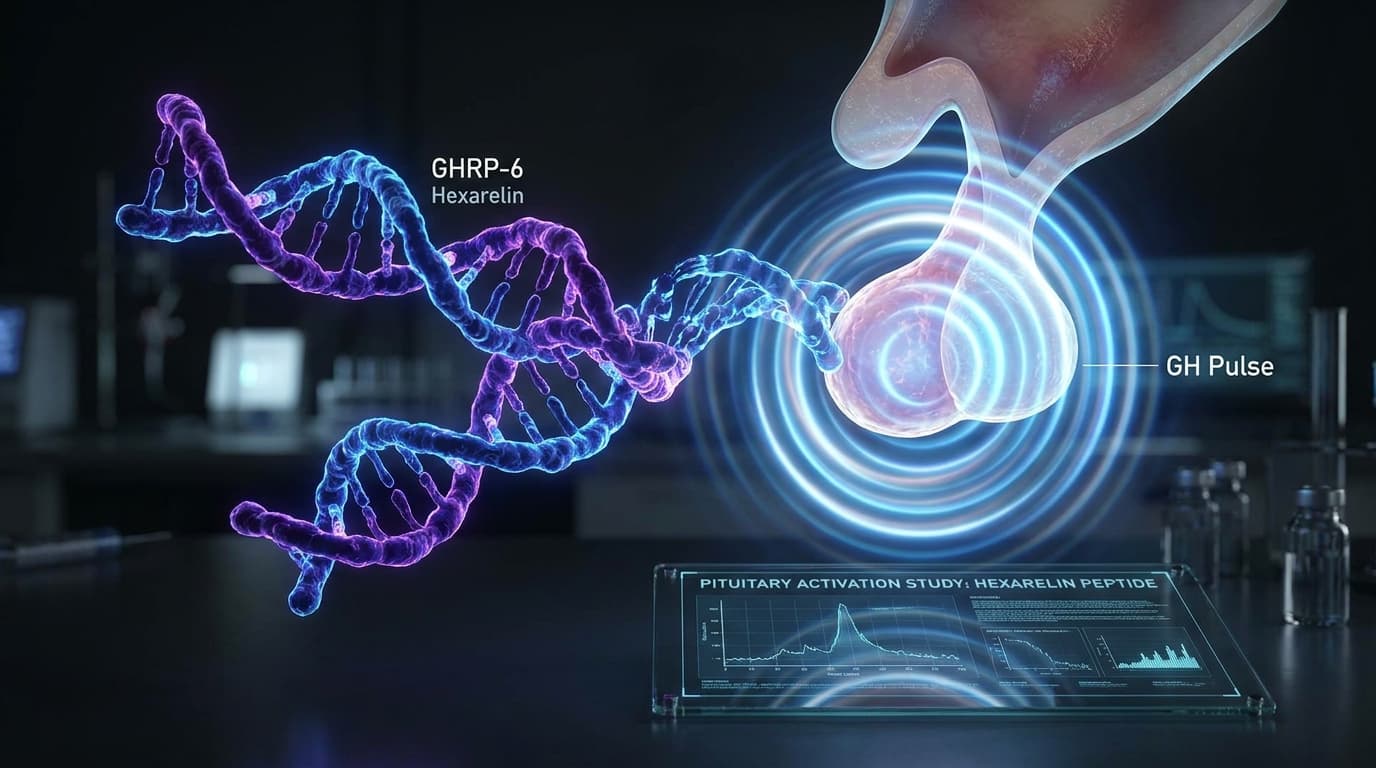
A comprehensive research guide to Hexarelin — the synthetic growth hormone releasing hexapeptide with the highest GH-release potency among all GHRPs, plus unique cardioprotective effects mediated through CD36 receptor signaling entirely independent of growth hormone.
The story of Hexarelin begins in 1984 with Cyril Bowers' landmark paper describing a new synthetic hexapeptide — six amino acids — that specifically released growth hormone from the pituitary with a potency exceeding any previously described synthetic compound. [1] It was this work that laid the pharmacological foundation for the entire class of growth hormone releasing peptides (GHRPs), ultimately leading to the discovery of ghrelin and its receptor (GHSR-1a) fifteen years later.
But what makes Hexarelin particularly compelling in 2026 isn't just its position as the most potent GHRP — it's the subsequent discovery that Hexarelin has a second receptor: CD36, a scavenger receptor expressed abundantly in cardiac muscle, macrophages, and adipose tissue. The cardioprotective effects mediated through this GH-independent pathway have made Hexarelin one of the most mechanistically complex research peptides in the GH secretagogue class, with research implications extending well beyond the pituitary. [3]
This guide covers the pharmacology of both receptor systems, the comparative potency data for GH release, the cardiac research literature, the phenomenon of Hexarelin desensitization, and how it compares to GHRP-2, GHRP-6, and Ipamorelin for different research applications.
GHSR-1a: The Primary GH-Releasing Mechanism
Hexarelin's primary pharmacological target is the growth hormone secretagogue receptor 1a (GHSR-1a) — the same G-protein-coupled receptor that endogenous ghrelin activates in the pituitary, hypothalamus, and throughout the body. Hexarelin predates the discovery of ghrelin; the receptor was an "orphan receptor" until 1999 when ghrelin was identified as its endogenous ligand, validating the pharmacological target that synthetic GHRPs had been engaging for over a decade. [7]
At the pituitary level, GHSR-1a activation by Hexarelin triggers a calcium-dependent signaling cascade:
- Phospholipase C activation → IP₃ generation → calcium release from intracellular stores
- Protein kinase C activation → voltage-gated calcium channel opening → extracellular calcium influx
- Calcium-dependent GH exocytosis from pituitary somatotroph cells
Simultaneously, Hexarelin acts at the hypothalamic level to stimulate GHRH (growth hormone-releasing hormone) release while inhibiting somatostatin (the GH-suppressing counterpart) — a dual hypothalamic action that amplifies pituitary GH output beyond what direct somatotroph stimulation alone would produce. [5]
Potency: Why Hexarelin Tops the GHRP Rankings
In head-to-head comparison studies, Hexarelin consistently produces the highest GH pulse amplitude among synthetic GHRPs at equivalent molar doses. The relative GH-releasing potency hierarchy is approximately: Hexarelin > GHRP-2 > GHRP-6 > Ipamorelin. Hexarelin's superior potency stems from its higher GHSR-1a binding affinity combined with its ability to synergistically modulate both pituitary somatotroph activation and hypothalamic GHRH/somatostatin balance simultaneously. [4]
The tradeoff: higher potency comes with greater cortisol and prolactin co-stimulation than Ipamorelin (which has essentially zero cortisol/prolactin effect), making Hexarelin less "clean" for applications requiring pure GH axis stimulation.

CD36: Hexarelin's Second Receptor and Cardiac Research Applications
In 2004, Demers et al. published a photoaffinity cross-linking study identifying CD36 as a direct binding partner for Hexarelin and related GHRPs in cardiac tissue. [3] This finding was significant because CD36 is a multifunctional scavenger receptor involved in:
- Long-chain fatty acid uptake in cardiac muscle and adipose tissue — the primary fuel substrate for cardiac metabolism
- Oxidized LDL recognition in macrophages — central to atherosclerosis biology
- Inflammatory signaling modulation in immune cells
- Cardiac fuel metabolism regulation and mitochondrial function
The pharmacological implications of Hexarelin/CD36 binding for cardiac tissue have been explored in several preclinical models:
Post-Ischemic Cardiac Recovery
Isolated perfused heart studies demonstrated that Hexarelin treatment improved left ventricular function during reperfusion following ischemia — an effect that persisted in GH-deficient animals, confirming the effect was GH-independent and mediated through a direct cardiac mechanism now attributed to CD36. [2] This is the pharmacological finding that distinguishes Hexarelin from all other GHRPs: no other GHRP produces comparable cardiac effects because no other GHRP binds CD36 with meaningful affinity.
Cardiomyocyte Protection
In cardiomyocyte culture models, Hexarelin reduced apoptosis under oxidative stress conditions through mechanisms that could not be attributed to GH or IGF-1 axis effects. The anti-apoptotic signaling downstream of CD36 activation remains an active area of investigation, with potential implications for ischemic heart disease research. [6]
GHRP Comparative GH Release Potency at Equivalent Doses
Relative Peak GH Release: GHRP Comparison (Equivalent Molar Dose)
Approximate relative potency from published clinical pharmacology data (Ghigo et al., 1997; multiple sources). Individual values vary by study design and subject population. Hexarelin is the reference at 100%.
Receptor Desensitization: Hexarelin's Primary Limitation
Hexarelin's high potency comes with a well-documented limitation: receptor desensitization. Repeated high-affinity GHSR-1a activation leads to receptor internalization and downregulation more rapidly than with lower-potency GHRPs. This was recognized early in Hexarelin research and confirmed in human studies showing significant attenuation of the GH response after 4–8 weeks of continuous administration. [4]
The desensitization mechanism follows standard GPCR pharmacology: persistent high-affinity agonist binding → β-arrestin recruitment → receptor internalization → reduced surface receptor density → diminished GH response to subsequent doses. Discontinuation allows receptor resensitization, but the time course varies by individual and dosing history.
In practice, research protocols have explored pulse dosing and cycling approaches to manage desensitization, recognizing it as an inherent feature of Hexarelin's pharmacology rather than an avoidable artifact. Lower-potency GHRPs like Ipamorelin show substantially less desensitization — which is one reason Ipamorelin has become dominant in clinical GHRP research despite Hexarelin's higher peak potency.
The desensitization issue applies primarily to the GHSR-1a mechanism (GH release). The CD36-mediated cardiac effects may have a different desensitization profile given that CD36 is not a GPCR and doesn't undergo the same internalization dynamics — an active research question for researchers interested in the cardioprotective properties.
| Property | Hexarelin | GHRP-2 | GHRP-6 | Ipamorelin |
|---|---|---|---|---|
| Amino acids | 6 | 6 | 6 | 5 |
| Relative GH release potency | Highest (reference) | High (~80%) | Moderate-High (~65%) | Moderate (~40%) |
| Cortisol stimulation | Moderate | Moderate | Low-Moderate | Minimal |
| Prolactin stimulation | Moderate | Moderate | Low | Minimal |
| Receptor desensitization rate | High (4-8 weeks) | Moderate | Low | Very Low |
| CD36 cardioprotective activity | Yes (confirmed) | Weak | Minimal | None reported |
| Appetite stimulation | Moderate | Moderate | High (ghrelin-like) | Minimal |
| Best research application | Max GH amplitude, cardiac biology | GH pulse research | GH + appetite studies | Clean GH pulses, clinical protocols |
Sourcing Research-Grade Hexarelin
Hexarelin is a 6-amino-acid peptide (His-D-2-Me-Trp-Ala-Trp-D-Phe-Lys-NH₂) with a well-defined molecular weight of 887.07 Da. Mass spectrometry verification of this molecular weight is the definitive identity confirmation. HPLC purity ≥98% from an accredited laboratory should be the minimum sourcing standard for research applications.
PeptideTech
Lab VerifiedHexarelin 2mg Research Vial
Check site for current pricing
Every batch dual-tested at ISO 17025-accredited US laboratories with QR-code COA. Mass spectrometry confirms exact 887.07 Da molecular weight for Hexarelin identity verification.
Modified Aminos
Same-Day ShippingHexarelin GHRP
Check site for current pricing
US operations with same-day dispatch. Third-party tested with published batch COAs. Red thermal mailers protect peptide stability during transit.
AminoUSA
US ManufacturedHexarelin Research Peptide
Check site for current pricing
ISO-certified US manufacturer. Domestic supply chain, third-party tested, COAs published on product pages with research reference documentation.
VANDL Labs
PremiumHexarelin 2mg Vial
Check site for current pricing
Premium lyophilized formulation with independent lab verification. International shipping available, full COA documentation included.
Hexarelin Research: Frequently Asked Questions
What makes Hexarelin more potent than other GHRPs?
Hexarelin's higher GHSR-1a binding affinity combined with its simultaneous modulation of hypothalamic GHRH and somatostatin signaling produces higher peak GH pulse amplitudes than GHRP-2, GHRP-6, or Ipamorelin at equivalent doses. The dual pituitary-hypothalamic action amplifies GH release beyond what direct somatotroph stimulation alone achieves.
What is CD36 and why does its interaction with Hexarelin matter?
CD36 is a multifunctional scavenger receptor expressed in cardiac muscle, macrophages, and adipose tissue. Demers et al. (2004) demonstrated that Hexarelin binds CD36 directly, producing cardioprotective effects (improved post-ischemic cardiac function, reduced cardiomyocyte apoptosis) that persist in GH-deficient animals — confirming the effect is completely independent of GH or IGF-1. No other GHRP demonstrates comparable CD36-mediated cardiac biology.
How quickly does Hexarelin desensitization develop?
Human studies show significant attenuation of the GH response within 4–8 weeks of continuous Hexarelin administration. This follows standard GPCR desensitization kinetics: β-arrestin recruitment drives GHSR-1a internalization, reducing surface receptor density and thus GH response magnitude. Resensitization requires discontinuation, typically 2–4 weeks, though this varies between individuals.
How does Hexarelin compare to Ipamorelin for research purposes?
Hexarelin produces higher peak GH release but with more cortisol/prolactin co-stimulation and faster desensitization. Ipamorelin is highly selective for GHSR-1a with minimal cortisol/prolactin effects and very low desensitization rate. For pure GH pulse research requiring clean, repeatable GH stimulation, Ipamorelin is preferred. For research requiring maximum GH amplitude, CD36 cardioprotective biology, or Hexarelin-specific receptor pharmacology, Hexarelin is the appropriate choice.
Is Hexarelin the same as ghrelin?
No — Hexarelin is a synthetic hexapeptide that activates the same receptor (GHSR-1a) as ghrelin but with a completely different amino acid sequence. Ghrelin is a 28-amino-acid endogenous peptide hormone with an essential octanoyl modification at Ser-3. Hexarelin predates the discovery of ghrelin; ghrelin was found as the endogenous ligand for the orphan receptor that GHRP research had characterized pharmacologically.
Research Outlook: Hexarelin's Unique Position in the GHRP Landscape
Hexarelin occupies a unique position in the GHRP family: simultaneously the most potent GH secretagogue in the synthetic GHRP class and the only GHRP with well-documented, mechanistically confirmed cardiovascular effects mediated through a GH-independent pathway (CD36). These two properties make it pharmacologically rich but also operationally complex compared to simpler, more selective agents like Ipamorelin. [2][3]
The desensitization issue is real and limits chronic administration protocols, but it doesn't diminish Hexarelin's value for acute pharmacological studies, cardiovascular research models, or research designs specifically requiring maximum GH amplitude. The CD36 cardiac biology represents an active research frontier with implications extending into ischemic heart disease, cardiac metabolism, and potentially atherosclerosis — areas where the peptide's history as a tool in the GH field undersells its actual research scope.
For researchers in endocrinology, cardiology, or sports physiology studying the GH axis, Hexarelin provides a pharmacological handle on GHSR-1a biology that is more powerful — and more complex — than any other available GHRP. Understanding both its receptor systems is essential to designing research protocols that leverage, rather than ignore, its full pharmacological profile.
For GH axis research with Ipamorelin (lower potency but cleaner selectivity), see the CJC-1295 + Ipamorelin Stack Guide. For IGF-1 downstream of the GH axis, see the IGF-1 LR3 Research Guide. For the HGH fragment with selective lipolytic effects, see the HGH Fragment 176-191 Guide.
Sources & References
- 1.Bowers CY, Momany FA, Reynolds GA, Hong A.. "On the in vitro and in vivo activity of a new synthetic hexapeptide that acts on the pituitary to specifically release growth hormone" — Endocrinology, 1984.View source
- 2.Muccioli G, Broglio F, Valetto MR, et al.. "Growth hormone-releasing peptides and the cardiovascular system" — Annales d'Endocrinologie, 2000.View source
- 3.Demers A, McNicoll N, Febbraio M, et al.. "Identification of the growth hormone-releasing peptide binding site in CD36: a photoaffinity cross-linking study" — Biochemical Journal, 2004.View source
- 4.Ghigo E, Arvat E, Muccioli G, Camanni F.. "Growth hormone-releasing peptides" — European Journal of Endocrinology, 1997.View source
- 5.Arvat E, Maccagno B, Ramunni J, et al.. "Interactions between hexarelin and somatostatin on GH secretion in normal subjects" — Clinical Endocrinology, 1997.View source
- 6.Torsello A, Bresciani E, Rossoni G, et al.. "Ghrelin plays a minor role in the physiological control of cardiac function in the rat" — Endocrinology, 2003.View source
- 7.Broglio F, Arvat E, Benso A, et al.. "Ghrelin, a natural GH secretagogue produced by the stomach, induces hyperglycemia and reduces insulin secretion in humans" — Journal of Clinical Endocrinology & Metabolism, 2001.View source