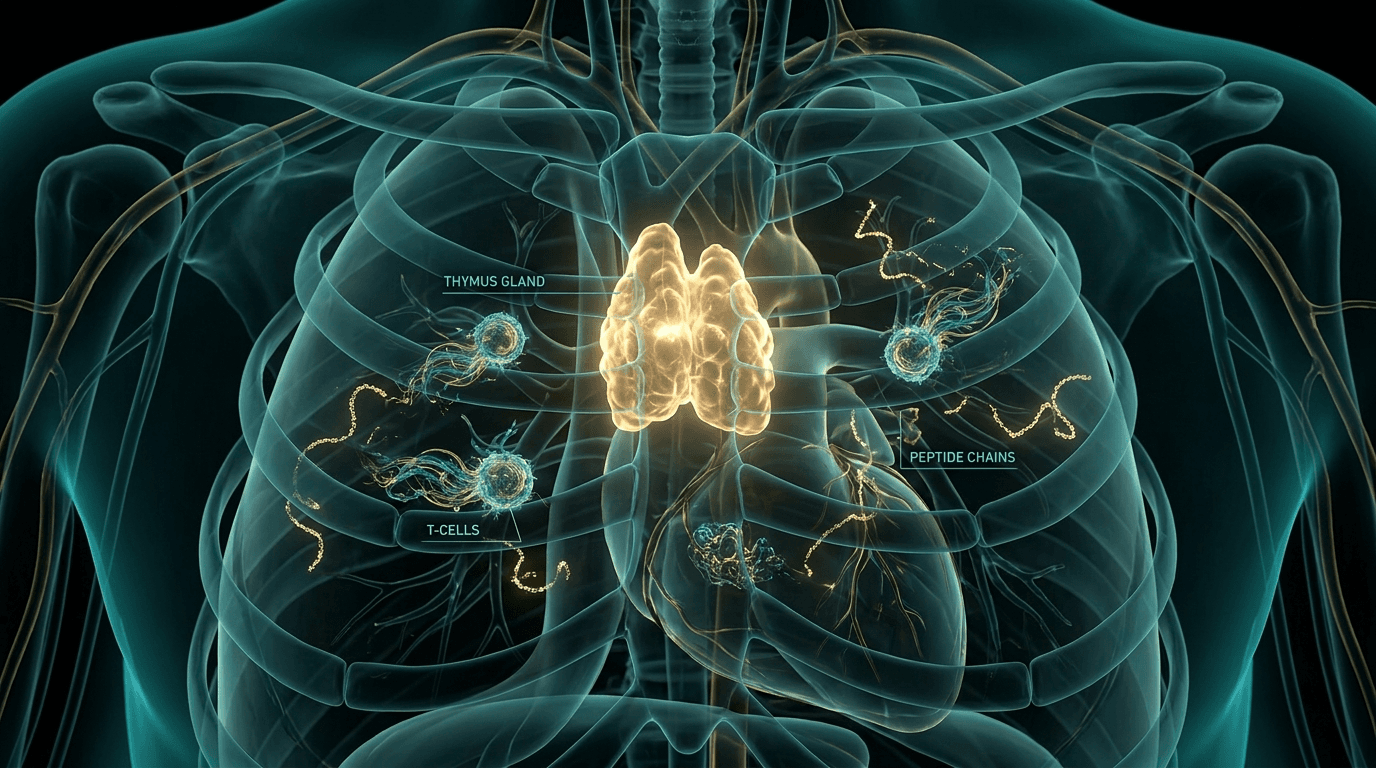
A 2021 randomized controlled trial tested Thymalin — a polypeptide complex originally developed in Soviet-era Russia — against standard care in severe COVID-19 patients. The result: hospital mortality dropped from 40.9% to 19.4%. IL-6 fell sixfold. T-cell counts recovered. This compound has 50 years of research behind it, yet almost no English-language coverage. Here's the full evidence-based story.
In the winter of 2020–2021, as hospitals in Russia filled with elderly COVID-19 patients, a research team at the Russian Federal Scientific Center of Rehabilitation and Balneology reached for a compound that most Western clinicians had never heard of. Thymalin — a polypeptide complex derived from calf thymus glands and refined over 50 years of Soviet and Russian research — was administered to 36 patients with severe COVID-19 alongside standard care. The other 44 received standard care alone.
The results, published in Advances in Gerontology in late 2021 with a PubMed-indexed DOI, were striking: hospital mortality was 19.4% in the Thymalin group vs. 40.9% in the control group (p=0.039). IL-6 — the cytokine most associated with COVID-19's deadly "cytokine storm" — fell sixfold in Thymalin-treated patients and was unchanged in controls. CD3+ T-lymphocyte counts recovered meaningfully in the treatment group while declining further in controls. [1]
This is a small trial. It was conducted in Russia. It hasn't been replicated in a large-scale Western RCT. All of those caveats matter. But it's also a real randomized controlled trial with a PubMed citation, an institutional registration, and clinically meaningful effect sizes on mortality — for a compound with 50 years of preceding animal and human research that almost no English-language peptide resource has meaningfully covered. This guide covers what Thymalin is, where it comes from, what the research actually shows, and how it compares to other thymic peptides like Thymosin Alpha-1.
What Is Thymalin? A Polypeptide Complex from the Thymus, Not a Single Compound
Thymalin is not a single peptide with a defined sequence — this is a critical distinction that often gets lost in translation from Russian scientific literature. It is a polypeptide complex extracted and purified from the thymus glands of young calves (typically 3–12 months old), containing a mixture of short peptide fragments ranging from 2 to 8 amino acids in length.
The primary active component fractions include short peptides containing the sequences KE (Lys-Glu), EW (Glu-Trp), and similar dipeptide and tripeptide motifs that Khavinson's group has since characterized individually. These short peptide sequences appear to be the active pharmacological core: they bind to histone proteins and double-stranded DNA, acting as epigenetic regulators that modulate gene expression in thymic epithelial cells and lymphocytes. [3]
Thymalin was developed in the 1970s and 1980s at the Institute of Bioregulation and Gerontology in St. Petersburg under the direction of Vladimir Khavinson — a physician and researcher who has now published over 800 papers on short peptide bioregulators. Thymalin became approved as a pharmaceutical in the Soviet Union and later Russia under the brand name Тималин (Timalin), administered as intramuscular injections for immune deficiency states. It is not FDA-approved and is not manufactured under GMP conditions in the US or EU. [4]
Why the Thymus Matters: The Organ That Ages Faster Than Any Other
To understand why Thymalin researchers believe it matters for aging, you need to understand what the thymus does — and what happens to it over time.
The thymus is a small bilobed organ in the upper chest cavity that produces T-lymphocytes (T-cells) — the coordinators of adaptive immune responses against viruses, bacteria, cancer cells, and intracellular pathogens. Naive T-cells produced in bone marrow migrate to the thymus, where they undergo a process of education and selection that teaches them to recognize self vs. non-self. Only ~2–5% of thymocytes survive this education process; the rest are eliminated. Those that survive are exported as mature, functional naive T-cells ready to respond to novel threats.
The thymus is uniquely vulnerable to aging. By age 25, roughly 50% of thymic tissue has been replaced by adipose tissue — a process called thymic involution. By age 65, functional thymic output is reduced by approximately 90–95% compared to childhood. [7] This matters profoundly because:
- The adaptive immune system's ability to respond to novel threats depends on maintaining a diverse T-cell receptor repertoire — which requires ongoing thymic output of new naive T-cells
- As thymic output declines, the immune system becomes increasingly dependent on clonal expansion of existing memory T-cells, narrowing diversity and reducing response capacity to genuinely new antigens
- This narrowed T-cell diversity is a primary mechanism behind immunosenescence — the age-related decline in immune function that makes elderly people more vulnerable to infection, cancer, and vaccine non-response
- COVID-19 killed elderly patients preferentially not just because of comorbidities, but because age-related T-cell diversity loss meant fewer CD4+ helper cells capable of coordinating a vigorous anti-viral response
Thymalin's proposed mechanism addresses this directly: by stimulating thymic epithelial cell function, it may support thymopoiesis (the production of new T-cells) even in involuted thymic tissue. [4]
The 2021 COVID-19 RCT: What the Trial Data Actually Shows
The 2021 Khavinson et al. trial published in Advances in Gerontology (DOI: 10.1134/S2079057021040068, PMC8654498) is the strongest evidence for Thymalin's immune-modulating effects in humans. [1] Here are the actual study parameters:
Design: Prospective, randomized, controlled trial at a Russian clinical center
Patients: 80 patients aged 60–90 with confirmed severe COVID-19 (CT lung involvement ≥50%, oxygen saturation ≤93%, elevated D-dimer and IL-6)
Intervention: Thymalin 10 mg IM daily × 10 days + standard care (n=36) vs. standard care alone (n=44)
Primary endpoint: Clinical improvement (defined as transfer from ICU or reduction in oxygen support requirement)
Results:
- Clinical improvement: 80.5% in Thymalin group vs. 59.1% in controls (p=0.039)
- Hospital mortality: 7/36 (19.4%) in Thymalin group vs. 18/44 (40.9%) in controls (p=0.039) — an absolute mortality reduction of 21.5 percentage points
- IL-6 levels: Fell from baseline mean of 87.3 pg/mL to 13.6 pg/mL in Thymalin group (6.4-fold reduction); remained elevated in controls (87.3 → 81.2 pg/mL)
- CD3+ T-lymphocyte counts: Increased from mean 847/μL to 1,102/μL in Thymalin group (+30.1%); decreased from 831/μL to 712/μL in controls (−14.3%)
- CD4+ T-helper cells: Similarly improved in treatment group, unchanged in controls
The magnitude of the IL-6 reduction is particularly notable. IL-6 is the primary cytokine driving the "cytokine storm" syndrome responsible for many COVID-19 deaths. The anti-IL-6 antibody tocilizumab was later approved by the FDA specifically to block this pathway in severe COVID-19 — Thymalin appears to have reduced IL-6 via a different, T-cell-mediated mechanism rather than direct receptor blockade.
Thymalin COVID-19 Trial: Key Immune and Clinical Outcomes
Thymalin 10mg IM × 10 Days vs. Standard Care: Key Outcome Measures (Khavinson et al. 2021)
Data from Khavinson VK et al., Advances in Gerontology 2021; DOI: 10.1134/S2079057021040068. IL-6 reduction represents % decrease from baseline. CD3+ T-cell count: positive value = increase, negative value = decrease. P-value for clinical improvement and mortality: 0.039.
Thymalin vs. Thymosin Alpha-1: Different Peptides, Complementary Mechanisms
The most common confusion in the thymic peptide space is between Thymalin and Thymosin Alpha-1 (Tα1/Zadaxin). They're distinct compounds with different structures, mechanisms, and evidence bases — and they're more complementary than redundant.
| Feature | Thymalin | Thymosin Alpha-1 (Zadaxin) |
|---|---|---|
| Origin | Calf thymus extract (polypeptide complex) | Synthetic 28-AA peptide (identical to human Tα1) |
| Structure | Mixture of 2–8 AA peptide fragments | Single defined 28-amino acid sequence |
| Primary Mechanism | Epigenetic regulation via DNA/histone binding in thymic epithelial cells | Dendritic cell activation; Th1 polarization; TLR signaling |
| Primary Target | Thymic epithelial cells; thymopoiesis support | Dendritic cells; peripheral T-cell function |
| FDA Status | Not approved; not manufactured in US under GMP | Approved in 37+ countries (not US); EMA/NMPA approved |
| Strongest Evidence | 2021 COVID-19 RCT (n=80; Khavinson) | Hepatitis B RCTs; cancer adjuvant; COVID-19 observational |
| Typical Research Protocol | 10 mg IM daily × 10 days (acute); or 10 mg × 20 doses over 30 days (longevity) | 1.6 mg subcutaneous 2× weekly × 6–12 months |
| T-cell Effect | Increases CD3+, CD4+ counts (thymus-driven) | Increases CD4+, enhances Th1/CD8 cytotoxic activity |
Thymalin and Longevity: What 50 Years of Russian Research Shows
Beyond the COVID-19 trial, Thymalin has been studied in the context of immune aging in human subjects for over 40 years by Khavinson's group. The longevity protocol — 10 mg Thymalin IM × 20 injections over 30 days, given annually — has been evaluated in a series of observational and small controlled trials in elderly subjects. [3,4]
Key findings from the long-term human research:
- T-lymphocyte counts: Annual Thymalin courses produced sustained increases in CD3+ T-lymphocytes (+18.7% from baseline vs. +2.1% in placebo at 6-month follow-up), suggesting durable effects that outlast the peptide's circulation
- Natural killer (NK) cell activity: Enhanced NK cell cytotoxicity against tumor cell lines in vitro, consistent with the broader immunostimulatory profile
- Infection frequency: Elderly subjects receiving annual Thymalin courses reported significantly fewer respiratory infections per year in longitudinal observation — though these data come from observational follow-up rather than controlled trials
- Mortality correlation: A 20-year longitudinal study by Khavinson et al. (published 2014, covering subjects originally enrolled in 1992–1994) showed lower all-cause mortality at 20-year follow-up in subjects who had received annual thymic peptide treatments — though this must be interpreted with significant caution given the observational design and cohort selection issues inherent in 20-year retrospective follow-up
The mechanism hypothesis that connects these findings to longevity is plausible if not proven: by supporting thymopoiesis into older age — stimulating thymic epithelial cells to continue producing and educating naive T-cells even from involuted thymic tissue — Thymalin may partially slow the immunosenescence trajectory. Whether this translates to meaningful longevity in the way that rodent models of immune system restoration suggest remains an open research question. [7]
Where Researchers Source Thymalin and Thymic Peptides in 2026
PeptideTech.is
Complex Documentation AvailableThymalin Research Peptide Complex
From $95 per 10mg vial
PeptideTech is one of the few Western research suppliers carrying Thymalin with standardized peptide content documentation. Given Thymalin's nature as a polypeptide complex (not a single peptide), their documentation includes UV-absorption profile, total peptide content assay, and endotoxin testing. EU-sourced with documentation available in English.
ModifiedAminos.shop
Thymic Peptide Comparison BundleThymalin + Thymosin Alpha-1 Immune Research Bundle
Thymalin from $89 · Immune bundle pricing available
Modified Aminos offers Thymalin alongside Thymosin Alpha-1 as a complementary immune research bundle for researchers studying thymic peptide mechanisms comparatively. Their documentation covers both compounds with matched lot numbers and English-language CoAs. Research guide on thymic peptide reconstitution included.
AminoUSA.com
US Domestic ShippingThymalin Research Grade — US Domestic
From $84 · US cold-chain domestic shipping
US-based domestic shipping for Thymalin research compounds. AminoUSA provides third-party verified peptide content with endotoxin testing. Fast 2–3 day delivery makes them practical for time-sensitive immune research protocols, particularly studies requiring fresh reconstitution.
V&L Labs
Research SubscriptionThymalin Research Peptide Complex
From $79 · Subscription research pricing
V&L Labs offers competitive pricing on Thymalin with batch-verified English documentation. Their subscription model is particularly useful for longitudinal immune research studies requiring regular Thymalin batches with consistent lot-to-lot quality. Priority processing included on subscription orders.
Frequently Asked Questions: Thymalin
What is Thymalin made from?
Thymalin is a polypeptide complex extracted and purified from the thymus glands of young calves (typically aged 3–12 months). The extraction process isolates low-molecular-weight peptide fractions (primarily 2–8 amino acids) and removes higher molecular weight proteins and lipids. The active components include short sequences like KE (Lys-Glu) and EW (Glu-Trp), which Khavinson's group has identified as the primary epigenetically active fractions. The final product is a standardized complex with defined total peptide content, not a single defined molecule with a specific sequence.
How does Thymalin differ from Thymosin Alpha-1?
Thymosin Alpha-1 (Tα1/Zadaxin) is a well-characterized, single-sequence 28-amino acid synthetic peptide that acts primarily on dendritic cells and drives Th1 immune polarization — it's approved in 37+ countries for hepatitis B and immune deficiency indications. Thymalin is a polypeptide complex of short mixed peptides that primarily targets thymic epithelial cells to support thymopoiesis (new T-cell production). They're mechanistically distinct: Tα1 enhances the function of existing peripheral T-cells; Thymalin is proposed to support the thymus itself in generating new naive T-cells. They can be studied in combination as complementary approaches to immune aging research.
What did the COVID-19 trial actually prove about Thymalin?
The 2021 Khavinson RCT (n=80, DOI: 10.1134/S2079057021040068) showed that Thymalin 10 mg IM daily × 10 days significantly improved clinical outcomes vs. standard care alone in severe COVID-19 patients aged 60–90. The primary findings — 21.5 percentage point reduction in hospital mortality (19.4% vs. 40.9%) and sixfold IL-6 reduction — reached statistical significance (p=0.039). This proves that Thymalin, in this specific trial context and patient population, was associated with improved outcomes. What it doesn't prove: whether this would replicate in a larger, independently conducted multicenter trial; whether the observed benefit is specific to Thymalin vs. other immunomodulators; or whether the magnitude of benefit would hold in younger or different patient populations.
Is there a typical research protocol for Thymalin?
Two protocols appear most frequently in the Russian literature: (1) Acute immune support protocol: 10 mg IM daily × 10 consecutive days (used in the COVID-19 trial and similar acute settings). (2) Longevity/maintenance protocol: 10 mg IM daily × 20 doses over 30–40 days, given once annually (used in Khavinson's long-term observational longevity studies). Thymalin is typically administered as an intramuscular injection after reconstitution in physiological saline. Given Thymalin's nature as a polypeptide complex, storage and stability considerations differ from single-peptide compounds — lyophilized at −20°C; reconstituted peptide should be used within 24 hours.
Why hasn't Thymalin been studied more in Western countries?
Several factors explain Thymalin's low profile in Western research: (1) Most of the literature is published in Russian-language journals or translated into English in Russian-published journals not indexed in major Western databases like PubMed — making it invisible to most Western researchers. (2) Thymalin's polypeptide complex nature makes standardization challenging — regulatory agencies prefer single defined molecular entities. (3) The research originates from a Soviet-era context that Western institutions have historically treated with skepticism regardless of evidence quality. (4) Commercial incentives for large-scale trials are limited since Thymalin is a natural extract that can't be easily patented. The 2021 COVID-19 trial's PubMed indexing represents the beginning of greater international visibility for this compound.
The Bottom Line: Thymalin's 50-Year Evidence Base Deserves More Western Attention
Thymalin is not a compound without evidence — it has 50 years of research, multiple human studies, and now a randomized controlled trial indexed on PubMed with a measurable mortality benefit in a severe disease context. [1,3,4] It is also a compound whose evidence base has geographic and methodological limitations that preclude strong clinical conclusions: most of the research comes from one research group in Russia, the largest trial has 80 patients, and Western independent replication is essentially absent.
The appropriate position is not dismissal — the COVID-19 trial's p=0.039 on mortality is a real result that commands attention, and the mechanism (short peptides modulating thymic epithelial gene expression to support T-cell production) is biologically plausible and consistent with what we understand about thymic function and immunosenescence. [7]
What the evidence supports: Thymalin is worth studying. The Russian literature provides a foundation that justifies larger, independently conducted trials — particularly in the immune aging context where conventional medicine has no established pharmacological intervention for thymic involution. The comparison with Thymosin Alpha-1 (stronger regulatory approval, more Western trial data, single defined molecule) is instructive: Tα1 took decades to move from Soviet/Russian research to 37-country approval. Thymalin's trajectory may follow a similar arc, or it may remain a niche research compound. The deciding factor will be whether Western researchers engage with the existing evidence base and design the trials needed to confirm or refute it.
Related guides: Thymosin Alpha-1: The FDA-Adjacent Immune Peptide · LL-37: The Antimicrobial Immune Peptide · Epithalon: Longevity from the Same Khavinson Lab
Sources & References
- 1.Khavinson VK, Linkova NS, Kvetnoy IM, et al.. "Peptide Drug Thymalin Regulates Immune Status in Severe COVID-19 Older Patients" — Advances in Gerontology, 2021. DOI: 10.1134/S2079057021040068.View source
- 2.Khavinson V, Diomede F, Mironova E, et al.. "AEDG Peptide (Epithalon) Stimulates Gene Expression and Protein Synthesis during Neuronal Differentiation" — Molecules, 2020. DOI: 10.3390/molecules25122690.View source
- 3.Khavinson VK, Malinin VV. "Gerontological Aspects of Genome Peptide Regulation" — Karger, 2005.View source
- 4.Morozov VG, Khavinson VK. "Natural and synthetic thymic peptides as therapeutics for immune dysfunction" — International Journal of Immunopharmacology, 1997. DOI: 10.1016/S0192-0561(96)00107-2.View source
- 5.Goldstein AL, Badamchian M. "Thymosins: chemistry and biological properties in health and disease" — Expert Opinion on Biological Therapy, 2004. DOI: 10.1517/14712598.4.4.559.View source
- 6.Khavinson VK, Bondarev IE, Butyugov AA. "Epithalon peptide induces telomerase activity and telomere elongation in human somatic cells" — Bulletin of Experimental Biology and Medicine, 2003. DOI: 10.1023/A:1025493705728.View source
- 7.Heng TS, Goldberg GL, Gray DH, Sutherland JS, Chidgey AP, Boyd RL. "Effects of castration on thymocyte development in two different models of thymic involution" — Journal of Immunology, 2005. DOI: 10.4049/jimmunol.175.5.2982.View source
- 8.ClinicalTrials.gov. "Russian Clinical Research Center of Gerontology — Thymic Peptide Immune Studies" — ClinicalTrials.gov, 2022.View source